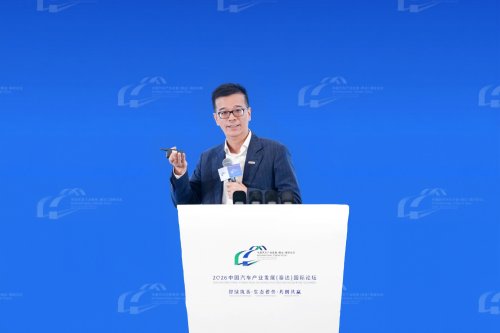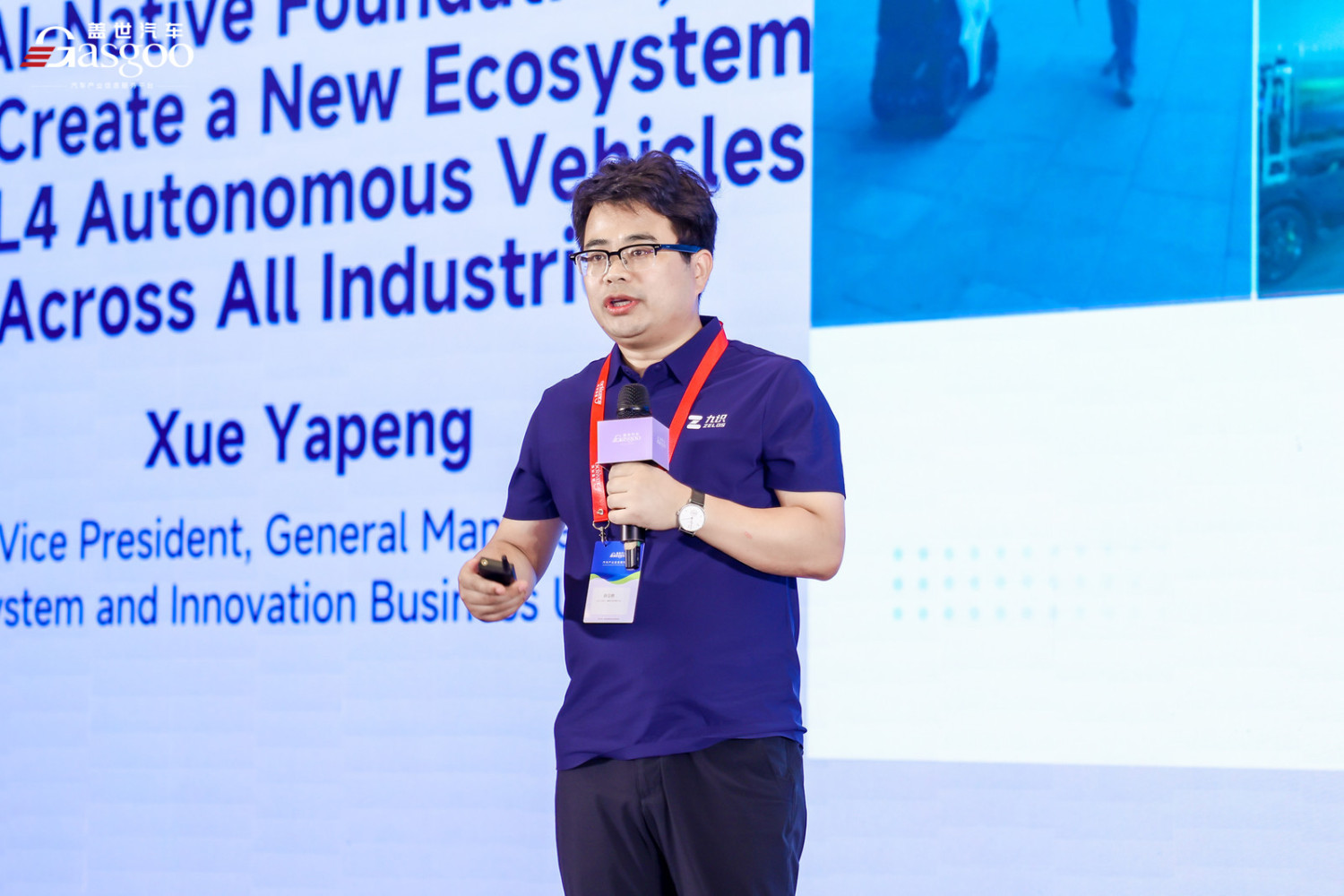



















Gasgoo Munich- At the Gasgoo 4th AI-Defined Vehicle Forum on September 18, Zelos' General Manager of Ecosystem and Innovation, Xue Yapeng, delivered a speech titled "Logistics Unmanned Vehicles: Products and Ecosystem Sharing." He argued that the value of physical AI must be rooted in the field, refined through continuous iteration in real-world scenarios. The core of the unmanned vehicle ecosystem, he noted, is division of labor: car experts build the vehicles, tech experts develop the AI, and scenario experts define the needs. The era of unmanned vehicles is just getting started, and they are set to evolve from simple logistics tools into core components of smart cities.Xue introduced Zelos as a pioneer in the domestic logistics unmanned vehicle sector, founded in August 2021 with offices spanning Beijing, Suzhou, Hangzhou, and Silicon Valley. The core team brings over a decade of R&D experience, having contributed to the development of more than 150 types of unmanned vehicles. Between 2021 and 2023, the company launched its LC logistics unmanned vehicle, becoming the first in the industry to achieve commercial deployment at the scale of 10,000 units. Looking ahead, Zelos plans to collaborate with various automakers via a V2X model to build ecosystem vehicles by the end of 2025. Recently, the company expanded beyond logistics into comprehensive urban services with the release of a robotaxi product.On the technical front, Zelos has constructed a "physical AI brain" comprising three modules: the vehicle-side VIA algorithm, the cloud-side VI model, and Safety AI. The VIA algorithm handles end-to-end real-time calculations, the VI model manages complex decision chains, and Safety AI ensures system security. Together, they enable efficient problem-solving and rapid risk response in complex real-world environments. Powering this architecture is the logistics sector's first 10,000-card computing cluster, guaranteeing ample computing power for continuous model training and stable operation. Zelos has also opened this physical AI brain to third-party partners.Regarding operational data, Xue revealed that Zelos has accumulated 250 million kilometers of driving mileage with a fleet of 30,000 units — making it the world's largest L4 autonomous driving fleet. Its operations span more than 20 countries and 300 cities, backed by the industry's most extensive L4 scenario library. This library covers an equivalent driving distance of 40,000 kilometers per hour, encompassing roughly 120,000 intersections and 100,000 traffic light identifications, which allows for continuous model optimization based on real-world issues. "The more we do, the clearer it becomes that the definition of physical AI is rooted in the field," Xue said.Addressing ecosystem cooperation, Xue stressed that the core of the unmanned vehicle sector is the division of labor. "Let those who understand cars build vehicles, and let those who understand L4 provide the safety net," he said. He described Zelos' collaborative logic as a virtuous industrial flywheel: anchored by breakthroughs in physical AI, it links OEMs and specialized vehicle refiners on the left to define hardware products, while connecting scenario partners on the right to refine products for specific use cases. This structure leverages the strengths of all parties involved.On the business implementation front, Zelos has established two core models. The first involves Class II chassis modification, featuring a 70,000-yuan M-type cargo box adapter that can be adapted for vertical scenarios such as gas, highway, and police patrols. The second is AI kit output, which embeds physical AI capabilities into OEM chassis to deliver L4 autonomy, effectively replacing traditional L2 driver assistance systems. Integrating AI capabilities with OEMs involves a six-stage process — from requirement consensus and joint execution to validation and mass production — covering over 1,000 deliverables. Additionally, Zelos has launched an intelligent development platform with full SDK capabilities, allowing users to build vehicle dispatch, monitoring, and management systems within a week.Looking ahead, Xue proposed that unmanned vehicles will evolve beyond basic point-to-point transport to serve niche scenarios across thousands of industries, collaborating with ancillary equipment to meet specific vertical needs. Future unmanned vehicle networks are set to become a core component of "Smart City Brain 2.0," supporting functions ranging from urban governance to public services. He concluded with a call for collaboration: while the commercial vehicle sector boasts over 1,000 brands, the unmanned vehicle sector will spawn tens of thousands of specialized brands. He welcomed partners from all industries to join in building this ecosystem. "The era of unmanned vehicles is just beginning," Xue said.