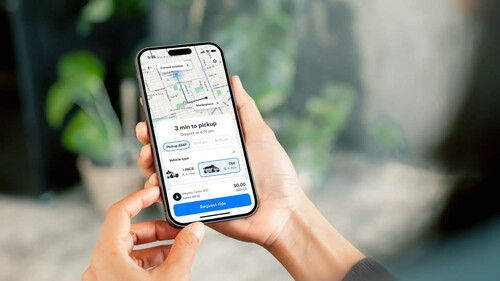
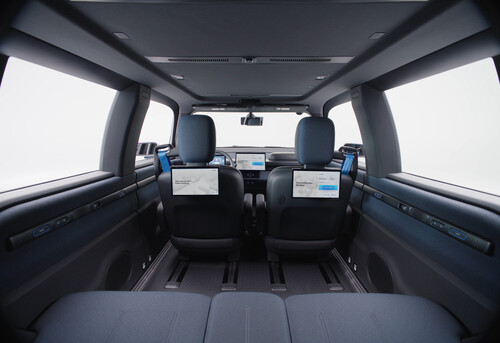
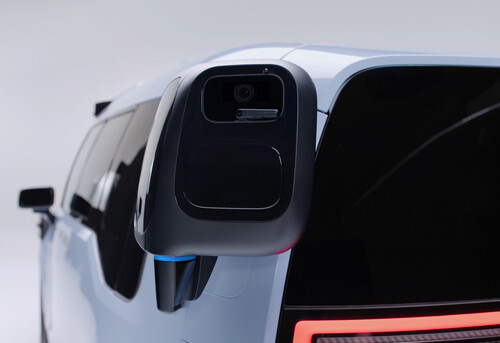
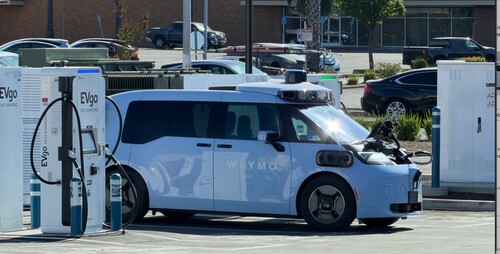
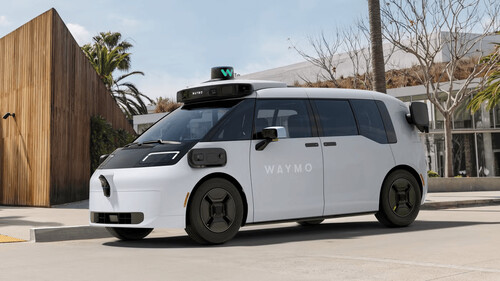
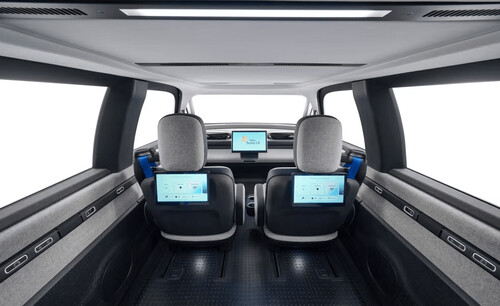
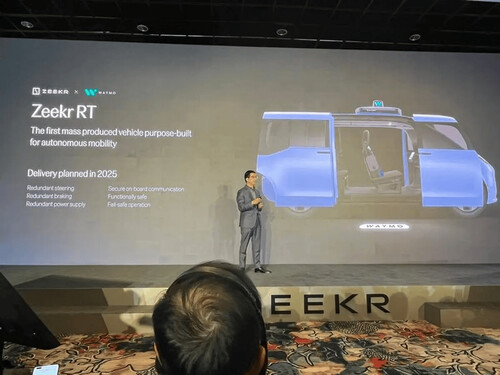
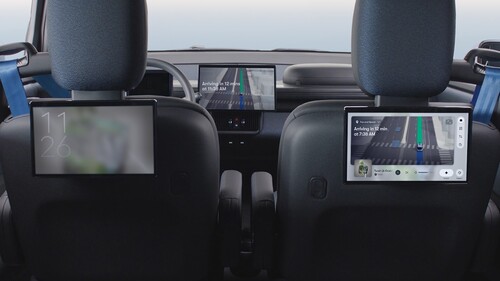
A Waymo Ojai arrives for pickupBrad TempletonWaymo has now made rides in their new Ojai robotaxi available to the public in the San Francisco Bay Area, L.A. and Phoenix. In Part 1 of this story, I described the implications of the robotaxi base vehicle being made in China. But is this vehicle, sourced from Geely's Zeekr division, any good?Rides In Waymo's Ojai Help Reveal Robotaxi FutureThere's no question the Qjai is much more designed to be a passenger's car than the Jaguar i-Pace, or even the Hyundai Ioniq 5 which Waymo will also use, and Motional uses. It is quite roomy, and has two giant sliding doors with no pillar between them. Combined with the low floor and high height, it makes for easy exit and entrance and a pleasant ride. It's still a standard minivan design, though--we don't see things like the face to face seating of the Zoox and Cruise Origin, or fancy recliners, or massage chairs like the Baidu Apollo vehicle. The fabric is pleasant and the seats comfortable, but again as one might expect from a mid-range minivan. Windows are large and visibility is excellent, even from the rear.AdvertisementAdvertisementThere are 3 screens, which can be set to show your route, a visualization of what the car sees, or music and climate controls. There does not appear to be a way to mirror your phone onto those screens, which would be nice for streaming, games and such. Wireless and wired phone charging is on offer, but you must bring a cord for the latter. Use of the driver's seat is now allowed, though it is fairly roomy. The vehicle is reportedly designed so that wheel can be removed when the time comes. Zoox recently got permits for their vehicles to operate with no steering wheel, so this may not be too far away. Putting 3 in the back would be quite doable, though a little cozy in some cases. (Much better than having 3 big guys in the back of a Cruise Bolt, which I once did.)Seatbelts were easy to put on--it surprises me that many vehicles have quite troublesome back seat seatbelts, particularly for a larger man. They have a fairly standard system that sometimes lets you lean forward, and sometimes forbids you--it would be nice in a self-driving car to have that based in part on the car's knowledge of whether braking risk is high or low. All riders can adjust the position of the front seats, to make more or less legroom for both. It did not seem to adjust the position of the "driver's" seat.The floor is flat, an advantage of being an EV. This makes moving around easier, putting in extra luggage. I suspect it also won't be hard to convert the front seats to rotating seats (you need the right airbags) so that vehicles can be configured for face-to-face seating, eliminating the competitive advantage Zoox has in that area. It might also be easier to adapt for wheelchair use.MinusA few negatives. I found the sound system to be merely "adequate," though I think many people might just like to use their own earbuds in a robotaxi. I also found ride quality rougher than expected. Self-driving cars do not need a suspension that can "feel the road" and so should offer a smoother ride than regular cars. With a LIDAR scanning the road for every bump, dynamic suspension should become a standard feature.The trunk of the Ojai is taller but narrower than the i-Pace. Good room in the cabin for extras, though.The headrests are giant and in the rear, block a lot of that wide window view. Most rides are 1-2 people and the 2 person rides will probably be in the back, but that may change when the steering wheel is removed. A manually retractable headrest could help, but may not be worth it for this short period. The trunk is taller than in the i-Pace, but narrower, and as such it still might be an issue for people with a larger amount of checked luggage, or a family going to an airport. Waymo allows riders to choose the type of vehicle they will get, possibly at the cost of a longer wait, but now adds a price surcharge to do this.AdvertisementAdvertisementI'm not sure I had enough time to judge this, but some have reported they don't think the Ojai drives as well. It is Waymo's 6th generation hardware, with fewer sensors than the i-Pace, but still plenty. I encountered some unusual routing decisions and rerouting choices, and occasional patches where it drove slowly with no need. There may ave been a few very tiny brake jabs that I haven't felt in the i-Pace. Driving felt safe, but you can't judge the safety and driving quality of a robocar from personal riding experience, not even if you take a thousand rides. (You can learn it's bad, but not that it's good.) As with most other vehicles though, this vehicle also doesn't like turning around or backing up, and it will go out of its way to avoid doing so in ways a human would not.For my review rides, I was taking extra time to enter and leave, taking photographs, sticking cameras on the window with suction cups. Multiple times this caused a call from rider support. While this is presented as "just making sure you are not having problems," it came off more as naggy, and generated a feeling of "hurry up, or they will want to talk to you about it." Normally, though, entry and exit are quick. I also had a strange experience which seemed like the doors tried to close on me while I was standing between them, but it did not repeat.A passenger takes a photo from the roomy backseat of the OjaiForm definitely follows function in this vehicle, it's not clear it will win any aesthetic awards. It's boxy and may not be that aerodynamic, if it were to be taken on a long highway trip. This is always the price of having height and roominess.At present, the Ojai is not allowed to go on freeways. This made trips longer, and made some trips I wanted to take much too long, though I did go as far as an 11 mile trip where going off-freeway added only 5 minutes.A Free Ride, When You've Already PaidIt was also interesting to experience a period where Ojai rides were free for testers. (This has now ended.) It changes your attitude towards use of the vehicle. Of course, robotaxi rides won't ever be truly free, but they are going to get cheaper, ideally "so cheap you don't think much about the cost." They also will become available as subscriptions where you pay a flat fee and think of individual rides as free. (When you own your own car, you often, mistakenly, think of using it as just the price of energy. In my case, with solar panels, I've already paid for my energy so I have almost no immediately visible incremental cost.)AdvertisementAdvertisementFor example, I attended a party which was a few miles outside the Waymo service zone. I took the Ojai to the edge of the zone and hopped an Uber the rest of the way. That's generally not a very good idea at present, because it's hard to control the delay at your interchange point. I would not have done it if not for wanting to learn. In the future, robotaxi providers should work together with human-driven ride hail to make this an almost seamless experience, with zero wait in the human-ride-hail to robotaxi direction, a minimal wait in the other direction, and a combined price. Not that the human drivers will like it much.Wait time predictions for the Ojai were poor, though to my surprise, a couple of times in the good direction, where the vehicle came much sooner than predicted before booking the ride. Uber is notorious for the reverse problem, because they rely on a human driver accepting your ride, a problem robots won't cause. If a vehicle comes earlier than predicted, the vehicle should be willing to wait longer for you, should you so choose. (In general, robotaxis should be willing to wait quite a long time for riders, so that you can have the "walk out and get in" experience. Robots should wait for humans, humans should not wait for robots.)The wait times were sometimes quite long, because there are fewer Ojais. It became clear just how important wait times are to rider experience. Yes, each one should be short, but the maximum wait time must also be short. If you know that mostly you get a 6 minute wait but at any time you might get a 25 minute wait, that hurts not just that particular ride. Now, any time you are leaving anywhere, you need to plan ahead, and look at your phone 25 minutes in advance, just in case the wait will be long. Worse, today, if you look then and it says 5 minutes wait, you have to then remember to look again in 15 minutes (it may have changed) and then 5 after that for the actual summon. Instead, there should be an easy UI to say when you want to leave, and the system should make sure a car is waiting for you then. That might require a waiting spot with "extended wait" ability. Most curbside spots have that, but some busy spots don't.If the wait time is short, and is always short, the experience is simpler. Most of the time, just summon when ready to leave. No planning needed.AdvertisementAdvertisementRobotaxi services hope to eventually become replacements for car ownership. Indeed, doing ride-hail is a distraction. A nice, but not great business that is easy as a first project. It's not the long term plan of Waymo or anybody else (except perhaps Uber itself.) But being a car replacement is hard. I had Waymo free for a month, and still often drove my own car. There were a variety of temporary reasons--no freeway trips, long waits, going outside the service area--but other reasons are harder to fix, such as times when you can't wait at all, or need to keep stuff in the vehicle. The latter case is a particular challenge which can be solved easily at a cost, but companies may not be ready for that cost. It's not just the way that many people keep a wide array of things in their car their might need at any time. It's even just having one small thing (my camera suction cup) I didn't want to carry around with me as I walked around. There are two solutions I see to this. One is having much lower cost idle time for cars and much lower cost for waiting space. The other is lockers that can quickly be exchanged between cars, though that increases wait times.Car replacement service won't be free, though it might have a monthly fee with similarities to the fees many already pay on a monthly or semi-annual basis, like lease payments, insurance, scheduled maintenance. That might be combined with "tanks" of miles you need to "fill up" every so often to simulate the car ownership pricing model.Waymo was contacted regarding questions in this article but was unable to respond in time.This article was originally published on Forbes.com