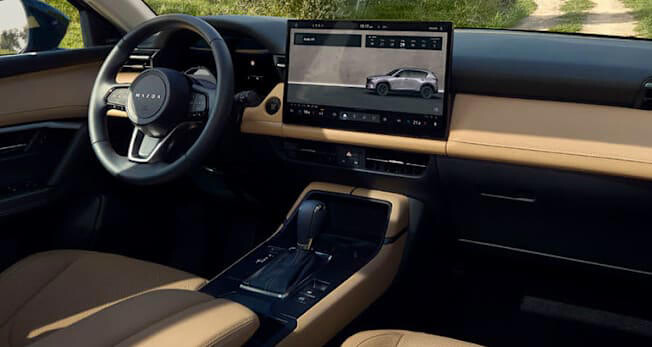
The horsepower wars are not relegated to machines purpose-built for performance. Nowadays, it feels like nearly every automaker has some sort of higher-output solution available across a surprisingly wide swath of its fleet, including seemingly pedestrian family vehicles. Some might come via electrification, but in the case of the two vehicles before us today—the 2026 Volkswagen Tiguan and 2026 Mazda CX-50—these hi-po conveyances twist the asphalt with good old-fashioned gasoline and turbochargers. Of course, building a holistically satisfying family car involves more than just adding power. Extra oomph might satisfy the driver, but automakers must pay attention to a whole host of other factors to make things just as peachy for the passengers. Let's see which of these two compact SUVs does just that. What We Tested Michael Simari - Car and Driver Both models here—the Tiguan SEL R-Line and the CX-50 Premium Plus—represent the pinnacle of their lineups and are thus quite expensive as far as small family SUVs go. The Tiguan's lineup starts at $32,280 for the S, and our tester bookends the other side of the offerings at $46,170 as tested. The CX-50 is less expensive, starting at $31,395 for the Select model; our range-topper's window sticker came in slightly more affordable than the VW's at $45,210. Neither of these vehicles is a screaming deal, but you can save a bit of scratch on the VW. Skip our car's $850 Avocado Green paint, $405 auto-dimming rearview mirror, and $365 in floor mats and bumper protectors, and the price delta evens out. Our Mazda's Cypress Green paint was only $200 by comparison; all-weather floor mats and a cargo liner added another $390 to its bottom line. Michael Simari - Car and Driver Since both models are the top of their pops, you get a stout list of features. The CX-50's Premium Plus niceties include a surround-view camera, auto-dimming inside and side-view mirrors, rear automatic braking, and blind-spot monitoring. The Tiguan SEL R-Line takes things a step further with massaging front seats (something Mazda doesn't offer on any vehicle it sells), plus a more aggressive R-Line appearance package that deletes most of the brightwork around the windows and front fascia. Exterior and Interior Looks can be deceiving. The Tiguan's boxy form may appear larger in all dimensions, but it exceeds the Mazda only in overall width (by nearly four inches, including mirrors) and height (by two to three inches). The CX-50 has about an inch more overall length, wheelbase, and ride height. Slip inside, and the CX-50 puts more stock in front legroom, where it beats the Tiguan, but the Mazda's rear passengers must make do with fractionally less gam space. Owing in part to its more upright body shape, the Tiguan takes the cargo-capacity crown, offering better volume whether the rear seats are up or down. When it comes to cabin aesthetics, both are swinging for the fences. The CX-50's white-on-black interior carries plush touch points and premium materials, and we love how many physical buttons, dials, and switches exist across nearly every surface. The tucked-away infotainment screen feels like a vestige of an earlier age, and it sort of is—the CX-50 is due for an update that brings it in line with the latest CX-5, for better or worse (read our latest long-term CX-5 update for more on that). 2026 Mazda CX-50 Turbo Premium Plus HIGHS: More guts than the average canopic jar, superb bump suppression, feels fancy. LOWS: Creature-comfort corner cutting, tighter rear-seat accommodations, not a highway-fuel-economy hero. VERDICT: A rocket that could use more pockets. The Tiguan's cabin is also top-notch. Our tester's two-tone brown and black interior looks and feels no less luxurious than an Audi's, and we enjoyed the door-to-door strip of wood, which adds some extra variety. Of course, the latest-gen Tiguan is all about the screens, which in this case comprise a normal digital gauge display and a 15-inch repurposed highway billboard. In addition to having more cargo capacity, the Tiguan also has more places to stash your stuff. We have one weird thing to point out, but it's bound to be important to somebody. Both cars have heated steering wheels, but the Mazda's heating element seems confined to between 9 and 10 o'clock on the left and between 2 and 3 o'clock on the right, while the rest of the tiller remains icy to the touch. Volkswagen's engineers, on the other hand, smartly realized that if you pay for a heated steering wheel, you probably want one that's warm the whole way around. Powertrain and Performance Even among high-strung turbo fours, the No Replacement for Displacement adage still holds true. The Mazda CX-50's 256-hp turbocharged 2.5-liter makes less horsepower than the Tiguan, but the larger mill churns out an absurd 320 pound-feet of torque. All-wheel drive is standard, as is an archaic six-speed automatic transmission. The CX-50 is the lightweight here, tipping the scales at 3864 pounds. By comparison, the Tiguan's 2.0-liter turbo four makes just 258 pound-feet of torque, but at 268 horses, it bests the Mazda on raw horsepower. All-wheel drive is standard here as well, and the transmission is a more modern-feeling eight-speed auto. The whole Teutonic shebang carries about one more human's worth of mass in its structure, weighing 4023 pounds on our scales. If you're assuming that the lighter, more torquey SUV will outperform its competition, you're right, but the gap is small. The last CX-50 we tested hustles to 60 mph in 6.4 seconds—two-tenths ahead of the Tiguan—and the Mazda's 167-foot stop from 70 mph bests the VW by nine feet. From there, things really tighten up: The CX-50's 14.9-second, 92-mph quarter-mile sprint is just a hair ahead of the Tiguan's 15.0 seconds at 96 mph. With a 5-mph rolling start, the two reach 60 within a tenth of each other. From 50 to 70, the Vee-Dub takes the lead, requiring just 4.5 seconds to the Mazda's 4.8. The Mazda notches a victory around the skidpad, maintaining 0.84 g of lateral grip against the Volkswagen's 0.78 g. 2026 Volkswagen Tiguan SEL R-Line Turbo HIGHS: Posh cabin trimmings, slightly more spacious inside, the most fun we've had in a VW SUV in a while. LOWS: Not our favorite infotainment interface, not our favorite brake pedal, traditional German road compliance. VERDICT: Fun for the whole family, driver included. Unfortunately, the CX-50's lighter curb weight and slicker-looking silhouette don't translate to stonkin' fuel-economy benefits. The two vehicles are nearly evenly matched by EPA estimates—both earned 29-mpg highway and 25-mpg combined ratings, but the Mazda's 23-mpg city value tops the VW's by one. The script flipped on our real-world 75-mph highway fuel-economy test, however, where the Tiguan overachieved with a 31-mpg result, out-skinflinting the 28-mpg Mazda, which fell short of its EPA highway estimate. Driving Experience Both SUVs are fun to drive and reward time spent behind the wheel, with each vehicle carrying its own little idiosyncrasies. There are a few parts of the driving experience where we think the CX-50 shines, and others where the Tiguan feels better. The Mazda's cabin may be louder at wide-open throttle (and tied at a 70-mph cruise), but overall, it seems quieter in day-to-day operation, especially over the zydeco washboards that Ann Arbor calls roads. The CX-50's bump damping is superior, making for a slightly more luxurious ride quality than the Tiguan, which carries some of that stereotypical German stiffness in its suspension tuning—but one person's "flinty" is another person's "composed," so it really boils down to whether you want that additional poise in your daily driving. (The Tiguan SE and base S offer smaller wheels with cushier tire sidewalls.) When it comes to pedal feel, the Mazda takes the crown; the Tiguan's brake pedal is a little mushy, and the throttle is a little too eager to open 'er up with a gentle tip-in. On the other hand, we preferred the Volkswagen's heftier steering feel. The Mazda's six-speed automatic handles gear changes deftly, but it's clear from our on-ramp-style acceleration testing that the VW's two extra gears are, in fact, providing a benefit. (Highway fuel-economy results reflect that as well.) It's not like you'll notice either gearbox doing its job, though. Michael Simari - Car and Driver And the Winner Is . . . By the skin of its teeth, the Volkswagen Tiguan claims the championship belt that it lost to the Mazda CX-50 in a 2024 two-car comparo. Back then, we said the CX-50 was worth the upcharge over the more efficient, more spacious Volkswagen because we preferred the Mazda's cabin and driving dynamics. Now, the Tiguan is the one that costs more, and while it remains more efficient and more spacious than the CX-50, it picked up some major slack in the interior-design department, and it drives just about as well. The 2026 Tiguan is an excellent all-rounder. It's a wonder what a new generation can do. ➡️ Skip the lot. Let Car and Driver help you find your next car.

 Liked by Matthew Gagnon, Ryan Mitchell
 Liked by Matthew Gagnon, Ryan Mitchell