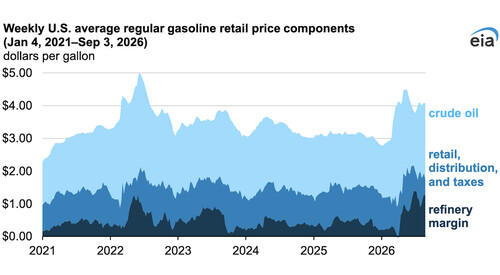
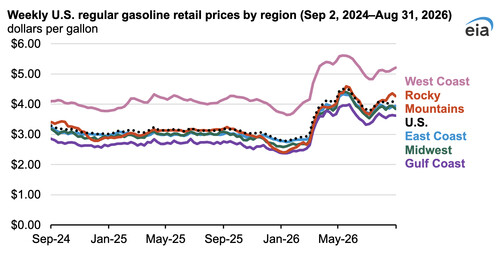
Venezuela Oil Deal and Gas Prices: What Drivers Should Expect at the PumpIf you drive anything, you've noticed the damage. The EIA's most recent weekly survey put regular unleaded at $4.049 a gallon, 92 cents higher than a year earlier, with on-highway diesel at $5.454 — a brutal $1.74 year-over-year jump. So when the president posts that he's just secured enough oil to "substantially lower Gas Prices for all Americans," it's fair to ask what that actually means for the next tank.Here's the announcement in the president's own words, from his Truth Social post Friday night: the U.S. has "secured majority U.S. control of more than 65 BILLION BARRELS of proven Oil Reserves in Venezuela, at no cost to the American Taxpayer," a transaction he says "MORE THAN DOUBLES American Oil Reserves." Sunday he followed up saying he'll use the crude to refill the Strategic Petroleum Reserve.Three things about that are worth understanding if you're deciding whether to keep the V8 or trade for something with a smaller displacement.AdvertisementAdvertisementReserves are not gasoline. They're not even oil yet.A proved reserve is an accounting estimate — the volume operators believe is recoverable from known reservoirs under current economics and current technology. It is not inventory. It is not in a tank. For scale, the EIA pegs total U.S. proved crude and lease condensate reserves at 46 billion barrels as of year-end 2023. So yes, 65 billion barrels booked somewhere on the American side of a ledger is a genuinely enormous number.Related articlesToyota China Sales Fall 24% As Fuel Costs Push Buyers To EVsA Car Dealer Faked Titles To Dodge Sales Tax For Years. Getting Caught Cost Less Than One Car.It also has almost nothing to do with the price on the sign at the corner station. Pump prices track the marginal barrel produced this month against the marginal gallon consumed this month. Reserves change the thirty-year story. Production changes the thirty-day one.AdvertisementAdvertisementAnd here's the part that should temper expectations: the Venezuelan barrels have already been arriving for a while. EIA's monthly import series shows U.S. crude imports from Venezuela at 471,000 barrels per day in May 2026, up from 118,000 in May 2025 and 86,000 that June. Flows have roughly quadrupled year over year. Gas still went up 92 cents. That's not an argument that Venezuelan crude is worthless — it's an argument that a war-driven supply shock swamps a few hundred thousand barrels a day.The molecules matter more than the barrel countThis is the part almost nobody explains, and it's the genuinely interesting engineering story.Venezuelan crude is heavy and sour — dense, viscous, high in sulfur. That's the opposite of what American shale produces, which is light and sweet. Refineries aren't blenders; they're purpose-built chemical plants, and a plant optimized for one slate runs badly on another.AdvertisementAdvertisementGulf Coast refineries are the exception, and by design. As EIA has documented, the region carries enormous secondary conversion capacity — cokers, hydrocrackers, and desulfurization units — specifically so it can process heavy, high-sulfur grades that trade at a discount to light sweet benchmarks. A delayed coker takes the tar-like bottom of the barrel that would otherwise become low-value residual fuel and thermally cracks it into lighter product plus petroleum coke. Hydrotreaters then strip the sulfur so the diesel can meet the 15 ppm ultra-low-sulfur spec your truck's DPF and SCR system require.Those units exist because of history: at the peak in 1997, EIA data shows the U.S. was pulling in over 1.6 million barrels a day of Venezuelan crude. The Gulf Coast built its coking capacity around exactly that kind of feedstock. Then shale arrived, and the average API gravity of Gulf Coast refinery input got lighter and lighter, leaving expensive conversion hardware underfed.So the practical takeaway is narrower than "gas gets cheaper." Heavy sour crude run through cokers and hydrocrackers is disproportionately a distillate story. If this deal delivers real volume, the first place a driver would notice is diesel — which right now carries a $1.40 premium over regular. That's the number to watch if you own a diesel pickup, run a small fleet, or are cross-shopping a diesel half-ton against a gas one.The SPR math is uglier than the announcement suggestsAdvertisementAdvertisementDOE's own numbers make the refill pledge look like a multi-year project, not a "topping out." As of August 20, the reserve held 294.1 million barrels against 714 million barrels of authorized capacity. That's over 400 million barrels of empty salt cavern.Two details from that same DOE page are worth chewing on. First, the average price the government has historically paid for oil in the reserve is $29.70 a barrel. Refilling at anything close to today's market means the taxpayer eats a spread that makes the "no cost" framing hard to square. Second — and this actually favors the plan — the SPR's current inventory is 192.3 million barrels of sour crude versus 101.8 million of sweet. The caverns are already weighted toward exactly the kind of high-sulfur crude Venezuela produces. From a pure fit-for-purpose standpoint, Venezuelan heavy is a reasonable SPR feedstock.Related ArticlesDeSantis Wants To Ban License Plate Cameras — But Missed The Network Selling Your Data To LendersVolvo's New EVs Can Warn Each Other About Deer and Crashes. That's Not Even the Interesting PartWhat DOE can't compress is time. Energy Secretary Chris Wright's own remarks in Caracas back in February described the work ahead as issuing licenses so companies could invest, raise production, and rebuild. Redeveloping neglected heavy-oil fields means drilling, artificial lift, diluent supply, upgrading, pipeline repair, and port capacity. That's a five-to-ten-year capital cycle, not a quarter.AdvertisementAdvertisementWhat to actually do with thisDon't re-plan a vehicle purchase around a social media post. Do run the arithmetic on your own situation, because at $4.05 a gallon the spread between vehicles is no longer trivial: 15,000 miles a year at 20 mpg costs about $3,040 in fuel. The same year at 28 mpg costs about $2,170. That $870 delta is roughly a car payment and a half, and it compounds every year you own the thing.If you've genuinely cut your driving this year, call your insurer — annual mileage is a rated factor, and most people never update it after the shock passes. And if you're deferring maintenance because fuel is eating the budget, resist on two items specifically: tire pressure and air filters cost almost nothing and both directly cost you mpg when neglected.The barrels may well come. The relief at the pump, if it arrives, will arrive quietly, in diesel first, and years after the headline.Join our Newsletter, follow our Instagram page, and connect with us on Facebook.