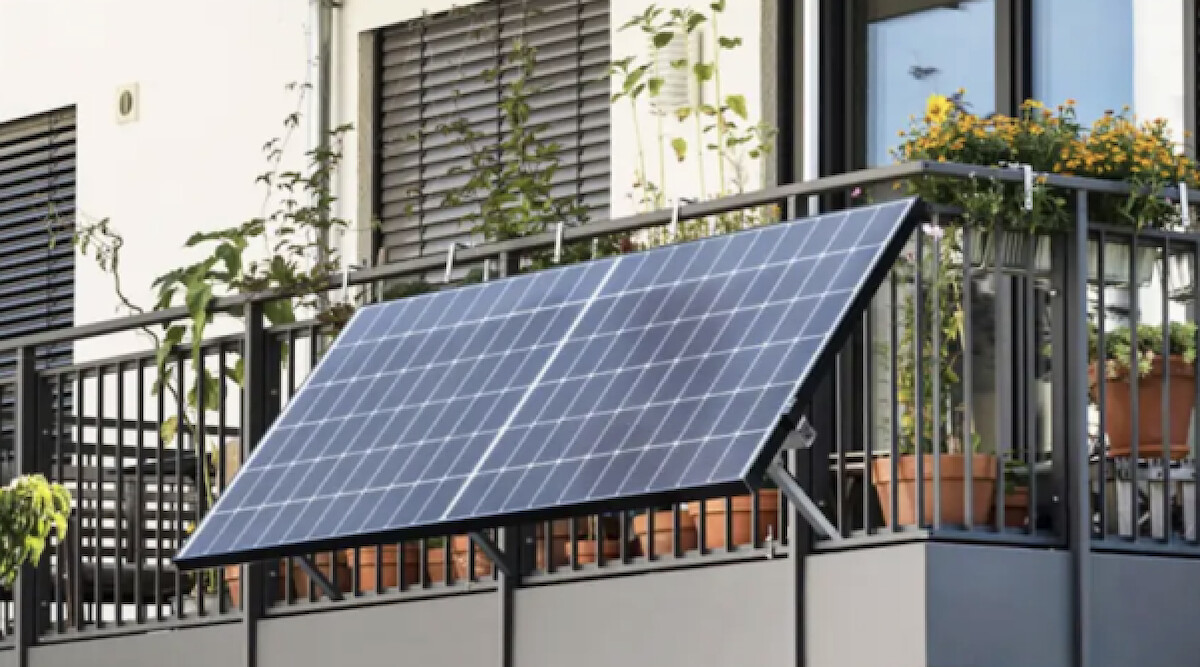
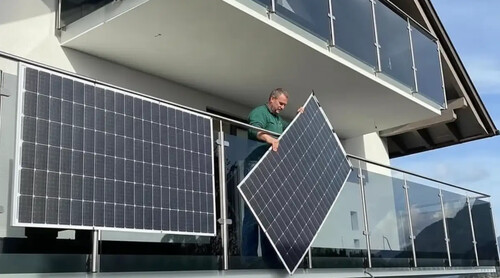
For all his bleating, braying bluster over fossil fuels, US President Donald Trump is presiding over a solar power revolution. On his watch, a total of nine states have now adopted balcony solar legislation, with New Jersey being the latest addition to the list. Balcony solar kits plug into ordinary household outlets just like any other home appliance — but instead of sucking electricity out, they reduce monthly utility bills by pumping free electricity from the sun back into household wiring. Rooftop Solar Good, Balcony Solar Also Good Balcony solar is shorthand for plug-and-play solar kits that can be hung or placed anywhere sunlight is available, including fencing and patios as well as balconies. Unlike rooftop solar systems, balcony solar kits can simply be unplugged and transported whenever a household moves, like any other portable appliance. Rooftop solar systems are typically grid-connected, enabling owners to sell their solar-generated electricity back to their local utility. That option is not available to balcony solar owners. Still, balcony solar has the potential to provide direct access to solar energy for whole new populations including millions of renters who are unable to install their own rooftop solar systems, along with households in multi-unit condominiums and co-ops. Plug-and-play solar is also an option for property owners with limited, shaded, or otherwise unsuitable roof space for rooftop solar systems (see more plug-and-play solar background here). According to the online solar marketplace EnergySage, purchasers can expect to pay $500-$1500 for a typical 400–800 watt kit, reducing their monthly electricity bill by $15–$50 depending on local utility rates. What’s The Holdup? Balcony solar is already popular in parts of Europe, with Germany being a standout example. However, it has only just begun to make an appearance in the US. The up-front cost of a plug-and-play kit is one impediment, but not the most important one. Landlords and HOAs (Home Owners Associations) can limit what can or can’t be hung about a property, including solar panels. Local governments can also impose restrictions. In addition, local utilities can require onerous paperwork, long waiting times and connection fees, under the assumption that plug-and-play kits should be treated like conventional rooftop solar systems. Mass uptake of plug-and-play solar also depends on the availability of trusted, reliable system components. Ideally, consumers should be able to trust a solar kit with their home electrical system the same way they trust any other new appliance. The trust gap was filled in January, when the safety certification firm UL Solutions launched a new certification platform for plug-and-play PV under the title, “Outline of Investigation for Interactive Plug-In Photovoltaic Equipment and Systems,” or UL 3700 for short. The UL 3700 “gold standard” is already beginning to emerge on the market (here’s one example). The online solar financing firm Solar.com is among the stakeholders explaining the particulars of a UL 3700 solar kit: Automatic Power Cut-Off: The system is “smart.” If you unplug the cord from the wall while the sun is shining, the metal prongs on the plug become “dead” in less than a second. This prevents anyone from getting a shock from the exposed plug. Grid Outage Protection: If the power goes out in your neighborhood (a blackout), the panels automatically stop sending power to your home or the grid. This ensures utility workers fixing the lines aren’t accidentally shocked by your panels. Overload Protection: The certification ensures the kit won’t “backfeed” too much power and overheat your home’s existing wires. It monitors the electricity flow to make sure your circuits stay cool and safe. Weatherproof & Durable: The panels and the plug-in box must be able to withstand extreme heat, freezing rain, and high winds without leaking electricity or breaking down. Ground-Fault Protection: Every kit must have built-in safety sensors (like the “Reset” buttons on your bathroom outlet) that instantly shut the system down if it detects any leak of electricity. First A Trickle… Even before UL Solutions posted UL 3700, lawmakers in some states were planning new legislation aimed at smoothing the way for a tsunami of balcony solar. Typically, enabling legislation prevents municipalities, landlords, HOAs, and other property-owning entities from issuing blanket prohibitions against plug-in solar panels, though some wiggle room may be provided for reasonable restrictions. The legislation also prevents utilities from requiring burdensome application requirements and fees. Utah became the first state to create a separate category for plug-in solar systems of up to 1,200 watts, back in March of 2025. That was the state of play until the first six months of this year, when similar bills were signed into law in Maine, Virginia, Colorado, Maryland, New Hampshire, Connecticut, and Vermont. On September 1, New Jersey Governor Mikie Sherrill added her home state to the list in an official bill signing ceremony. EnergySage also notes that additional bills have passed both legislative chambers in New York, and one chamber in California and Massachusetts. Bills are also advancing in Delaware, Michigan, Missouri, North Carolina, Ohio, Pennsylvania, South Carolina, and Washington, DC. Eleven other states are considering legislation but deferred action until 2027, while pushback from utilities and electric coops sank bills in Wyoming and Georgia. Balcony Solar Comes To New Jersey As a densely populated, space-constrained state, New Jersey is ripe territory for the emerging balcony solar marketplace. Despite the usual gloomy, cold weather of a mid-Atlantic winter, the state has established a strong track record of rooftop solar uptake, including utility scale arrays as well as residential solar. The new Garden State Balcony Solar Act exempts plug-in solar systems of up to 1,200 watts from fees, approvals, equipment mandates, and other requirements imposed by utilities. “It also prevents landlords, homeowner associations, and similar entities from broadly prohibiting the use of these devices, while barring municipalities from prohibiting them or requiring permits for their use,” Governor Sherrill’s office adds. For the record, the new balcony solar legislation is just one of several solar-friendly steps taken by New Jersey policy makers since Sherrill took office this past January 20, including the expansion of the state’s existing community solar program to 3 gigawatts, with a focus on installing solar arrays at landfills and other brownfields. In addition, last month the state selected three solar developers to perform the inaugural installations for a three-year agrivoltaic pilot program. Authorized under the Dual-Use Solar Energy Act of 2021, the program passed a key planning milestone last year. Photo: Nine US states have now adopted legislation that clears the path for plug-in balcony solar kits, including Utah, Maine, Virginia, Colorado, Maryland, New Hampshire, Connecticut, Vermont, and New Jersey (cropped, courtesy of New York State Legislature).