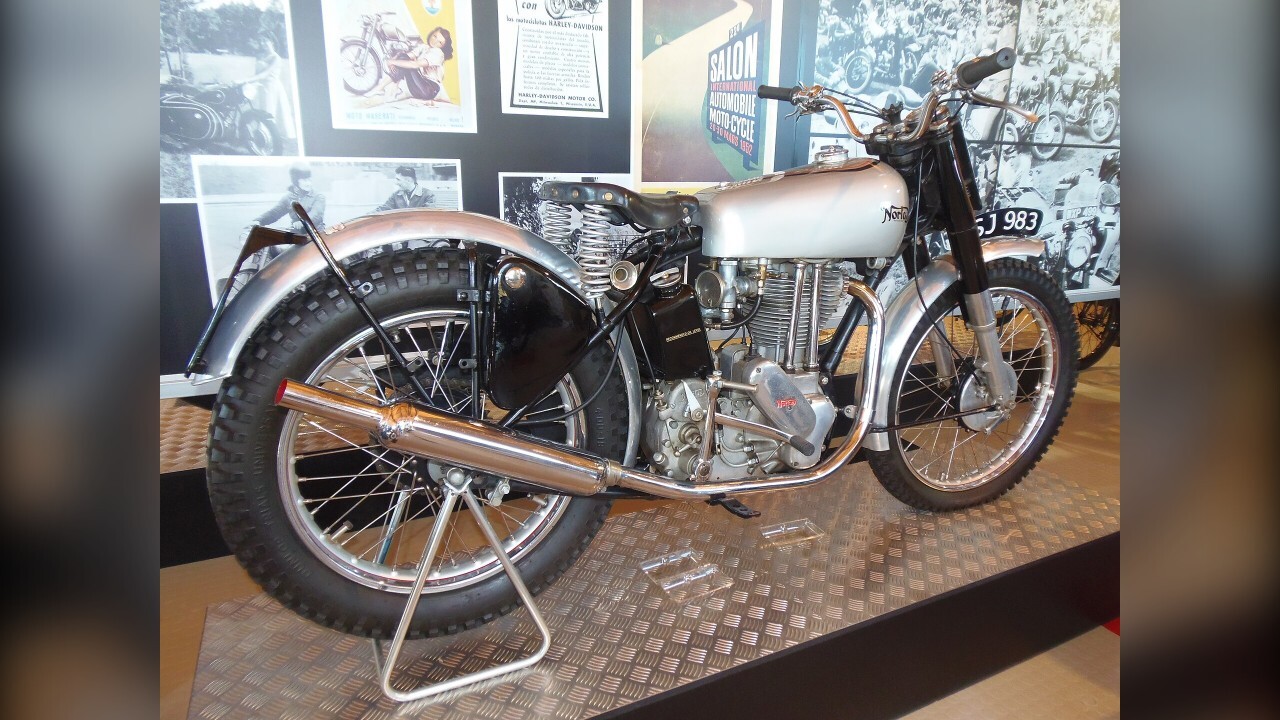
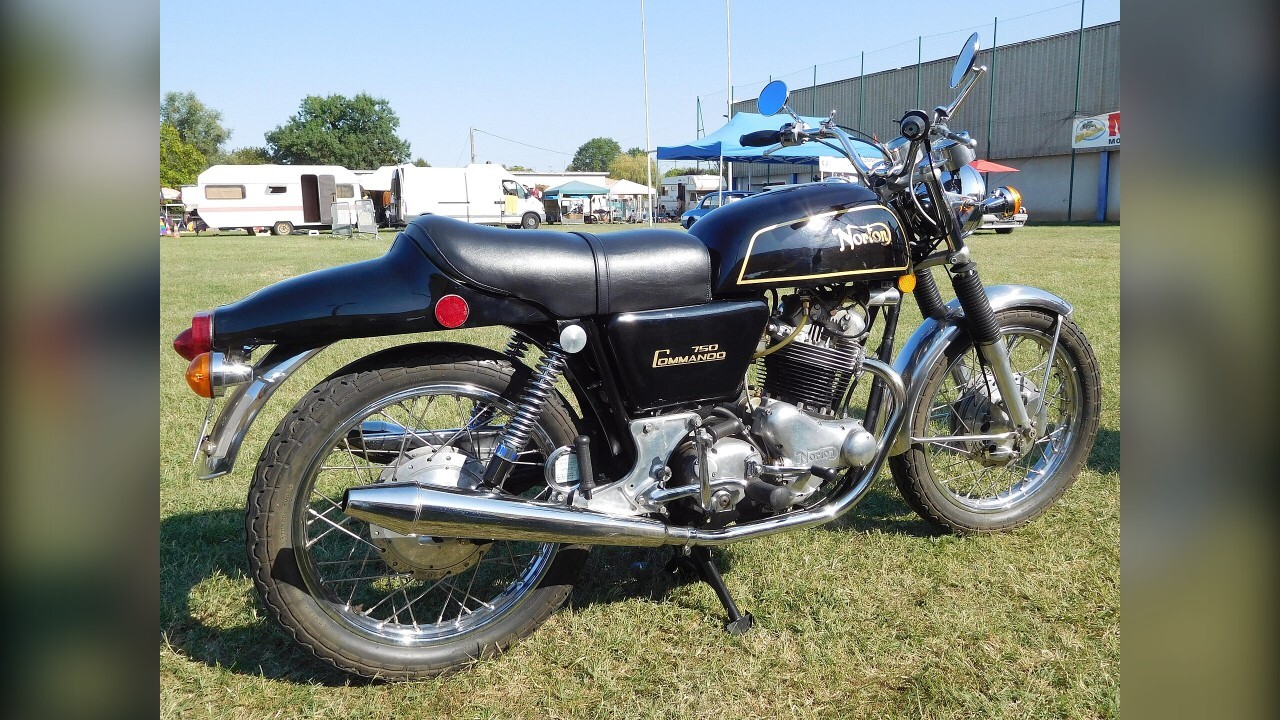
Edward Turner sketched the Ariel Square Four engine in 1928, and Ariel kept building Square Fours until 1959. That kind of staying power was common in the British motorcycle industry. Many of its bikes started as cheap commuters, stopgaps or troubled designs, then stayed in production for decades. Some of them survived because police forces, post offices and learner riders kept ordering them. Others survived because a stubborn engineer refused to let a good idea die. A few even outlasted the companies that built them, rolling out of the door while the firm itself was going under. These are our picks: eight British motorcycles that, in our view, outlived the expectations set for them. The years, engines and production facts come from period records, museums and classic bike historians. Every verdict is our own. 1. 1938 Ariel Square Four 4G The Square Four packed four cylinders into a compact square block. Turner devised it in 1928, and the first bikes carried small overhead-cam engines. Those early “Cammy” models had a reputation for cooking their rear cylinder heads, which could have ended the story right there. Instead, Ariel redesigned the engine in 1936. The result was the 4G of 1937, with a 995 cc engine and pushrod-operated overhead valves. The 1938 bike pictured here comes from those first years of the big-bore design. Then, in 1939, Ariel offered its patented Anstey-link plunger rear suspension as an option, and it returned after the war in 1946. The later Mk II of 1953 made 40 brake horsepower and could reach about 100 mph. Ariel Square Four production finally stopped in 1959, when the company ended all of its four-stroke models. Our take: a design that began with an overheating problem ended up running for roughly three decades. If you want one, look for a well-documented engine rebuild, because the four-cylinder layout rewards careful assembly. For touring two-up at a relaxed pace, we think few prewar British bikes feel smoother. 2. 1947 Sunbeam S7 The Sunbeam S7 arrived after the war as BSA’s idea of a luxury tourer. Erling Poppe designed it, and its layout was unusual for a British bike. It used an overhead-cam inline twin of about 500 cc, driving the rear wheel through a shaft instead of a chain. Fat “balloon” tires gave it a distinctive look, though they made the handling uncertain at speed. The start was rough. Early bikes vibrated so badly that the first machines sent to South Africa were recalled. Sunbeam fixed that with two bonded rubber engine mounts. Meanwhile, BSA had chosen a worm-drive rear gear, and it reportedly stripped under power, so Sunbeam cut output to about 24 brake horsepower. Only 2,104 original S7 tourers left the factory between 1946 and 1948, including bikes like the 1947 example pictured. Yet the design refused to die. The S7 de luxe and the lighter S8 followed from 1949, adding 5,554 and 8,530 bikes, and the line lasted until 1956. In our view, that is a remarkable recovery for a bike that stumbled out of the gate. If you’re shopping, an early S7 is the collector’s choice, but the later bikes are easier to live with on the road. 3. 1950 Velocette LE Mk I Velocette launched the LE at the 1948 Earls Court show as the “Motorcycle for Everyman.” It looked nothing like a normal British bike. The Mk I used a 149 cc water-cooled, side-valve flat twin, with shaft drive and the engine, gearbox and clutch built as one unit. Coil ignition helped it start easily. It was not cheap, though. At launch, an LE cost £126, while a BSA Bantam cost £76. Civilian buyers never arrived in the numbers Velocette had forecast, according to the Grampian Transport Museum. Police forces saved it. More than fifty British forces used the LE and ordered more than half of all production. Officers on the bikes nodded to their superiors instead of saluting, and the LE became the “Noddy Bike.” The museum’s later 200 cc example returned 120 mpg and topped out at 53 mph. Velocette kept the LE in production until 1970, through the Mk II of 1951 and the Mk III of 1958. Our take: no one at Earls Court in 1948 would have guessed a quiet 149 cc twin would outlast most of the flashier bikes around it. Find a Mk I with its original water-cooling parts intact, because those are harder to replace than the bodywork. 4. 1957 Norton Dominator 88 Norton’s first twin, the Model 7 Dominator, appeared in mid-1949. Bert Hopwood, who had worked on the Triumph Speed Twin team, designed its 497 cc parallel twin. The engine was good, but it needed a better frame to shine. That frame came from Ireland. The McCandless brothers designed and raced a new chassis, and Norton bought the design and had Reynolds build the frames. The result became known as the Featherbed. Norton developed the Model 88 around it in 1951 and sold it at home from 1953. Around 1957, the year of the bike pictured, Norton also introduced sidecar Featherbed frames. From there, the Dominator kept growing. The Model 99 arrived in 1955, and the 650SS followed in 1961, often called the “best of the Dommies.” Norton’s factory racing version of the 500 cc twin made 55 brake horsepower and revved to 8,000 rpm. In our view, the 88 outlived expectations because a frame designed for racing turned an ordinary road twin into a benchmark. If you buy one, confirm that the frame and engine numbers belong together, because in our view a Featherbed frame is too tempting for special builders to leave alone. 5. Panther Model 120 with sidecar Phelon & Moore built Panthers, and its big singles were made for hauling. The Model 120 arrived in 1959 as a stretched version of the older Model 100. Its “sloper” engine, designed by Granville Bradshaw, grew to 645 cc with a slightly larger bore and a 6 mm longer stroke. The extra size was all about pulling power. The bigger single gave more low-speed torque, quicker acceleration and a higher cruising speed. Because sidecars were popular at the end of the 1950s, Panther also built a purpose-made sidecar chassis. It attached by a three-point mounting and used swinging-arm suspension with an Armstrong shock absorber. Buyers could even add a trailer with a towbar. Here’s the surprise. By 1962, Phelon & Moore was in receivership, yet it kept building the Model 120 until 1966, when it simply ran out of parts. The bike then stayed on sale for about another year. Our take: few machines have outlived their own maker’s finances so stubbornly. If you want a classic sidecar outfit, this is one of the most authentic ways to get one. Check the sidecar mountings carefully, since a hard-working outfit puts heavy loads through them. 6. 1961 Velocette Venom Velocette introduced the Venom in November 1955 at its Hall Green works in Birmingham. It used a 499 cc overhead-valve single with perfectly square 86 mm by 86 mm dimensions. On paper, it was a fast touring single from a small company with old-fashioned ideas. Then came March 1961. At the Montlhéry track near Paris, a team of eight riders took a lightly modified Venom, fitted with a racing carburetor, megaphone exhaust and fairing, and ran it for 24 hours. They lapped consistently at about 107 mph and averaged more than 100 mph for the full day. According to The Vintagent’s account of the run, the record still stands for a 500 cc machine. Velocette built 5,721 Venoms before production ended in 1970. In addition, a 1965 race kit led to the Thruxton model, of which 1,108 were built. In our view, a big single from a family firm had no business setting a 24-hour record that would last this long. If you buy a Venom, learn its kick-start routine before you ride it in public. 7. 1965 Triumph Tiger Cub Edward Turner launched the Triumph Tiger Cub T20 at the Earls Court show in November 1953. It grew out of the 150 cc Terrier and shared that bike’s frame and forks. The Cub’s 199 cc overhead-valve single had an alloy head and enough pep to feel like a real Triumph. Rules helped it last. In 1961, Britain limited learner riders to 250 cc, so a small four-stroke like the Cub suddenly had a ready market. Triumph also added swinging-arm rear suspension in 1957 and built off-road versions for trials and scrambles. By the time the 1965 bike pictured here left the factory, the Cub had been in production for over a decade. The final Super Cub, launched in November 1966, even shared its frame and parts with the BSA Bantam D10 to save money. Production ended in 1968. Our take: a lightweight that started as a stretched commuter ran for 15 years and taught a generation to ride. Look for one with its original Triumph tinware and paperwork, because those details decide its value. 8. 1970 BSA Bantam B175 The Bantam began with a captured design. BSA’s experimental department in Redditch obtained a German DKW RT 125 in 1946 and used it as the basis for a simple two-stroke. The first D1 had just 123 cc and launched in 1948. According to Hagerty’s Bantam history, BSA went on to build more than 250,000 Bantams. The British General Post Office was a huge customer. It began using Bantams in December 1948, bought 6,574 in total and overhauled each one every 15,000 miles. Over time, the engine grew to 148 cc and then 173 cc. The last series arrived in 1969 as the D175, later renamed the B175, with a 12.6-brake-horsepower engine, four speeds and a top speed of about 65 mph. BSA dropped the B175 in 1971 after more than two decades of Bantams, yet the Post Office kept them in service until the mid-1970s. Dealers also sold leftover B175s until at least 1973. Our take: the 1970 B175 is the best-developed Bantam and the easiest one to ride in modern traffic. Buy one with a healthy crankshaft and seals, and you’ll own the most refined version of a design that began with a war prize.

 Liked by Emma Hall, Chloé Rogers














 Liked by Emma Hall, Chloé Rogers