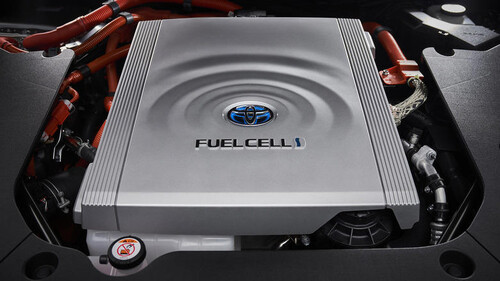
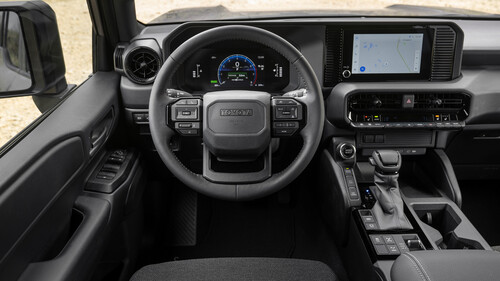
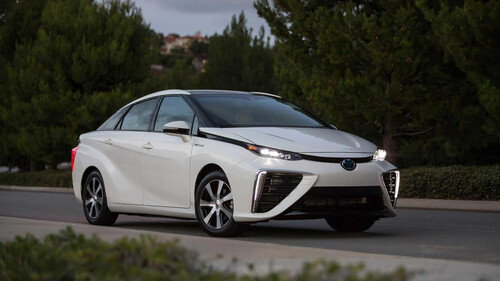
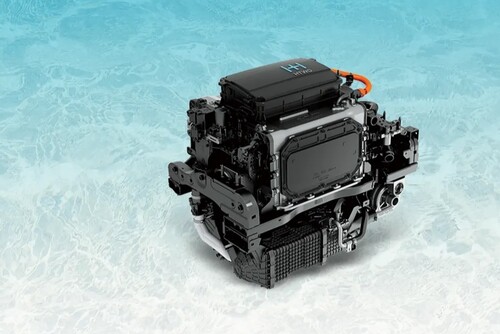
Toyota’s Hydrogen Hilux Finally Shows Up In 2028, Six Years After It Started TestingThe Auto WireShawn HenryTue, September 22, 2026 at 6:30 PM UTCAdd us on Google1 / 2Toyota’s Hydrogen Hilux Finally Shows Up In 2028, Six Years After It Started TestingToyota just confirmed that a hydrogen fuel cell version of its new Hilux pickup will reach customers in 2028. Read only the headline, and it sounds like routine automaker futurism: a nice round year, a truck climbing a gravel quarry in the press photo, a line about "the future of mobility."The real story isn't the truck. It's the calendar.Toyota didn't decide to build a hydrogen Hilux this month. The project traces back to a feasibility study that began in early 2022, funded in part by the UK government's Advanced Propulsion Centre and built out by Toyota Motor Manufacturing UK alongside engineering partners Ricardo, ETL and D2H. The first hand-built prototype rolled out of Toyota's Burnaston plant that year in about three weeks. By September 2023, Toyota had a running truck to show. By June 2024, the program had grown to ten prototypes, five doing durability testing on public roads and two working double duty as course vehicles at the Paris Olympics.AdvertisementAdvertisementNone of that made it into most coverage of Toyota's hydrogen pickup. It's the part of the story that actually explains the 2028 date. This wasn't a snap decision chasing a headline. It's the tail end of a six-year, multi-country engineering program finally catching up to a production timeline, and even now, Toyota says it's holding out for its third-generation fuel cell hardware, expected on the market in 2026 or 2027, rather than shipping the truck with the older Mirai-sourced stack that powered the prototypes. The Hilux isn't waiting on hydrogen. Hydrogen is waiting on cheaper, more durable fuel cells.That timeline matters more than the truck itself, because it tells you Toyota is treating powertrain development the way it has always treated manufacturing: no launch until the process is boring and repeatable. It just happens to be doing that with four different powertrains under one nameplate at once, which is a strange thing for a company built on standardizing everything.Here's the lineup Toyota confirmed for the ninth-generation Hilux, powertrain by powertrain: a 2.8-liter 48V mild-hybrid diesel as the volume seller in Western Europe, arriving this spring; Toyota's first body-on-frame battery-electric truck, already rolling out with a 59.2-kWh battery good for a WLTP-rated 257 kilometers, or about 160 miles; carryover 2.8-liter diesel and 2.7-liter petrol engines reserved for Eastern European markets that aren't getting the hybrid or the EV at all; and, in 2028, the hydrogen fuel cell variant. Toyota calls this its multipath strategy, and its own newsroom is unusually candid about the reasoning: different regions have different energy infrastructure and different customers, so instead of picking a powertrain and forcing the market to adapt, Toyota is building the market's constraints into the product line itself.That 257-kilometer range on the battery Hilux is worth sitting with, because it's the detail that makes the hydrogen version make sense. A pickup's whole job is hauling weight, and adding battery capacity to hit a bigger range number means adding mass, which eats into the payload and towing capacity the truck was built to deliver. Toyota's own hydrogen prototypes, by contrast, were rated for up to 600 kilometers on just three tanks holding a combined 7.8 kilograms of hydrogen, more than double the battery truck's range, at a fraction of the weight a battery pack would need to match it. That's not marketing math. It's the same reason fuel cells keep showing up in vehicles that carry heavy loads over long distances, buses, forklifts, even railway trains, which Toyota is separately developing with JR East and Hitachi in Japan, and keep struggling to catch on in ordinary passenger cars, where the weight penalty of a battery matters far less than the hassle of finding a hydrogen pump. Toyota's harshest critics keep score by comparing the Mirai to the Model 3. The more honest comparison is a hydrogen work truck against a battery work truck, and on that comparison, hydrogen has a real, physics-based argument for the first time.AdvertisementAdvertisementIt's an argument the United States is unlikely to hear anytime soon. As we've reported, federal tax incentives that funded America's hydrogen buildout are being phased out, and California, the only state with a public hydrogen fueling network worth mentioning, has been losing stations even as regulators tout the program. Toyota's hydrogen Hilux isn't bound for American driveways. It's a European and fleet play, aimed at exactly the commercial buyers, mining operations, utility fleets, government contracts, who refuel a handful of trucks at a private depot instead of expecting a public pump on every corner. That's a fundamentally different bet than the one Toyota already lost in the U.S. passenger market, and it's worth not conflating the two.There's a service-side wrinkle worth knowing about, too. Hydrogen's interaction with metal isn't cosmetic. Hydrogen atoms can migrate into susceptible alloys and make them more brittle over time, a well-documented phenomenon that engineers have to design around in tanks, fittings and structural components. It's one more reason fuel cell trucks are likely to stay inside factory-trained service networks for years rather than showing up at the independent shop down the street, which has real implications for total cost of ownership on any fleet that buys one.Put it all together and the Hilux isn't really a hydrogen story. It's a story about a company that spent seventy years teaching the rest of the industry how to eliminate variation, choosing instead to build four distinct trucks under one badge and betting that flexibility, not conviction, is what wins a transition nobody can predict with a straight face.Would you trust a fleet's worth of hydrogen work trucks before you'd trust a hydrogen sedan in your own driveway? And if a manufacturer built you a truck engineered around your own region's energy reality instead of a global average, would that change how you feel about the pace of the shift away from gas?The post Toyota's Hydrogen Hilux Finally Shows Up In 2028, Six Years After It Started Testing appeared first on The Auto Wire.