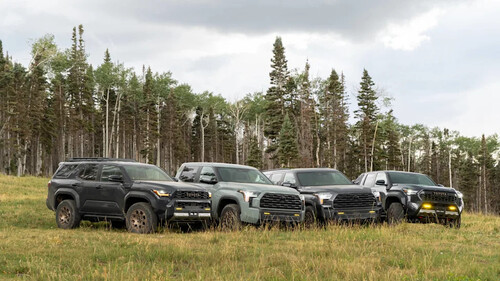
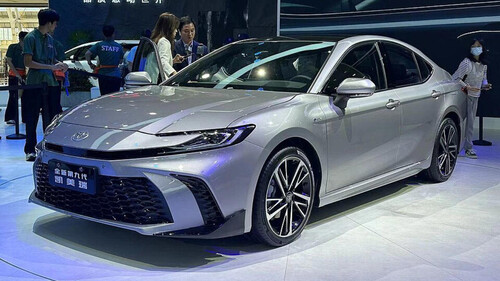
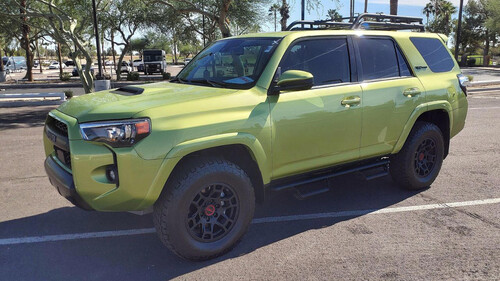
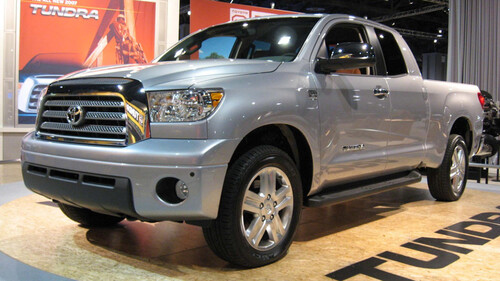
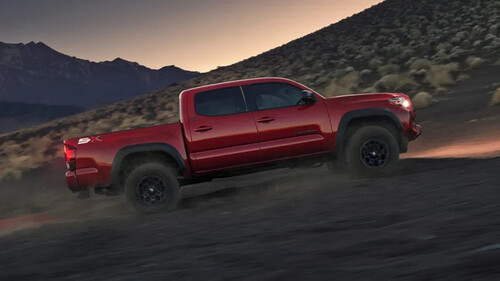
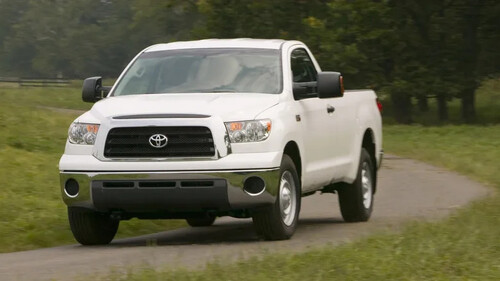
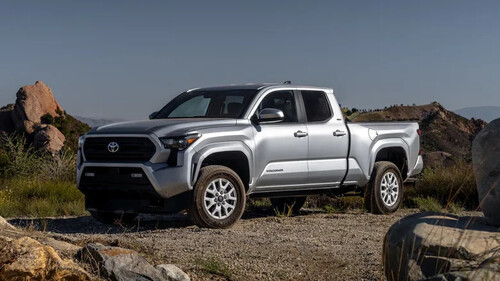
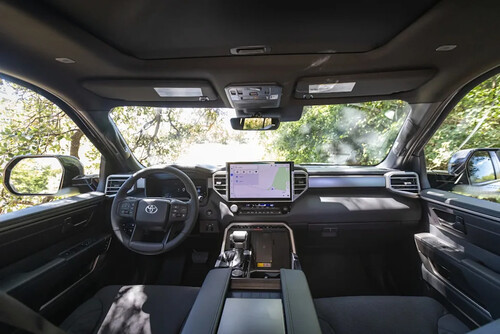
Toyota’s 4Runner and Tacoma get all the love these days. After decades of platform sharing and dynamic evolution, high-performance versions of the 4Runner and Tacoma are more mainstream than ever. But Toyota’s truly rowdiest off-road trucks are hidden in plain sight.
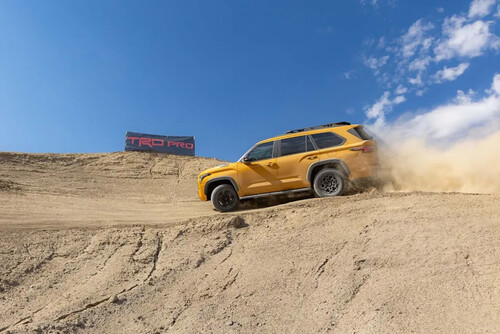
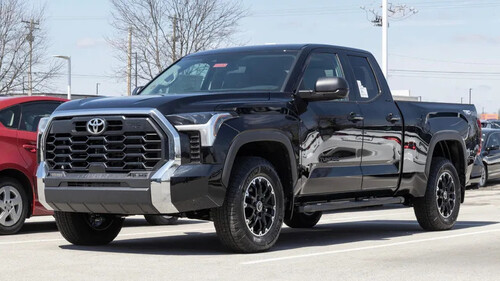
TRD Pro models represent Toyota’s brawniest off-road specimens, and the Tundra TRD Pro and Sequoia TRD Pro are simply bigger than others. Fitted with FOX QS3 adjustable valve shocks with a piggyback/remote reservoir, 18-inch forged BBS wheels, and available ISO-dynamic seats, the Tundra and Sequoia TRD Pro models are built with Baja in mind. To test this claim, Toyota gave me the chance to romp both TRD Pro models on a custom-built rally stage at Grand Junction Motor Speedway. It was a blast.
With 437 hp and 583 lb-ft of torque on tap from Toyota’s twin-turbocharged 3.4-liter V-6, launching the 5800-pound models was shockingly easy on a soft, sandy surface. After setting the transfer case in 4-High, the 10-speed automatic transmission (which we’ve previously complained about on Tundra and Sequoia Trailhunter models) generously held a lower gear ratio. Diving through a wavelike dip and approaching the first berm on the course, my right-seat instructor explained that maintaining exactly 25 mph was critical for front-end survival on these longer trucks.
I was coached to keep my foot steady, and the Tundra TRD Pro skimmed through the air before settling its 145.7-inch wheelbase into the silty course. The shorter Sequoia had a more willing kick over its first jump, but there were more opportunities to prove my own bravery. Tracking the truck’s front end through the following baby chicane required slightly more off-center steering input than I expected, likely a result of the standard 33-inch Falken WildPeak all-terrain tires. I couldn’t linger on the lack of bite for long, as the second berm called for at least 37 mph. Digging further into the throttle, the combination of immediate hybrid torque and spooling turbos often forced me to lift before takeoff to maintain the perfect velocity.
Launching at nearly 40 mph required a carefully desired downslope to catch the three-ton rigs, but neither the Tundra nor the Sequoia came down on their nose. The Sequoia regained its composure a second or two earlier than the Tundra, but the adjustable Fox shocks and stiffened ISO-dynamic seats shielded me from most of the impact. And the adolescent joy of jumping a massive truck was only the surface of the capability testing available on the rally stage.
The Highmark, a rising and then descending hairpin built on a significant slope, was by far the most daunting feature on the course. With a minimum clean speed of 25 mph, the uphill approach required careful throttle inputs, eliciting the 10-speed automatic transmission’s annoying shifting hesitations. If I climbed too slowly, I risked getting stuck. Approach too quickly, and I would run out of steering angle. Mastering the 180-degree turn necessitated a hair of maintenance throttle while turning the wheel to full lock each way in a matter of seconds. With a 122-inch wheelbase, the Sequoia bested each stage of the Highmark and kept my confidence intact, while the Tundra remained a handful run after run.
This rally stage wasn’t the kind you see at American Rally Association events. Instead of forested gravel lanes, the custom-built track blended Nitro Circus with Motocross, banked walls and all. And keeping my speed up required a motocross approach, riding the banked walls from turn to turn. By banking the rigs sideways, there was no need for constant steering-angle adjustment or tapping the brakes. Again, the stubby Sequoia was better able to take advantage of this geometric benefit, while the Tundra’s rear end struggled to keep up.
Double tabletop jumps were the crescendo of the stage. After winding through a coiled snake of turns, my co-driver asked for a rotation speed of 28 mph, a quick tap of the brakes, and then another launch into the air at 28 mph. The pre-takeoff checklist meant I didn’t really process the first jump, but a batch of giggles escaped after landing on the second fence. Even two extra miles per hour undid the careful calculation, painfully planting the front wheels and pushing both me and my co-driver up and out of our seats.
The final section of the stage was higher speed, allowing the Tundra to show off its natural habitat. The faster I went, the more compliant the full-size pickup became. A set of high-speed whoops rocked the bed of the Honeycomb-colored truck but left the cab undisturbed. Better yet, a 45-mph chicane illustrated the Tundra’s predictable rear-end rotation. A sharp stab of the wheel slowly became a pleasantly controllable slide. While the Sequoia understandably excelled in the more technical turns, the Tundra was prepared for high-speed hijinks.
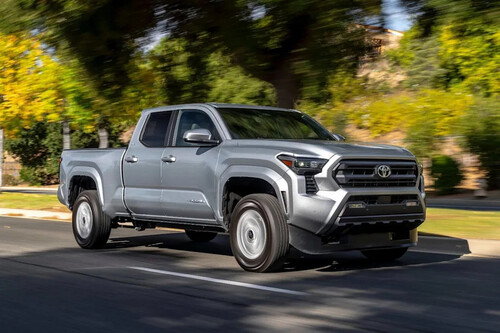
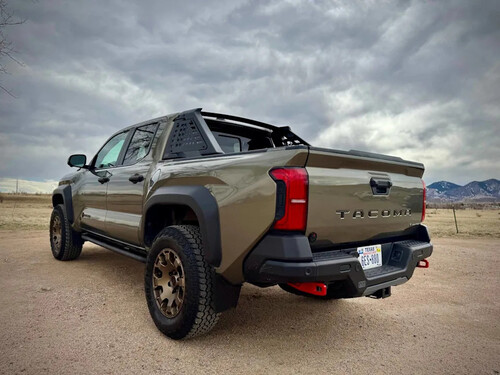
To round out my highly technical test, I took TRD Pro versions of the 4Runner and Tacoma on the very same course. Yes, the Tacoma turned in better than the Tundra. Of course, the 4Runner jumped significantly higher than the Sequoia. But neither model was leaps and bounds better than their big siblings. With sticker prices at or above $70,000 for all four models, the choice is less about capability and more about compatibility. Especially because each model shares suspension components, the right TRD Pro model may depend on how much space you need. If you really do need a third row of seating or a longer bed, the Sequoia and Tundra TRD Pro won’t let you down if you ever make it to Baja.