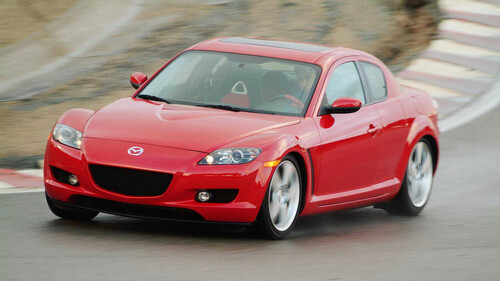
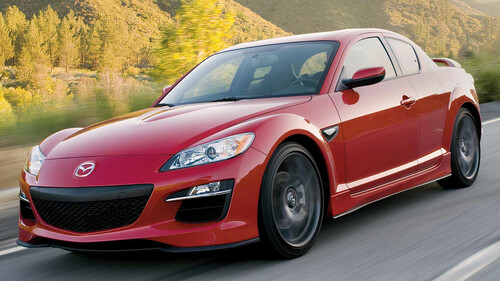
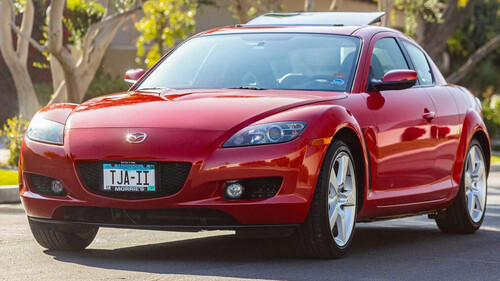
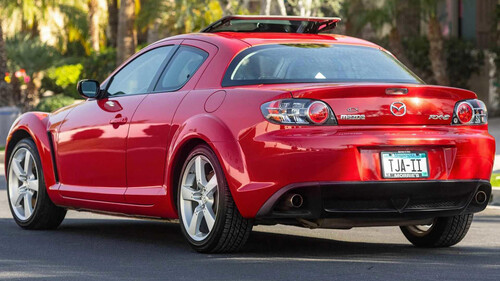
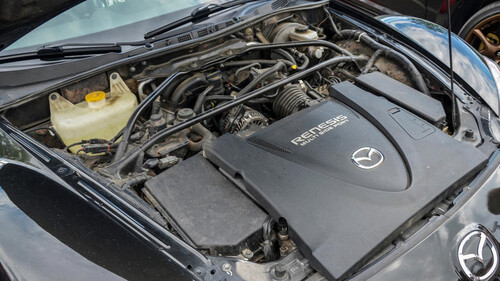
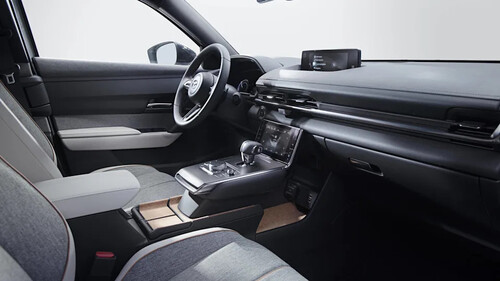
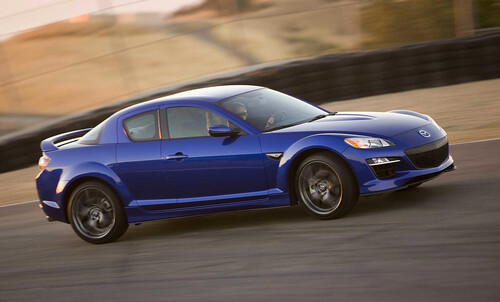
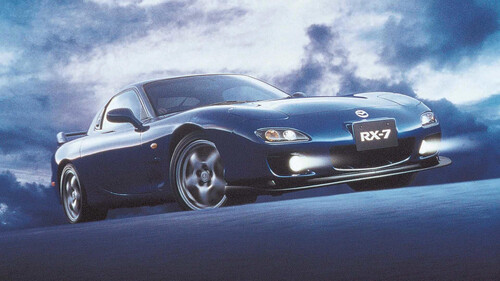
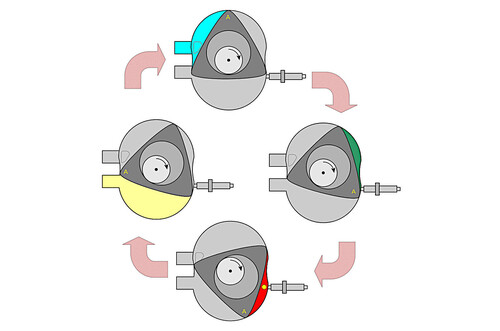
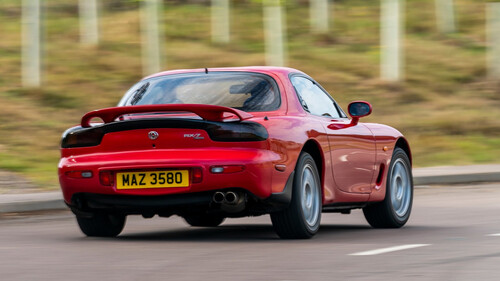
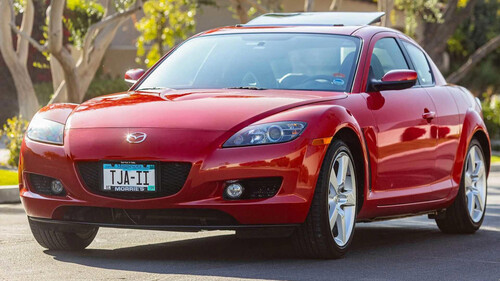
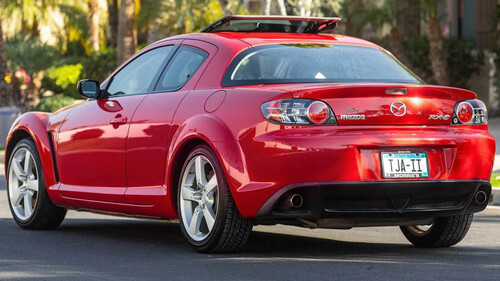
Autoblog and Yahoo may earn commission from links in this article.There's no shortage of oddball concept vehicles that put function over form and vice versa, few of those models ever head to production. Mazda has never been one to shy away from unique designs, whether in the form of bodystyle or powertrain, and there are several models that prove just that. Among them is the Mazda RX-8, a sports coupe that succeeded the legendary RX-7 and served as the hub for the industry's last rotary engine.Mazda USARotary versus conventional enginesMost automakers abandoned the rotary engine back in the 1970s, and the conventional engine that we know today became the standard. Both powerplants have their benefits and drawbacks, but the major differences come down to design, fuel efficiency, and emissions.MazdaRotary engines use a triangular rotor that spins in a circular motion to generate power. They lack valves, connecting rods, and camshafts, among other moving parts, allowing for smoother operation. Rotary engines are also compact and lightweight, resulting in a high power-to-weight ratio. On the flipside, they have higher emissions, lower fuel economy, and they burn oil by design. AdvertisementAdvertisementAs fuel efficiency and emissions standards became more stringent, conventional engines became the standard. They have better thermal efficiency, resulting in higher fuel economy and lower emissions. There's also fewer maintenance intervals to take into consideration. On the other hand, conventional engines typically require a larger displacement to match the power output of a rotary engine. The many moving parts cause more vibrations as well.Mazda USAWhile the Mazda RX-8 didn't manage to shed all of the rotary engine's problems, it did prove that some of the major issues were manageable. Not only that, but the Japanese automaker managed to deliver exciting driving dynamics in a lightweight sports coupe that could seat up to four passengers. If RX-7 may have put performance on a pedestal, then the RX-8 put balance at the forefront.Thinking about selling your car? Get an instant cash offer online now. Click here to get started.Balance over performanceWhen the Mazda RX-8 hit the market for the 2004 model year, it came stock with a 1.3-liter rotary engine that generated 197 to 238 horsepower when mated to automatic and manual gearboxes respectively. Models equipped with a manual transmission were capable of generating 159 lb-ft of torque, while automatics got bumped up to 164 lb-ft. Rather than load the rotary engine into a conventional chassis, Mazda designed every aspect of the sports coupe around the powertrain.MazdaThe compact engine's placement allowed for a short front overhang and low hood line that improved visibility. There was little weight hanging over either axle, a factor that allowed the sports coupe to rapidly change direction. The end result was a small car with a 50:50 weight distribution and engaging driving dynamics that few other vehicles could match.AdvertisementAdvertisementAs for the vehicle's performance, a high rev limit became a major draw for enthusiasts. The Renesis rotary engine featured a 9,000 RPM redline when paired with the manual gearbox. The automatic transmission dropped the redline to 7,500 RPM. A low center of gravity paired with the RX-8's small size and lightweight design created the perfect storm for a high-revving sports car.MazdaThe RX-8 featured coupe proportions and four usable seats. A lack of a fixed B-pillar and the rear-hinged half doors made accessing the second-row seats a breeze. In order to open the rear doors, however, you had to open the front doors first.Shopping for a new car? Click here to get a great deal on your next vehicle. Powered by Carvana, no haggle pricing, 100% online.Rotary engine's last hurrahIt's clear from a glance at the Mazda RX-8's performance specifications that it wouldn't be speeding past most of its sports car rivals, especially when accelerating in a straight line. Low-end torque was minimal, requiring drivers to maintain a high RPM to get meaningful acceleration. While Mazda did manage to improve the rotary engine's fuel economy, it still wasn't anything to write home about. Not only that, but it still burned oil by design. MazdaRegardless of its faults, the Mazda RX-8 and its rotary engine became a popular model among enthusiasts who valued driving dynamics over pure performance. The vehicle's 50:50 weight ratio and compact, lightweight engine paired with responsive steering made for a sports coupe that could carry its momentum through corners like few other vehicles on the road.Final thoughtsWhile the RX-8 was a direct replacement for the RX-7, it was largely considered a spiritual successor, if a successor at all. It lacked the twin-turbo powerplant that had made the RX-7 a gem among the sports car segment. Instead, the RX-8 served as a step towards practicality while maintaining sporty driving dynamics.WieckIn 2012, Mazda discontinued the RX-8 globally due to the sports coupe's inability to meet stringent fuel economy and emissions requirements. The rotary engine went with it, effectively making the design extinct. While there's not likely to be another Mazda sports car powered by a rotary engine, the RX-8 serves as a shining example of a time when automakers weren't afraid to shun convention in favor of uniqueness.AdvertisementAdvertisementNotably, Mazda still has a rotary engine in production, but not for the reasons you might expect. The MX-30 e-Skyactiv R-EV utilizes a rotary engine as a generator to power an electric motor and extend the crossover's range. That model is currently available in Europe and Japan, but it won't be coming to the United States, as Mazda killed off the MX-30 after just two years on the market.Disclaimer: Autoblog aims to feature only the best products and services. If you buy something via one of our links, we may earn a commission.This story was originally published by Autoblog on Jul 23, 2026, where it first appeared in the Features section. Add Autoblog as a Preferred Source by clicking here.