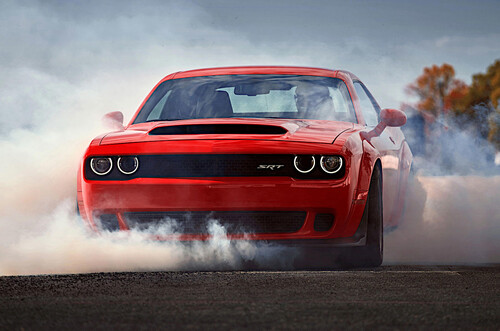
10 Coolest Cars That Nobody Bought: Cult Classics ryan lugo - MotorTrendThe automotive marketplace likes to think it's a meritocracy, but history suggests otherwise. Despite compelling designs, innovative engineering, or genuinely unique personalities, the vehicles on this list failed to move in the volumes their creators expected. Some showed up before the public knew what to do with them. Others suffered from bad timing, confusing branding, questionable pricing, or the unfortunate reality that mainstream buyers don't always want the same things car enthusiasts do.But while they may have been overlooked when new, many have gained the recognition they deserved in hindsight. And in some cases, the industry eventually circled back to ideas these vehicles had already explored. These are the sales-floor underachievers that deserved better. Here are the 10 coolest cars that no one bought.1) Isuzu VehicrossPhoto credit: IsuzuWhen it landed in U.S. showrooms just before the turn of the century, the Isuzu Vehicross looked like nothing else on—or off—the road. But there was substance behind this two-door compact SUV's futuristic looks.AdvertisementAdvertisementBody-on-frame construction, short overhangs, a locking differential, and an advanced (for its time) four-wheel-drive system that used a dozen independent sensors to detect wheelspin and redirect power to the wheels with the most grip made the Isuzu Vehicross a seriously capable off-roader. But it was also expensive, and its diminutive proportions translated to a cramped cabin. Fewer than 6,000 were built between its Japanese debut in 1997 and the end of production in 2001.2) Mazdaspeed 6Photo credit: MotorTrendDesigned to go up against Europe's entry-level sport sedans, the Mazdaspeed 6 boasted a unique 2.3-liter turbocharged four-cylinder engine that sent 274 horsepower to all four corners through a six-speed manual transmission and a torque-splitting all-wheel-drive system, while the chassis benefited from enhanced torsional rigidity, upgraded brakes, and a sport-tuned suspension.It was touted as the best-handling and quickest sport sedan Mazda had produced to date when it arrived for the 2006 model year. But despite visual enhancements like a more aggressive front fascia, side skirts, and a rear diffuser, for most folks it was tough to tell the Mazdaspeed 6 apart from a garden-variety Mazda 6. Those who were cross-shopping BMWs and Audis dismissed it, while folks looking for something like a Subaru WRX STI largely ignored it.As a result, the Mazdaspeed 6 lasted just two years before Mazda discontinued it. Its performance credentials were never in doubt, though, and it has since earned a reputation as a legitimate sleeper sedan.3) Subaru SVXPhoto credit: MotorTrendOn paper the SVX was Subaru punching well above its weight class: a smooth, high-speed grand tourer designed by Giorgetto Giugiaro, powered by a 3.3-liter flat-six, and aimed at buyers who might otherwise look at Japanese luxury coupes or entry-level European GTs. But the SVX also faced an uphill battle right out of the gate. It was expensive for a Subaru, not particularly sporty, and also not very practical.AdvertisementAdvertisementStill, design elements that once looked eccentric—such as the cyberpunkesque bodywork and the "window within a window" door glass—now read as bold and kind of exotic. Although the SVX was only produced for a single generation between 1991 and 1996, it offers a glimpse into a what-if scenario where Subaru continued to hone this grand tourer into a distinctive and compelling alternative to the usual suspects from Europe.4) DMC DeLoreanPhoto credit: Bring a TrailerThe DeLorean is one of those cars where the story matters almost as much as the vehicle itself. In purely commercial terms, it was a mess. In cultural terms, it became immortal.The DeLorean was supposed to be a futuristic sports car built in Northern Ireland under the leadership of John DeLorean, a former designer for General Motors who helped establish the template for muscle cars as we know them today with the introduction of the first Pontiac GTO. But starting a car company is pretty tough, as it turns out. While the DMC DeLorean's design made it a bona fide head-turner, its performance didn't match the image, and there were serious build quality issues when production started in 1981. The timing didn't help, either, as the economic recession of the early '80s was in direct conflict with the car's premium pricing.There are, of course, other issues that have been the subject of numerous books and movies in the years since, but suffice to say that the DMC DeLorean was a deeply compromised car right from the get-go. Under different circumstances, it might have been relegated to a forgotten chapter of automotive history, but the car's starring role in the 1985 film Back to the Future propelled the stainless-steel-bodied coupe into the collective consciousness. DMC built roughly 9,000 examples of the DeLorean between 1981 and 1983 before the automaker imploded, but it has since found new life in the restomod scene.5) BMW Z3 M CoupePhoto credit: MotorTrendBMW never intended for the Z3 M Coupe to be a high-volume seller, and its styling basically ensured that. Affectionately known as the Clown Shoe, its premium pricing already confined it to a niche audience, while the concept of a shooting-brake-style two-seater was utterly foreign to most enthusiasts. Buyers in that price range could step into more conventional M3 territory and feel like they made a rational decision instead of a stylistic gamble.AdvertisementAdvertisementAs a result, sales of the Z3 M Coupe were modest, especially when compared to BMW's traditional M models. But its performance credentials were never in question, and time has helped reframe the Z3 M Coupe's oddness into a virtue.6) Dodge Magnum SRT-8Photo credit: DodgeSharing its mechanical underpinnings with the hot-rodded Charger sedan, Dodge's SRT-infused wagon blended style, utility, and performance in a way few other American cars ever have. Yet despite the aggressive bodywork, performance-tuned chassis, and 425-hp 6.1-liter V-8 under the hood, the Magnum SRT-8 struggled to connect with enthusiasts during its brief time in production.Dodge was already going out on a limb by attempting to revive the station wagon in general, and although those who understood it immediately recognized the Magnum SRT-8's undeniable cool factor, there just weren't enough of them willing to sign on the dotted line. The SRT-8 model was produced from 2006 to 2008, when the entire Magnum lineup was put out to pasture.2008 models are particularly notable not only for their single-year refresh (pictured above), but also because Dodge built less than 250 examples of the Magnum SRT-8 in total that year, which technically makes them rarer than the Ferrari Enzo.7) Acura NSX (NC1)Photo credit: AcuraOne of the most hotly anticipated performance cars in recent memory, the revival of the NSX nameplate certainly wasn't lacking an audience, but it was such a departure from the original's design ethos that Acura had a tough time convincing enthusiasts to give it a shot.AdvertisementAdvertisementIts aluminum space frame, double-wishbone suspension with magnetorheological dampers, and mid-mounted, twin-turbocharged V-6 gave the second-generation NSX legitimate supercar credentials, but its hybrid system added complexity without really enhancing the overall experience. And considering the highly analog nature of the original NSX, the new car wasn't pushing the same buttons for enthusiasts, while its pricing put it in direct competition with the likes of the Porsche 911 Turbo and the Audi R8 V10.Although its sales never reached the volumes that Acura had hoped for, the second-generation NSX is still a stunningly capable car that showcases a lot of impressive engineering. It may not have been the NSX that some enthusiasts were hoping for, but it's still a monster performer in its own right.8) Pontiac G8 GXPPhoto credit: PontiacThe G8 GXP was ultimately a story of the right car at just the wrong time. Essentially a re-rebadged version of the Holden Commodore SS sold in Australia, the rear-drive GXP was outfitted with a performance-tuned chassis as well as a 415-hp V-8 that could be optionally paired with a six-speed manual transmission. We likened the Pontiac G8 GXP to an American BMW M5 in our first test.Unfortunately, the car was launched during the throes of the 2008 financial crisis, when General Motors was struggling to keep the lights on. Produced for a single model year, the 2009 G8 GXP shuffled off this mortal coil alongside the rest of the G8 lineup and the Pontiac brand itself. Only about 1,800 examples of the G8 GXP were built before GM pulled the plug.AdvertisementAdvertisementIt's important to keep in mind that the car's limited production really has more to do with the struggles of its parent company than the desirability of the car itself. Low-mileage examples regularly trade hands at or above the car's original MSRP on the secondhand market, especially when they're equipped with three pedals.9) Cadillac CTS-V WagonPhoto credit: CadillacDodge may have gone out on a limb with the Magnum SRT-8, but Cadillac went several steps further in that direction with the CTS-V Wagon. Outfitted with Nürburgring-developed chassis tuning and a 556-hp supercharged V-8 that could be optionally paired with a six-speed manual gearbox, we deemed the CTS-V Wagon one of the greatest sleeper hot rods of all time at the conclusion of our long-term test back in 2011.The CTS-V Wagon was always going to be a niche product, and Cadillac was well aware of that. But it still hurt to see this long-roof missile ride off into the sunset after fewer than 1,800 were built during its four-year production run. While we've gotten some seriously awesome fast wagons in the years since, none of them have offered the holy grail combination of supercharged V-8 grunt, track-tuned RWD dynamics, and the ability to row your own gears. This one's a true future classic.10) Volkswagen PhaetonPhoto credit: MotorTrendThe Phaeton began as a personal challenge from Volkswagen chairman Ferdinand Piëch, who wanted the automaker to build a luxury sedan capable of matching or surpassing the best offerings from around the world—particularly those from its fellow German automakers. Engineers were essentially given a blank check to make it happen, and the result was a technological tour de force.AdvertisementAdvertisementUnlike typical VWs, the Phaeton rode on a vehicle architecture shared with the Bentley Flying Spur and came packing a W-12 engine, air suspension, and a level of craftsmanship that rivaled flagship luxury sedans from established premium brands. But it was also priced like a premium luxury sedan despite wearing a Volkswagen badge and looking like an oversized Passat, making it a tough sell against rivals like the Mercedes-Benz S-Class and BMW 7 Series.Compound that with an American dealer network that wasn't equipped to sell or service a six-figure flagship luxury sedan, and it's not hard to see why the Phaeton lasted just three model years before Volkswagen withdrew it from the U.S. market.It did fare better in other parts of the world, though. While the Volkswagen Phaeton was only sold in America from 2004 to 2006, its production life spanned from 2002 to 2016 thanks to stronger interest in markets like China and South Korea. U.S. sales failed to exceed 2,500 units during the aforementioned three-year period, but Volkswagen ended up producing more than 84,000 Phaetons throughout the car's 15-year run.