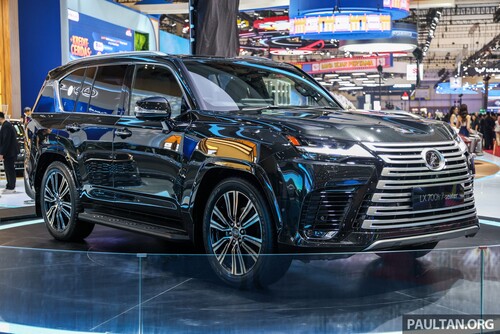
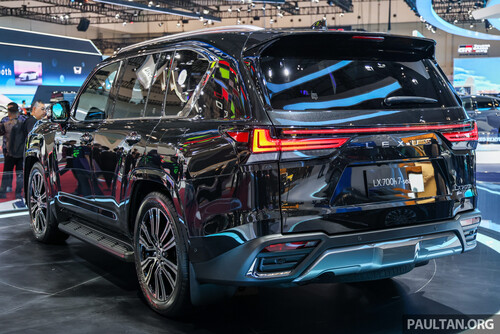
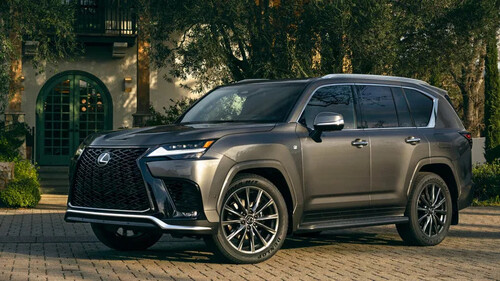
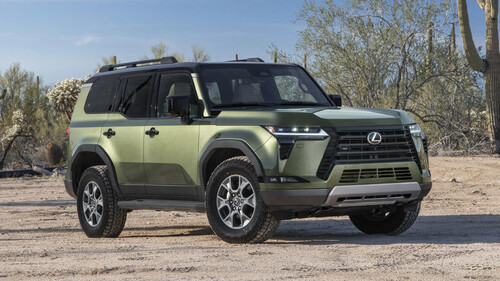
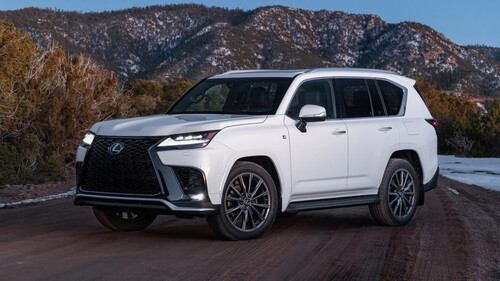
The Lexus LX 700h Overtrail Might Be the Best Stock Overlanding Vehicle You Can BuyOff-Road.comEvan DeMarcoWed, September 23, 2026 at 5:00 PM UTCAdd us on GoogleBeige Lexus LX 700h Overtrail and gray Lexus GX 550 Overtrail parked side by side on a rocky mountain overlook in Colorado.The Lexus LX 700h Overtrail Might Be the Best Stock Overlanding Vehicle You Can BuyI drove the Lexus LX 700h Overtrail up Colorado's Imogene Pass and the GX 550 back down. Five minutes into the descent, I was already missing the LX. That wasn't supposed to happen.Somewhere above 12,000 feet, with Telluride disappearing behind us and some seriously steep drop-offs sitting just outside my window, I had a fairly ridiculous realization: Janna Breslinand I were wheeling a $120,000 Lexus 700h Overtrail, and the Lexus seemed considerably less concerned about it than I was. It wasn't heavily modified. It wasn't on 37s. There were no portal axles, aftermarket bumpers, or suspension parts hiding underneath it. It had essentially come straight off the lot, unless you count the bag of nuts and beef jerky the guys from OLT 4x4 had thoughtfully left in the back seat. Yet here I was climbing Imogene Pass in an LX 700h Overtrail, cycling through lockers, Crawl Control, Multi-Terrain Select, Turn Assist, and Active Height Control while the truck quietly went about its business as though this were exactly what it had been built to do. After roughly two and a half hours climbing one of Colorado's most iconic mountain roads, I started asking a question I hadn't expected to be asking: Is the LX 700h Overtrail the best stock overlanding vehicle you can buy today?[caption id="attachment_77975" align="aligncenter" width="1536"]Lexus LX 700h Overtrail on a rocky section of Imogene Pass in ColoradoThe Lexus LX 700h Overtrail tackles rocky terrain high on Imogene Pass in Colorado[/caption] By the end of the trip, I thought the answer might be yes.Imogene Is the Right Kind of TestWe left Telluride and headed east toward Ouray over Imogene Pass, topping out at 13,114 feet. Imogene is not a serious rock-crawling trail, but according to the sign at the beginning of the trail, it does require a high-clearance 4x4 and is not for novice drivers. There are steep grades, loose rock, narrow shelf roads, and, with heavy rain over the previous couple of days, some spots that had me concerned I forgot to make a life insurance payment. Visit Telluride describes it as a rugged 4x4 road. Visit Ouray rates it a Class 4 out of 5 for difficulty and danger. But Imogene isn't the Rubicon Trail. You're not spending the day dragging differentials across boulders while your friend stands outside yelling, "Passenger! Passenger! No, your OTHER passenger, dummy!" It's a mountain route, and that distinction matters. Most of the other vehicles we encountered seemed to fall into one of two camps: heavily modified Jeeps or Toyotas, and side-by-sides. Bigger tires. Armor. Lifts. Vehicles whose intentions were obvious before the first tire ever touched dirt. Then there was our convoy of stock Lexuses. (For the record, there was a heated debate on the proper vernacular for the plural of Lexus. I think "flock of Lexi" deserves the win, but I will unfortunately have to defer to the Lexus marketing department for final approval.) Among the Jeeps and Toyotas, the Polaris and Honda side-by-sides, the absurdity wasn't lost on me. Our convoy was easily worth a couple million bucks, or half an apartment in California. Partway up, we stopped at Tomboy, the ruins of an old mining settlement sitting roughly 3,000 feet above Telluride in Savage Basin. Calling it a "camp" undersells the place. The Tomboy Mine began producing significant gold ore in the late 1800s. At its peak, hundreds of people lived at roughly 11,500 feet. There was a school, a store, stables, miners' cabins, and even a YMCA with a bowling alley and tennis courts. The mine finally closed in 1927. [caption id="attachment_77983" align="aligncenter" width="1535"]Lexus LX and GX Overtrail SUVs lined up on rocky terrain near Imogene Pass in ColoradoA lineup of Lexus LX and GX Overtrail models during an off-road drive in the San Juan Mountains near Imogene Pass.[/caption] More than a century before anyone had Crawl Control, heated seats, or a 2,400-watt inverter, people were living year-round up there and moving workers, equipment, and gold across essentially the same terrain. I could barely breathe in the thin air, let alone go bowling. Hey, I take my bowling seriously. My time there made me realize how tough people used to be. It's hard to feel tough when you're seeing all of this from heated leather seats. While walking around Tomboy, I talked with a few side-by-side drivers coming the other direction. One of them made a point that stuck with me. Imogene wasn't really about beating some impossible obstacle. It was about the drive. The scenery. The history. The crossing itself. Maybe that's why Lexus brought us there. That conversation helped clarify what I was actually trying to judge. Not the best rock crawler. The best overlanding vehicle. Those are two very different assignments. Rock crawling asks how hard a vehicle can fight terrain. Overlanding asks how well it can live with terrain, distance, people, gear, and everything that happens before and after the trail. One is more about the journey, and one is more about the destination. That contrast would become increasingly important as the day went on.What Lexus Actually BuiltThis is where the LX gets interesting. The Lexus LX 700h Overtrailcombines a twin-turbocharged 3.4-liter V6 with Lexus' parallel hybrid system and a 10-speed automatic, producing 457 horsepower and 583 lb-ft of torque. The hybrid system matters because Lexus didn't abandon the mechanical architecture that makes the LX useful off-road. The electric motor sits between the engine and transmission, allowing Lexus to retain the conventional full-time four-wheel-drive system, low-range transfer case, and torque-converter automatic. The electric motor can also contribute power in low range, where precise throttle control actually matters. Then you start going through the rest of the hardware. Active Height Control. Adaptive Variable Suspension. Multi-Terrain Select. Crawl Control. Turn Assist. 33-inch all-terrain tires. A 2,400-watt inverter. And front, center, and rear locking differentials. That last part deserves some attention. Toyota offered optional front and rear lockers on the U.S.-market 80 Series Land Cruiser beginning in the 1990s. When the 100 Series arrived, the factory front locker disappeared. The Toyota community has been screaming to get it back ever since. The LX 700h Overtrail effectively brings that factory triple-locker formula back to Toyota's full-size U.S. Land Cruiser family after nearly three decades. More importantly, these weren't features I was reading about in a hotel room. I got to use them. At one especially tight switchback, the GX in front of me needed a three-point turn. I engaged Turn Assist in the LX and drove around it in one shot. Turn Assist works with Crawl Control by applying braking force to the inside rear wheel, tightening the vehicle's turning radius. It sounds mildly gimmicky when someone explains it during a product presentation. It feels considerably less gimmicky when you're trying to turn a full-size luxury SUV around a switchback with a substantial amount of mountain missing from one side of the road. One of the most interesting pieces of engineering underneath the LX is also one of the easiest to misunderstand: Active Height Control is not an air suspension. Most adjustable-height SUVs use air springs, essentially inflatable bladders that raise and lower the vehicle by changing pressure. The LX takes a very different approach, combining conventional metal springs with gas and hydraulic springs, shock absorbers, and a hydraulic control system. More importantly, Lexus says AHC can make ride-height adjustments at each individual wheel, increasing wheel articulation as the terrain changes. One of the Lexus engineers explained it to me in much simpler terms: the system can effectively move hydraulic pressure where the chassis needs it, allowing a wheel to drop farther into a depression or rise over an obstacle while helping the tire maintain better contact with the terrain instead of simply rolling the body onto the outside edge of the tire. That difference became obvious after switching directly from the LX into the GX. The GX is extremely capable, but the LX feels almost unnaturally flat and composed over uneven ground, with the suspension doing work underneath you that would normally translate into far more body movement. Lexus also says the integrated front-and-rear AHC system can react to steering inputs to reduce body roll, while AVS continuously adjusts damping to the road surface. The result is a vehicle that can gain clearance and articulation on the trail, then lower itself and tighten up again on pavement without forcing the owner to live with the normal compromises of a permanently lifted suspension. Most of the LX's luxury off-road competitors solve adjustable ride height with air. Range Rover and Defender rely heavily on electronically controlled air springs, while the latest Defender OCTA adds hydraulically interconnected dampers to that air-suspension architecture. Mercedes takes another route in the G-Class, using conventional springs with adaptive damping and hydraulic roll-control hardware. The LX's AHC system is different again, using hydraulic pressure and individual-wheel height control as part of the suspension itself. That helps explain why it feels so different over broken terrain: the system isn't merely lifting or lowering the body, it is actively managing how each corner of the vehicle interacts with the trail. If and when this kind of hydraulic suspension architecture becomes broadly available outside the Toyota/Lexus ecosystem, I can imagine nearly every serious premium off-road vehicle moving toward some version of it. Once you've driven a truck that can reshape its suspension around the terrain, a fixed lift starts to feel surprisingly primitive. And because of this, as well as many other things, somewhere on the climb, my perception of the LX flipped. I stopped thinking of it as a luxury SUV that happened to be capable off-road and started thinking of it as a serious off-road platform that happens to have extremely luxurious aspects built into the platform, including cooled seats. By the way, if the person or persons who invented cooled seats haven't been nominated for a Nobel Prize, I'm officially logging a complaint as soon as I'm done with this article.Where Lexus Still Gets It WrongAfter a quick break at Tomboy, during which I had to pee six times thanks to something called altitude diuresis, I was ready to hop back into my borrowed LX and continue the journey toward Ouray. At this point, it was safe to say I was a fan of the LX, but maybe not quite ready to start writing love letters to Lexus. There are things I don't like. First, the front end. It screams soccer mom. Look at the image below, which shows the GX and LX together at Tomboy, and tell me you don't immediately see the LX parked at the local soccer park, a cooler full of orange slices and Capri Suns in the back. [caption id="attachment_77953" align="aligncenter" width="1536"]Beige Lexus LX 700h Overtrail and gray Lexus GX 550 Overtrail parked side by side on a rocky mountain overlook in Colorado.Lexus LX 700h Overtrail and GX 550 Overtrail on Imogene Pass in Colorado, showing the very different design personalities of Lexus' two off-road-focused SUVs.[/caption] The GX immediately says, "Saddle up, we ride," while the LX says, "Honey, did you forget your Crocs?" For a vehicle with this much legitimate hardware underneath it, I get the feeling the designers at Lexus were trying to make it less intimidating and more commercially acceptable. To combat this, companies like Dissent Off-Road have done some impressive cosmetic surgery to the LX. By trimming the fascia, adding a proper high-clearance bumper, portals, and 37s, the LX went from Pierce Brosnan's James Bond to Daniel Craig's. It goes from "I'll meet you at Nordstrom" to "don't F with me." The capability was always there. You just couldn't see it. The interior has a few quirks as well. The GX gets a clean, integrated 14-inch infotainment display. The LX uses a 12.3-inch upper display and a separate 7-inch lower screen for climate and vehicle functions. I asked Lexus about the decision and was told part of the engineering rationale involved maintaining optimal HVAC performance, particularly in the hotter markets where the LX has historically had a substantial customer base. That makes sense. Anyone who has sat inside a vehicle with terrible air conditioning when it's 110 degrees outside knows climate control stops feeling like a luxury feature pretty damn quickly. But as an interface, I still prefer the GX. The locker controls are another miss. They sit partially hidden behind the steering wheel and took me a moment to find. Once I knew where they were, they were still more awkward to use on the trail than I would like. They could have easily been placed next to the gear shifter, which would have been more intuitive. Then there's the shifter itself, which feels like Lexus decided the conventional gear selector had enjoyed far too many years without being reinvented. None of these are deal breakers. They're annoyances. I've driven vehicles with actual performance problems and engineering shortcomings that would keep them out of my driveway. The LX doesn't have that kind of problem. It has the kind of problems you complain about after realizing how little else there is to complain about. It's the equivalent of saying the towel animal at your luxury five-star resort didn't quite look like an elephant. Our brains, especially in this world, are geared (yes, that was an automotive pun and a dad joke wrapped up in one) to look at problems.You Can Build a Monster. But Should You?From Tomboy, we had another 45 minutes to the summit and lunch. Along the way, I started thinking about an upcoming trip to Moab and wondering if the LX could become a serious rock crawler. Absolutely. The drivetrain isn't the issue. You already have low range, three lockers, precise hybrid torque delivery, and a chassis derived from the Land Cruiser 300. The obvious limitations are tires, clearance, bodywork, and approach and departure angles. Then the aftermarket gets involved. 74Weld offers portal axles for the LX 700h that add nearly four inches of lift at the hub, add gear reduction, and create room for much larger tires. Dissent has already built an Lexus LX 700h Overtrail using portals and 37-inch Nittos while retaining the factory Active Height Control system. So yes, you can build one. The more interesting question is whether you should. Portals alone cost about $17,000. Add high-clearance bumpers, sliders, skid plates, wheels, 37s, recovery equipment, lighting, and labor, and your six-figure Lexus starts wandering into a financial neighborhood normally occupied by exotic cars and girls named Tiffany (see Hot/Crazy Matrix for reference). Would it be spectacular? Heck yeah. The Dissent build is beyond incredible. Would I spend close to $200,000 building a luxury Land Cruiser and then repeatedly smash it against rocks? That is a different question, one I should probably ask my therapist, accountant, and insurance agent, in that order. And it brings us back to the thing I think enthusiasts occasionally get wrong when talking about overlanding. A rock crawler has a relatively focused job. Clear the obstacle. Ground clearance, articulation, tire size, gearing, lockers, protection, and approach angles rule the conversation. Overlanding has to solve a bigger equation. The vehicle still has to cross difficult terrain, but it also has to carry people and gear. It may have to tow. It needs useful range and power. It has to spend long hours on pavement and still leave the driver capable of forming complete sentences at the end of the day. One is about the journey, and one is more about the destination. That's a real philosophical difference that drives (that's another pun and dad joke. One more and I get a set of steak knives) different buying behavior in the vehicle market. For overlanding, the vehicle gets you to the trailhead and then to the end, where camp is. And that's where the LX becomes extremely difficult to dismiss.The Highway Is Where the Equation ChangesA good friend of mine has a technical term for vehicles that ride exceptionally well: "It's like butter." On pavement, Active Height Control, Adaptive Variable Suspension, the hybrid powertrain, and the driver-assistance systems turn the LX into an absurdly comfortable long-distance vehicle. And 583 lb-ft of torque is not decorative. At one point, I was stuck behind a slower vehicle on a two-lane highway. The passing lane opened, I put the LX into Sport S and went around. The truck didn't gradually gather momentum. It left the Subaru Outback way back. For something this large and luxurious, the acceleration is two parts awesome and two parts, "Yes, Your Honor, I know this is the third time this month you've seen me." And that brings us back to the journey-or-destination conversation. A purpose-built crawler can outperform a stock LX on the right obstacle. I'd still rather drive the Lexus 500 miles to that obstacle. And I'd definitely rather drive it 500 miles home.Then I Got Into the GXAt the top of Imogene Pass, our trail guides, Jackson and Kurt from OLT 4x4, had lunch prepared. The views and the food were incredible. Of course, adding another 2,000 feet in elevation exacerbated the bladder issue to the point that I spent more time looking for a tree above the tree line than actually chatting with the really cool people on the trip. Regardless of my number-one problem (set of steak knives in the bag), I was starting to think the LX might actually deserve the title I'd been considering all morning: best overlanding vehicle on the market.AdvertisementAdvertisementThen we switched vehicles. I climbed into the GX 550 for the descent into Ouray. The GX, as I mentioned before, is a good-looking vehicle. It quietly inspires confidence with body lines that let you know it was made to be on a trail. You get in and the buttons are where they are supposed to be. The gear shifter is elegantly simple. The big screen easily showed my OnX map and the latest Craig Alanson e-book I was listening to. I was stoked to be proven wrong about the LX. Five minutes later, I wanted the LX back. That is not because the GX is bad. Far from it. The GX is excellent. There's a popular criticism that the GX is essentially a Land Cruiser 250wearing Lexus lipstick. That's funny and also very lazy. Yes, they share Toyota's GA-F architecture, but the GX gets a twin-turbocharged 3.4-liter V6 producing 349 horsepower and 479 lb-ft instead of the Land Cruiser's 2.4-liter four-cylinder hybrid. The GX Overtrail also gets E-KDSS, which can independently lock and unlock the front and rear stabilizer bars to balance body control and articulation. The GX already looks like it belongs on the trail. The LX is the older brother who got divorced, went to the gym, ate his protein, started injecting peptides, and came back looking like he had something to prove. Same bloodline, but suddenly the soft-spoken luxury guy is the one everyone is watching. His social calendar is full, and his ex-wife is regretting her decision, especially since she moved on to something not as robust. So, let's break it down. There are several things I genuinely prefer about the GX. The exterior design is better. The dashboard is better. The single 14-inch screen is better. The button location is better. If I were choosing between the two in a parking lot, based entirely on appearance, I'd probably take the GX. But we weren't standing in a parking lot. We had just driven both vehicles across the same mountain on the same day. And that, my friends, changed everything. At the end of the day, I asked every one of the journalists and influencers on the trip which vehicle they preferred, and the unanimous answer was the GX, making me a stranger in a strange land. For overlanding, the goal is simple: go out there, find a place that is yours, enjoy the heck out of your time there, and get back home. While rock crawling might be about the journey more than the destination, for overlanding, that journey should still be one of enjoyment. The LX makes that journey, and thus the destination, way more enjoyable. It has more power and torque, adds a front locker the GX doesn't offer, brings Active Height Control, and isolates the driver from the road and trail in a way the GX simply doesn't. It feels more effortless. And at the most basic level, it has more room to put stuff in the back, an essential requirement of any good overlanding vehicle. The price difference is not small. The 2026 GX Overtrail starts at $74,680, while the Overtrail+ starts at $82,145. The Lexus LX 700h Overtrail starts at $116,785. That puts roughly $35,000 to $42,000 between them. But at that price, the LX arguably isn't competing with its younger brother anymore. It walked right onto the playground, kicked the Range Rover and G-Wagen in the nuts, and said, "This is my playground now." Those vehicles bring their own strengths, and people can argue until closing time about styling, luxury, and prestige. But if the question is which one gives me the combination of factory off-road hardware, long-distance comfort, and genuine trail capability I actually want for overlanding, the LX makes a very difficult case to beat. Underneath all the leather and electronics, it remains the American doorway into Toyota's Land Cruiser 300 platform, which was rated by ChatGPT (so you know it's true) as the best stock overlanding vehicle, right above the INEOS Grenadier Trailmaster.The Question Lexus Couldn't AnswerAfter two days with Lexus, I left Colorado convinced the LX 700h Overtrail belongs near the top of any conversation about stock overlanding vehicles. But driving to the airport, I kept coming back to another question. Will they ever see the dirt?Lexus told us that more than 2,300 LX Overtrails had already been sold in 2026. That number surprised me, as my original estimate was around 500, mainly because people had told me they couldn't get them. But selling them isn't really the interesting part. The G-Wagen is extraordinarily capable. So is a Range Rover. Yet the natural habitat of an awful lot of them seems to exist somewhere between the Pilates studio and Whole Foods. Case in point: I've never actually seen either one of those vehicles on a trail. But head to a semi-annual sale at Lululemon and it's Rovers and G-Wagens as far as the eye can see. Will the LX suffer the same fate? Will it become another status symbol for the Real Housewives of Hoboken, who think triple-locked means a better security system? Or will owners eventually realize what Lexus actually built and start taking these things outside? I hope it's the latter. I drove one from Telluride over Imogene Pass, past the ruins of a 19th-century gold mine, using technology that would have looked like witchcraft to the people who originally traveled that road. [caption id="attachment_77977" align="aligncenter" width="4032"]Group of drivers and media with Lexus SUVs at the summit of Imogene Pass in ColoradoOur group at the 13,114-foot summit of Imogene Pass in Colorado with the Lexus LX and GX test vehicles.[/caption] Then I switched directly into one of the most capable SUVs Lexus has ever built. And I wanted the LX back. That's what ultimately convinced me. The Lexus LX 700h Overtrail isn't remarkable because it's the best rock crawler in the world. It isn't. It's remarkable because it doesn't need to be. It can cross serious terrain straight from the dealership and, when the dirt ends, settle onto the highway and take you home with a level of comfort most purpose-built rigs couldn't replicate with another $50,000 thrown at them. That's overlanding. And somewhere above 12,000 feet in Colorado, one thing became painfully obvious: An LX 700h Overtrail sitting in a mall parking lot isn't a luxury SUV. It's unrealized potential.