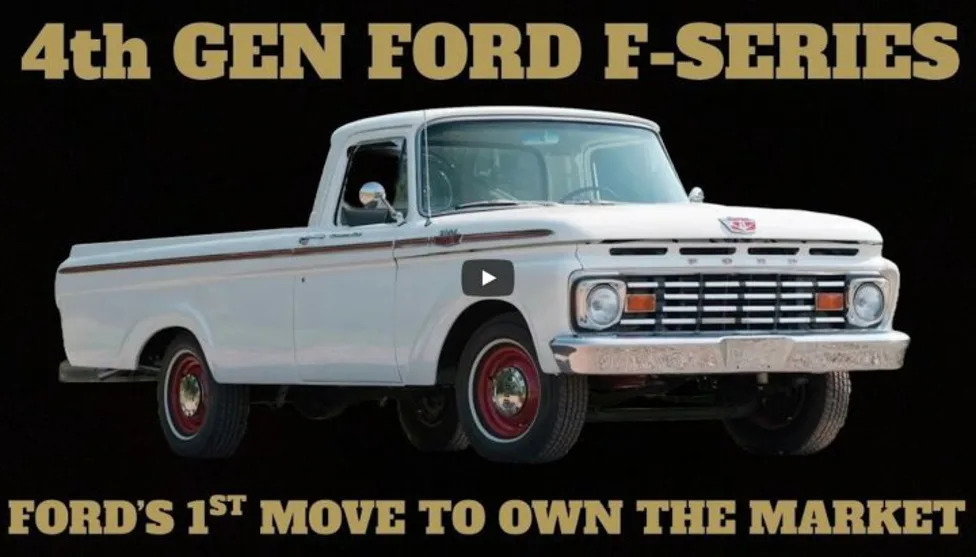



















the 4th gen f series trucks ford marches to leadershipThe Fourth Generation F-series Truck built from 1961 to 1966 would bring several changes to the F-series lineup. Once again Ford was trying to lead the way in the pickup segment. A couple of these changes would be long lasting and one big one wouldn't survive this generation. We will cover those changes in this look at the 4th generation Ford F-Series.The TTAC Creators Series tells stories and amplifies creators from all corners of the car world, including culture, dealerships, collections, modified builds and more.AdvertisementAdvertisementAn AI-generated transcript summary edited by a staffer is below.[Image: Tony's Fords and Mustangs/YouTube]Become a TTAC insider. Get the latest news, features, TTAC takes, and everything else that gets to the truth about cars first by subscribing to our newsletter.Summary: Fourth-Generation Ford F-Series (1961–1966)The video explores the fourth generation of the Ford F-Series Fourth Generation, a pivotal era that introduced several innovations that shaped pickup truck design for decades while also featuring one notable experiment that ultimately failed.Major Redesign for 1961Introduced in October 1960 as 1961 models, the lineup included the F-100 (half-ton), F-250 (¾-ton), and F-350 (one-ton), available in both two- and four-wheel drive.AdvertisementAdvertisementKey changes included:A lower, wider body for improved accessibility and cargo capacity.A longer 114-inch wheelbase.Modern, squared-off styling with a full-width grille and dual headlights.A wider tailgate with improved latching and support mechanisms.Increased interior room and cargo space.Ford's Unibody ExperimentOne of the generation's most significant changes was the introduction of "integrated pickup" construction:The cab and bed were stamped as a single steel unit.Ford believed this would reduce manufacturing costs and improve assembly efficiency.Traditional separate-bed construction remained available with Flareside models.AdvertisementAdvertisementHowever, the design proved problematic:Heavy loads could cause body flex.Excessive flexing sometimes made doors difficult to open or close.Customer complaints led Ford to abandon the unibody design midway through the 1963 model year.The company returned to conventional cab-and-bed construction and later introduced a stronger double-wall cargo bed.Engines and Mechanical Features1961–1964 Engines223-cubic-inch inline-six (135 horsepower)Optional 292-cubic-inch V8 (160 hp)1965 Mechanical OverhaulFord introduced several important upgrades:New reinforced ladder frameRevolutionary Twin I-Beam front suspensionNew engine lineup:240-cubic-inch inline-six (150 hp)300-cubic-inch inline-six (170 hp)352-cubic-inch V8 (208 hp)AdvertisementAdvertisementThe famous 300-cubic-inch inline-six would remain in Ford trucks in various forms until 1996 and became known for its durability and torque.Twin I-Beam SuspensionIntroduced in 1965, Ford's Twin I-Beam suspension:Replaced the traditional solid front axle.Allowed each front wheel to move independently.Improved ride quality significantly.Became a defining Ford truck feature through 1979.Ford heavily marketed the smoother ride, positioning it as a major competitive advantage.New Features and InnovationsSeveral features introduced during this generation became industry standards:Central tailgate latch (1964), now common on virtually every pickup truck.First four-door Crew Cab (1965), available on F-250 and F-350 models.Ranger trim package (1966), featuring:Bucket seatsFull carpetingCenter consoleAdvertisementAdvertisementThe Ranger package marked Ford's first major effort to make pickups more comfortable for everyday drivers, foreshadowing the modern lifestyle truck market.Styling EvolutionAnnual styling updates included:1962: Ford lettering moved above the grille.1963: New six-section grille design.1964: New grille and raised roof for additional headroom.1965: Egg-crate grille and relocated turn signals.1966: Aluminum grille and introduction of the Ranger trim.Sales GrowthThe generation was a major commercial success:Model YearU.S. Sales1961136,9991962183,0381963221,0761964272,2451965303,4141966372,758Sales nearly tripled during the six-year production run.LegacyThe fourth-generation F-Series helped transform pickup trucks from purely work-oriented vehicles into more versatile transportation. While the unibody pickup experiment failed, several innovations introduced during this era - including the Twin I-Beam suspension, Crew Cab configuration, central tailgate latch, Ranger trim package, and 300-cubic-inch inline-six engine - left a lasting impact on the truck industry and helped establish the F-Series as the dominant pickup line in North America.