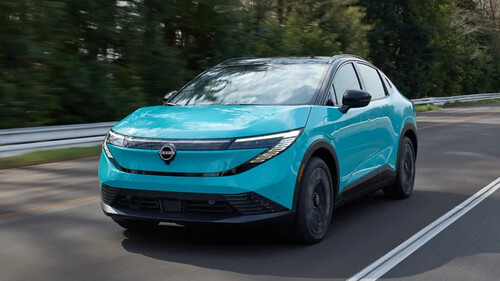
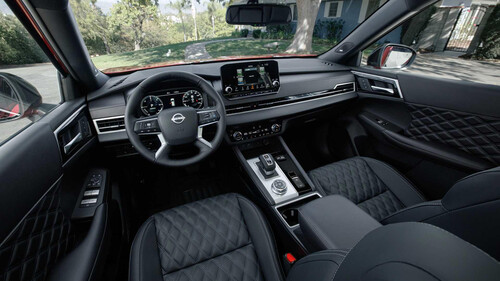
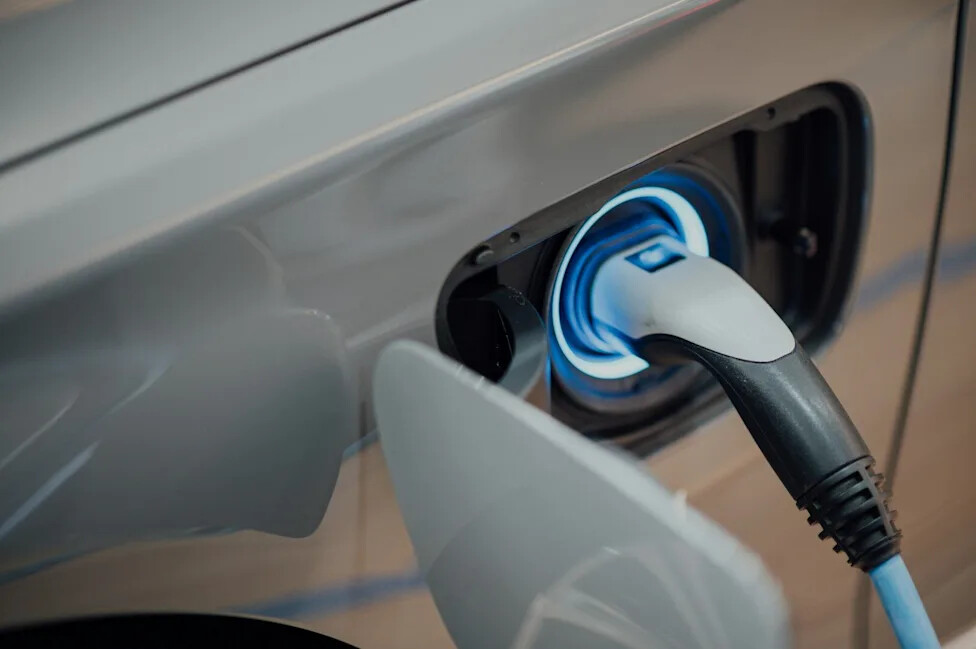
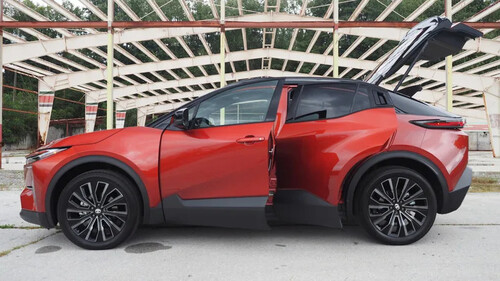
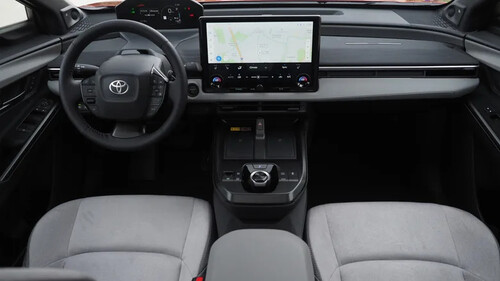
The Mitsubishi Eclipse Sportback EV shares a platform with the Nissan Leaf, a beloved and affordable EVMitsubishi wasn't shy about admitting that the 2027 Eclipse Sportback EV is only visually separate from the Nissan Leaf. And that's not necessarily a bad thing.When we test drove the new Nissan Leaf, we were blown away by how much we loved it. With pricing ranging from roughly $29,990 to $39,990, it has a roomy, upscale cabin, responsive software and a range of up to 303 miles. Between intuitive highway driver-assist tech, dual EV charge ports (one for level 1 or 2 charging and one for DC fast charging) and clever cargo space, Nissan made the case for everyday EV ownership surprisingly effortless.So, when Mitsubishi announced it was adapting the Leaf's winning formula for its own lineup as the 2027 Mitsubishi Eclipse Sportback EV expectations were high. Mitsubishi, had, after all, built the first highway-capable EV all the way back in 2009. This time, though, rather than reinventing the EV, Mitsubishi partnered with Nissan, a company that it holds a stake in, to adopt the Leaf's tech and systems and wrap it in Mitsubishi's sharper Triple Diamond styling.AdvertisementAdvertisementGetting behind the wheel only proved that great bones make for a great tech-sharing opportunity. We don't know how much it'll cost just yet, but we can only assume its price will be in the same ballpark.This story is 100% human-researched and written based on actual first-person knowledge, extensive experience and expertise on the subject of cars and trucks.The 2027 Mitsubishi Eclipse Sportback EV Has Not One, But Two, Charging PortsThe two charging ports built into the 2027 Mitsubishi Eclipse Sportback EV – Credit: Kristen BrownSomething that really impressed me about the Leaf is the charging capabilities. Mitsubishi's engineers explained it simply: on the left side of the car are the Level 1 and Level 2 J1772 ports. The placement is purposeful: if you pull into your home-charging setup, you don't have to walk around to the passenger's side to plug it in before heading inside, or unplug it as you head to work in the morning. On the right side is the Tesla-style NACS port that's optimized for Level 3 DC fast charging. If you want it, the Eclipse will come with an adapter for CCS fast charging, the standard charge style that's being replaced by NACS, as well as a 120V and 240V charging cable so you can charge overnight on a standard charger in the garage.AdvertisementAdvertisementThe Nissan Leaf charges $170 for a CCS adapter, even if you go with the more expensive Platinum+ trim, so that puts a point towards the House of Eclipse for ease of ownership.With Only One Mitsubishi Eclipse Trim, Shopping is SimplifiedThe interior of the 2027 Mitsubishi Eclipse Sportback EV – Credit: Kristen BrownMitsubishi spent a lot of time discussing their go-to-sale plans for the Eclipse Sportback EV and one of the most important components is making the shopping and the actual purchase easier for every customer. Instead of three trims with different ranges and a mix/match of features as we see in the Nissan Leaf, there will be just one trim offered for the Eclipse. Just one. The single model will come with a maximum range of 282 miles and 217 horsepower, with just one optional Tech Package.Pricing for the single optional package hasn't been released yet either, but it adds four premium features: roof rails, a 10-speaker premium sound system from Bose (complete with speakers in the headrests and a full subwoofer), a power liftgate and a panoramic electrochromic glass roof. The purpose is simple: instead of giving customers too many options, just give them one. One trim, one available package. That's it.And that's part of the company's larger mission overall. Mitsubishi is developing an online shopping tool that allows people to do most of the shopping and paperwork online, needing to only come to the dealership to make the final signatures and collect the car itself—not unlike how Hyundai sells cars on Amazon, or how Stellantis sells cars through Carvana. We Don't Know Pricing Yet, But We'd Bet It's More Than FairThe side profile of the 2027 Mitsubishi Eclipse Sportback EV – Credit: Kristen BrownCompanies selling identical copies of their partner's strong seller is nothing new in today's EV landscape. We see it happening with Toyota and Subaru. The Toyota C-HR and the Subaru Uncharted are copy-and-rebrand jobs, just like the Toyota bZ and the Subaru Trailseeker. Since Nissan and Mitsubishi have a similar partnership, the Nissan Rogue shares a platform with the Mitsubishi Outlander (the gas-only Outlander uses Nissan's powertrain and switchgear, while Nissan uses Mitsubishi's PHEV system for the upcoming Rogue PHEV). AdvertisementAdvertisementAll that is to say that pricing will likely be extremely similar to the Leaf's current pricing. I'd be very shocked if the Mitsubishi Eclipse Sportback EV was remarkably more expensive than the Leaf. In fact, I'd wager that to make it more compelling than the Leaf, pricing would be less expensive, since the range is set at a single figure and there's only one trim offered.Driving the Little-EV-That-Could Proved There's Lots of Potential to Go AroundThe rear quarter end of the 2027 Mitsubishi Eclipse Sportback EV – Credit: Kristen BrownOne of my favorite things from Nissan is their software. It's very intuitive and easy to interpret; every setting is right where you'd assume it'd be, settings are easy to access, and there's a ton of available information displayed in a format that's incredibly simple to digest. Mitsubishi didn't pull an Acura and use their partner's (GM's) platform and inject their own software; no way. Mitsubishi just installed Nissan's software and called it a day, and that's preferred. Nissan's EV software is excellent, and if anything, is a strong selling point. Especially with Google Automotive built-in for smarter route-planning, charging suggestions, battery preconditioning for quick charging, and more.While the Eclipse Sportback EV isn't built for speed, the horsepower rating of 214 definitely helped bring the city-slicking commuter EV further up the scale and closer to the "fun EV" category. Mitsubishi, funnily enough, admitted that they don't measure zero-to-sixty times because their customers don't ever ask about those silly numbers—and we agree; it's a bogus number. When it's flipped into Sport Mode, it does feel like it wakes up a bit more, which was a real treat on the winding roads of Washington state.Unlike the Leaf, the Eclipse Won't Have One-Pedal DrivingWe've seen industry twins under a different name before. But this one's especially good. – Credit: Kristen BrownSomething that caused quite a stir was a lack of one-pedal driving, unlike its Nissan Leaf muse. Engineers said that, according to their surveys, Mitsubishi buyers prefer to use their brake pedal to come to a complete stop. So, they implemented what they call "e-Step," which is their version of adjustable regenerative braking with the acceleration pedal, but the system isn't designed to come to a complete stop for you. You have to do it yourself. I heard some mumbles and grumbles from my colleagues, but I didn't mind its absence. I typically don't use one-pedal driving anyway. Turns out, I'm Mitsubishi's ideal buyer. Who knew?AdvertisementAdvertisementThe company also noted that they put more sound dampening in the Mitsubishi Eclipse Sportback EV, and it showed. When I wasn't busy jamming out and enjoying the 10-speaker premium sound system, I was relaxed because the little EV is shockingly quiet while driving. The suspension kept things smooth but poised, the steering was responsive, and the braking worked just as expected. Driving it was an absolute pleasure.Mitsubishi Says It'll Have "MI-Pilot" Drive Assistance, Taking a Page fro Nissan's PROPilot AssistThe front side end of the 2027 Mitsubishi Eclipse Sportback EV – Credit: Kristen BrownUnderneath the skin, the Renault–Nissan–Mitsubishi Alliance's shared EV architecture means Mitsubishi won't be reinventing the wheel when it comes to advanced highway driving assistance. Instead, the brand will carry over Nissan's proven ProPILOT Assist hardware and software stack, rebranded as MI-PILOT Assist (Mitsubishi Intelligent-PILOT) moniker.The hands-on Level 2 semi-autonomous driving suite uses forward-facing radar with a windshield-mounted camera to significantly cut down on highway commute fatigue. Key capabilities include:Adaptive Cruise Control with Stop & Go: Automatically manages throttle and braking to hold a preset following distance from the car ahead of you. In gridlock, the vehicle can come to a full stop and hold itself in place, resuming travel automatically if traffic moves within 30 seconds.Active Lane Centering (Steering Assist): Reads lane markings to provide continuous, subtle steering corrections that keep the Eclipse tracking smoothly in the center of the lane rather than ping-ponging between the lines.Speed Limit Assist & Traffic Sign Recognition: Uses a camera to detect posted speed limit signs, alerting the driver or adjusting the vehicle's cruising speed with a quick click on the steering wheel.Navi-link Curve & Ramp Slowdown: Uses onboard GPS data to anticipate sharp highway bends, interchanges, and exit ramps, proactively reducing speed before entering the curve for a more natural driving feel.Driver Monitoring & Emergency Assist: Relies on hands-on capacitive wheel sensors to ensure driver engagement. If a driver remains unresponsive to audible and visual prompts, the system can flash the hazard lights, bring the vehicle to a controlled stop in its lane, and unlock the doors.It Won't Replace Your Large SUV For the Kids, But It'd Be a Great CommuterThe rear quarter end of the 2027 Mitsubishi Eclipse Sportback EV – Credit: Kristen BrownI stand at about 5'8", so I'm a pretty harsh critic of rear seats and legroom. And, I'm a bit sorry to say, the Mitsubishi Eclipse Sportback EV is a tad cramped. With the driver's seat set to where I sat and the passenger's seat mirroring it, my knees were hard pressed against the seat back. The little EV is on the narrow side, so I felt pressed against the door, which had a high window sill and low seating position, so it was harder to see out of. Yes, my tester had the fancy pants sunroof, but you can't see out of it clearly—it just lets in light, so visibility wasn't improved back there. The very rear window isn't visible at all from the rear seats, so there was very little light coming in for rear passengers. AdvertisementAdvertisementLower LATCH points are very easy to access underneath a removable plastic cover, and each seat has a top tether point on the seatback, but a rear-facing seat would most certainly force the front passenger and driver to scootch forward to accommodate it. That wouldn't be that hard, since the dashboard doesn't stick out that far and there's plenty of legroom to go around, but they'd be cramped back there. One car seat would be pretty easy to host, but I couldn't imagine my four- and three-year-old being happy back there in their seats. So, while it won't replace your Toyota Grand Highlander, the Eclipse Sportback EV would fit seamlessly into your two-car formula (one being the dedicated family car and the other being a dedicated commuter) as the ecological option to sit in traffic for you.