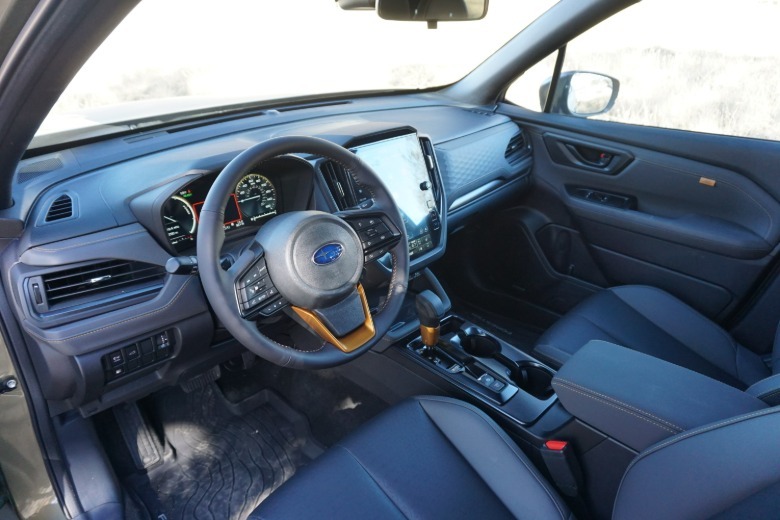
Decades before the advent of the soft-roader, Subaru was building everyday cars with a limited amount of extra off-road capability. So it should be no surprise that its Wilderness line of slightly more capable crossovers has been a hit. So, too, has Subaru's integration of hybrid systems, in an era when buyers of volume cars such as the Forester are happy to get their hands on anything that means greater efficiency. Naturally, Subaru has now combined the two by offering a Forester Hybrid in Wilderness trim. The recipe seems like a sales hit waiting to happen, but is it worth the extra complexity? Our expert editors test every vehicle we review. Read more about how we test and review cars here. The Lowdown Subaru finally brought a hybrid powertrain to the Forester for the 2025 model year. A new Wilderness was introduced a few months later, but it lacked the gas-electric system available on the basic car. The Forester Wilderness Hybrid combines the two, allowing Subaru to offer a system peak of 194 horsepower from a 2.5-liter flat-four and a 1-kWh battery pack. EPA-estimated fuel economy is down slightly from the basic Forester Hybrid, but the 33 mpg city and 29 mpg highway are still both solid numbers for a crossover with 9.3 inches of ground clearance and Yokohama Geolander all-terrain tires. For most buyers, that improvement alone should justify the price, which is $1000 more than the basic Forester Wilderness. Vehicle Tested: 2027 Subaru Forester Wilderness Hybrid Base Price: $41,970 Price as Tested: $41,970 Location: Hollister, California More Specs: Powertrain: 2.5-liter Atkinson-cycle flat-four, lithium-ion hydride battery pack Power: 194 hp @ 5600 rpm (peak system output) Transmission: continuously variable automatic, all-wheel drive 0–60 mph: 8.6 sec (estimated) Weight: 3940 lb EPA mpg: 33 city, 29 highway, 31 combined How Does It Drive? Fred Smith Befitting the Wilderness Hybrid's soft-roader credentials, the media drive took place on the dirt, grass, and gravel roads of a private ranch. While this made for beautiful scenery, it did little to showcase what the car could do as a daily driver or challenge its off-road capabilities. Those capabilities did impress on a more technical off-roading course that Subaru built for the event, although that comes with the caveat that the company presumably built the course with the car's limits in mind. Even though this is ultimately still a relatively conventional crossover with nothing like the articulation of a more extreme off-roader, the all-terrain tires were capable of handling substantial ruts and steep hill descents. Fred Smith Approach, break-over, and departure angles of 23.5, 20.6, and 25.5 degrees, respectively, are identical to the nonhybrid Forester Wilderness. This hybrid crossover has the clearance to get over obstacles a car camper or kayaker might find on the trail to their favorite outdoor-recreation spot. The biggest frustration here was the low resolution of the X-Drive off-road menus built into the infotainment screens, a feature that felt behind the respectable capabilities of the crossover itself. While the off-road performance is what sets the Wilderness apart from its more pedestrian Forester Hybrid brethren, limited on-road testing suggests that the car feels similar in everyday situations. Given the all-terrain tires, that's a solid achievement, even if the end result is still relative mediocrity. This Forester is no performance car, and anyone who might have been expecting a canyon carver will instead have to make do with relaxed acceleration and a frustrating continuously variable automatic transmission. What's It Like to Live With? Fred Smith The Forester is a tentpole for Subaru because it combines the basic compact-crossover shape today's buyers want with some degree of utility in all forms. The Wilderness goes one step further in providing even more capability, but its day-to-day strength will be how little it sacrifices to do that. The Forester Wilderness Hybrid drops 5 mpg of efficiency in the city in comparison to the standard Forester Hybrid, for 33 mpg. The basic Forester Wilderness, by contrast, gets just 24 mpg in the city. The hybrid remains relatively comfortable and quiet on the road too, which is great news for buyers who do not want to hear harsh noises from all-terrain tires and the unique drone of a Subaru boxer engine all day. Still, the Wilderness line is differentiated by its capabilities. Buyers looking for a soft-roader do expect to use the car on a trail every so often, which makes the Wilderness Hybrid's lack of a spare tire a major issue. Since components of the hybrid system are packed where a spare would go on a normal Wilderness, buyers of this car will either have to find another way to carry a fifth tire or contend with the reality that a flat could derail their outdoor adventures in a worse way than the same problem would in the nonhybrid model. Should I Buy One? Fred Smith That missing spare tire is one of two major drawbacks for the Wilderness Hybrid. The other is the towing capacity, down from 3500 pounds to just 1500. Both of these are serious limitations for buyers who have certain use cases in mind for their soft-roader, but neither is necessarily a problem for the average buyer. The price difference is not negligible, but fuel savings should cover the difference in cost within a few years. For most buyers, that makes the Hybrid the obvious choice. Buyers looking at other hybrid soft-roaders could also consider the new Toyota RAV4 Woodland and the Honda CR-V Trailsport. The Subaru is the only one of the three hybrids with conventional full-time all-wheel drive, although that specific differentiator is not necessarily a game changer for buyers who will be spending most of their time on the street. For those who do need to venture a little further a little more often, though, the Forester Hybrid Wilderness seems like the strongest choice. Highlights and Lowlights We Love: Strong fuel economy for something with off-road capability. Stylish body cladding and overall design. Full-time all-wheel drive. We Don't Love: The underwhelming powertrain, even with the extra torque of the hybrid system. That missing spare tire and reduced towing capacity. Favorite Detail: Fred Smith Subaru's Wilderness models are sold with synthetic StarTex interiors meant to be easily cleaned, and this particular vehicle even includes a synthetic steering-wheel cover in lieu of the usual leather. This is a small detail for most, but it does mean that the cabin is entirely vegan. For some very specific buyers, however, that one detail could make all the difference.

 Liked by Mia Harris, Madeleine Bouchard
 Liked by Mia Harris, Madeleine Bouchard