Like an enthusiastic Ms. Pac-Man, the icon representing us happily ate through the yellow dots showing our route on the onX Offroad screen. Our vehicle? The 2027 Subaru Forester Wilderness Hybrid. Our location? Rancho Quien Sabe (i.e., Ranch Who Knows) in California—somewhere in the Diablo Range mountains, southeast of San Jose. Our destination? Lunch, some 35 miles away on the far side of off-road obstacles ranging from simple loose gravel to gnarly ascents and descents as steep as 30 percent.
Featuring the same 9.3 inches of ground clearance as the nonhybrid Wilderness model, our Forester—with an Atkinson-cycle 2.5-liter boxer four-cylinder and a pair of electric motors (one serving as a generator) tucked within the transmission case—clambered over hill and dale. Aside from the powertrain, the new Wilderness Hybrid is much the same as the nonhybrid Forester Wilderness, right down to the 235/60R-17 Yokohama Geolandar G015 all-terrain tires, which offer more than enough grip for trail work.
Aside from the obvious fuel-economy benefits that come with the 194-hp hybrid system, we found the addition of the electric motors to be genuinely helpful off-road. Subaru updated the hybrid system on all 2027 Forester Hybrids to provide more torque from the primary drive motor and to make traction-control interventions smoother. When we had the Forester’s nose pointed skyward, we could feel the traction motor pulling the car toward the summit as if it were connected to a winch. In situations where electric power alone can’t cut it, though, the 2.5-liter flat-four groans like a geriatric canine. The sound emanating from under the hood can be grating, but we never found ourselves in need of more power—at least not while off-roading. On the road, the hybrid system is similarly helpful in providing a nice torque bump at low speeds, though that sensation of quickness disappears at highway speeds.
On the trails, we often found ourselves reaching for the camera button located near the shifter, which turns on the front-facing camera and Subaru’s X-Mode. The camera is disappointingly low-resolution and struggles with overexposure, but X-Mode automatically engages hill-descent control, which we found useful on the steeper descents.
We’re pleased to report that the smooth transition in braking power between regenerating electricity and the car’s friction brakes is as seamless as in the standard Forester Hybrid. We’re less pleased to report that the brake response is still a bit overeager at the top of the pedal. The ride is smooth, and the seats are well padded, though only gently bolstered. Visibility from the driver’s seat is akin to looking out from a fishbowl (we’d imagine), which is to say, it’s great.
Buyers in chillier climates will appreciate that Subaru has made the heated steering wheel and heated rear seats standard features, rather than extra-cost options like before. Under the 11.6-inch central screen—which is laggy and low-res as in all Foresters—Subaru equips the Wilderness Hybrid with an updated wireless phone charger that now grips your phone to keep it from sliding about.
In a strange bit of cost cutting, Subaru opted to give the Wilderness a panoramic sunroof but neglected to power the interior shade for said sunroof. The manual shade means that unless you’re a trapeze artist or share a build with Victor Wembanyama, chances are you’ll struggle to fully open the sunroof cover without turning around and lifting yourself out of your seat.
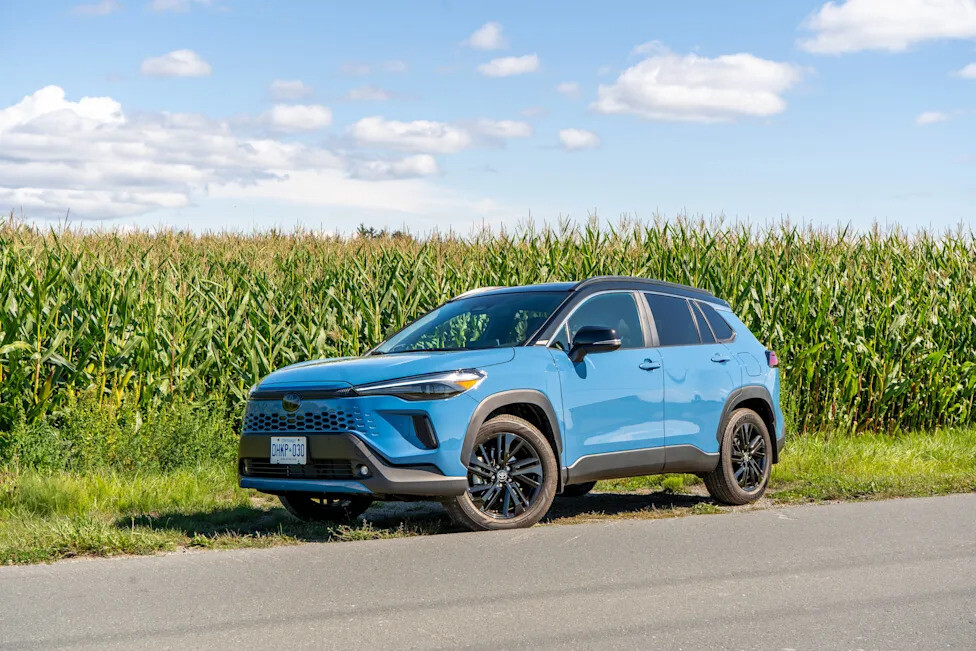
Subaru is particularly proud of the price point for the new Wilderness Hybrid. At $42,020, the hybrid version costs just $1000 more than the nonhybrid Wilderness. Unfortunately for Subaru, cross-shoppers should note that the $42,250 Toyota RAV4 Woodland, which boasts 35 more horsepower than the Subi and, at 38 mpg combined versus the Forester’s 31 mpg, crushes the Wilderness Hybrid in fuel economy.
Still, the Wilderness Hybrid takes two known quantities—the Forester Wilderness and the Forester Hybrid—and mashes them together. Since both work well enough on their own, it’s no surprise they work even better together. The Forester Wilderness Hybrid won’t wow anyone, but if you often traverse bush and briar in search of lunch, forking over the extra $1000 for the hybrid version is a no-brainer.
➡️ Skip the lot. Let Car and Driver help you find your next car.
Specifications
Specifications
2027 Subaru Forester Wilderness Hybrid
Vehicle Type: front-engine, front-motor, all-wheel-drive, 5-passenger, 4-door wagon
PRICE
Base: $42,020
POWERTRAIN
DOHC 16-valve 2.5-liter Atkinson-cycle flat-4, 162 hp, 154 lb-ft + AC motor, 118 hp, 199 lb-ft (combined output: 194 hp; lithium-ion battery pack)
Transmission: continuously variable automatic
DIMENSIONS
Wheelbase: 104.9 in
Length: 182.9 in
Width: 72.4 in
Height: 69.3 in
Passenger Volume, F/R: 58/49 ft3
Cargo Volume, Behind F/R: 69/28 ft3
Curb Weight (C/D est): 4000 lb
PERFORMANCE (C/D EST)
60 mph: 8.6 sec
1/4-Mile: 16.7 sec
Top Speed: 113 mph
EPA FUEL ECONOMY
Combined/City/Highway: 31/33/29 mpg
Jack Fitzgerald’s love for cars stems from his as yet unshakable addiction to Formula 1. After a brief stint as a detailer for a local dealership group in college, he knew he needed a more permanent way to drive all the new cars he couldn’t afford and decided to pursue a career in auto writing. By hounding his college professors at the University of Wisconsin-Milwaukee, he was able to travel Wisconsin seeking out stories in the auto world before landing his dream job at Car and Driver. His new goal is to delay the inevitable demise of his 2010 Volkswagen Golf.