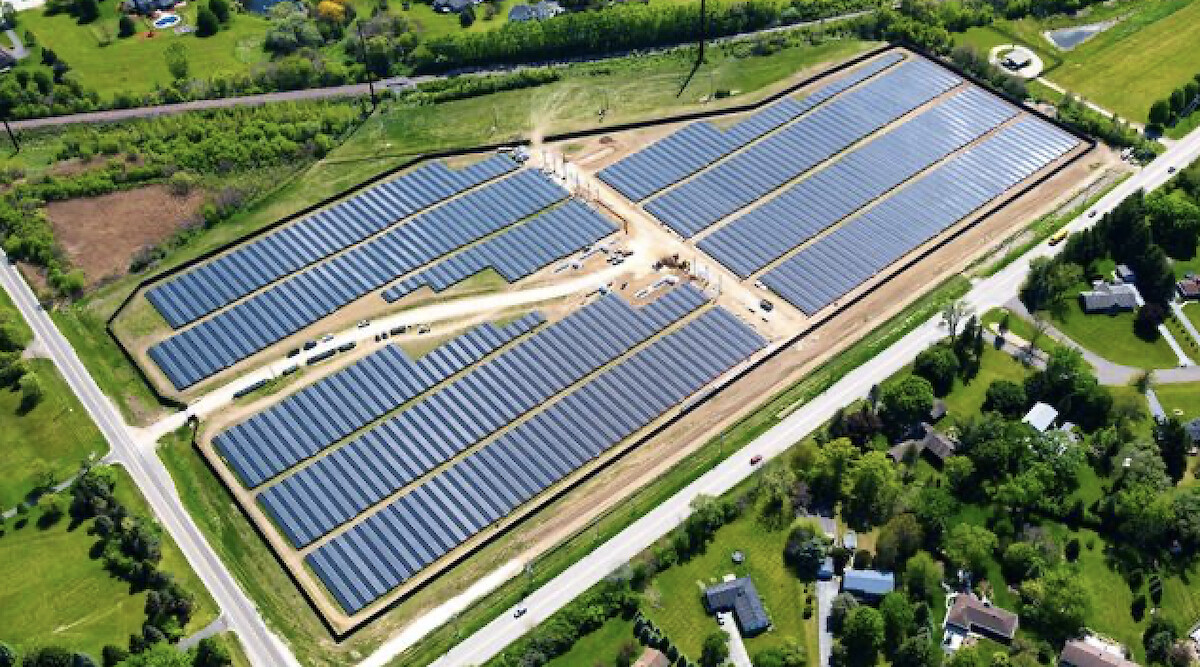
Demand for solar power is running hot, and yet space for solar development is increasingly limited by community opposition and government intervention at the federal, state, and local level. Space is at a premium even where the regulatory environment favors solar, particularly in cities and other urbanized areas. That’s where the creativity factor steps in, as illustrated by the US firm Cultivate Power. Making Space For Solar Power “Developing solar on constrained parcels is a growing focus for the industry. It’s becoming more important as competitive land use drives solar onto smaller and smaller parcels,” Cultivate explained in an email to CleanTechnica last week. The company’s latest project is a case in point. The new Bowes Solar array sits on a 22-acre site in Elgin, Illinois. Situated between two residential subdivisions, the site is further encumbered by high-voltage power lines and train tracks. A wetlands area in one corner offers yet another obstacle to conventional solar development. The Cultivate team tackled the challenge from several angles. To accommodate the irregular footprint of the site, they divided the installation into two arrays for a combined total of 11 megawatts (DC). By dividing the site in two parts, Cultivate also gained the flexibility needed to accommodate setback requirements and avoid impinging on the wetland. To maximize the solar power potential of the site, Cultivate deployed a high-density racking system developed by the firm Planted Solar. In addition, the Planted Solar racking system sits low to the ground, helping Cultivate to avoid conflicts related to community aesthetics. With the installation of an opaque fence and additional screening, the panels are not visible from outside of the site. Solar Power And Community Engagement Small-scale solar power projects rarely make headlines, let alone national news. However, the Bowe arrray did attract local coverage that fleshes out the picture in terms of the steps solar developers can take to rally local support for their projects, particularly in the area of small-scale community solar. Community solar refers specifically to solar power plants that directly benefit local communities in the form of reduced electricity costs and increased tax revenues. Chronicle Media, for example, notes that the new Bowes array will benefit ratepayers with lower electricity rates. Distributed through the utility Commonwealth Edison, the lower rate covers the whole area, including 580 low- and moderate-income households. “Aimed at saving customers 20 percent on energy charges, the project will also benefit several larger customers, including three small businesses, two towns and a church,” notes Chronicle reporter Bill Dwyer. “Cultivate Power officials say that collectively subscribers will save $13.9 million on their ComEd bills during the next 40 years,” Dwyer adds. Lower electricity rates are an important community engagement tool, but not the only one. Property tax revenues from the site are also expected to total $2.1 million over the next 40 years, benefiting the local school district and other agencies while making productive use of a property that resisted other forms of development, largely due to the wetlands factor. The Chronicle further notes that Cultivate is making substantial contributions to Elgin Community College and Food for Greater Elgin (a member agency of the Northern Illinois Food Bank), along with contributions to Friends of the Fox River, We Care Solar, and the Evolve Foundation among others local organizations. High Density Solar Arrays Are Coming For Your Fossil Fuels Community engagement aside, the solar technology developed by Planted Solar also played a key role in the Bowes project. Planted launched on a mission to squeeze the maximum amount of kilowatts out of a small space. The company points out that community solar projects generally require 5-7 acres for each MWp (megawatt-peak), with MWp referring to the theoretical maximum output of the array under ideal conditions. That would mean, for example, that an 11-megawatt array like the Bowes Solar project could not fit into a 22-acre space. Alternatively, a smaller array could be developed at the site, but then the law of diminishing returns might kick in, killing the project altogether. Planted addresses the challenge with a software-enabled racking system that requires only about 2 acres per MWp, with the flexibility to fill in irregular spaces that are typically left undeveloped in a conventional solar array. At 2 acres per MWp, a 5-megawatt community solar project would only require about 15 acres of land all together, instead of the 40-50 acres called for under a conventional scenario. Another conventional rule of thumb is that sites with a slope of more than 10% require grading. Such sites are often automatically eliminated from consideration for community solar projects due to the additional expense of grading. Substantial earthwork can also delay the permitting process or result in project cancellation. The Planted system addresses that challenge with a terrain-following strategy that accommodates existing grades of up to 27%. “Sites where a landowner wants pasture or vegetation preserved, or where a county has made low-disturbance a condition of approval, are often viable candidates,” Planted notes. “The site still needs to meet slope and acreage thresholds, but grading restriction alone doesn’t disqualify it,” the company adds. The Power Of Community Solar Interested? Community solar planners can use Planted’s online contact form to submit information about their site and received an assessment. Meanwhile, if you caught that thing about landowners and pastures, that brings up a rural angle of interest. As illustrated by the Bowes project, community solar projects are often associated with cities. Elgin, for example, is one of the biggest cities in Illinois aside from Chicago. However, Cultivate Power’s equity investor, Generate Capital, points out that community solar projects can be valuable assets in rural communities, too. “In a rural farming community like Mercer County, solar savings are out of reach for renters and low- and moderate-income families who are unable to install their own panels,” Generate explains. “Landowners, meanwhile, face pressure to keep every acre productive. Community solar answers both, extending savings to local subscribers, while giving a working farm stable new income alongside its crops,” the firm adds. Generate draws attention to Cultivate’s Goldenrod Solar project, commissioned in Mercer County last year. Though weighing in at just 5 megawatts, the project delivers enough solar power to accommodate 850 local subscribers, with anticipated savings of 10-20% on their electricity bills. As is typical of community solar projects, low- and moderate- income households represent 55% of the subscribers. The community engagement element of the Goldenrod project also included contributions to local organizations including Black Hawk College Foundation, Sherrard High School, and Mercer County High School Future Farmers of America chapters, among others. Photo: A high density racking system enables a new 11-megawatt solar power plant to fit inside a constrained, irregular parcel of land in the city of Elgin, Illinois (cropped, courtesy of Cultivate Power via email).