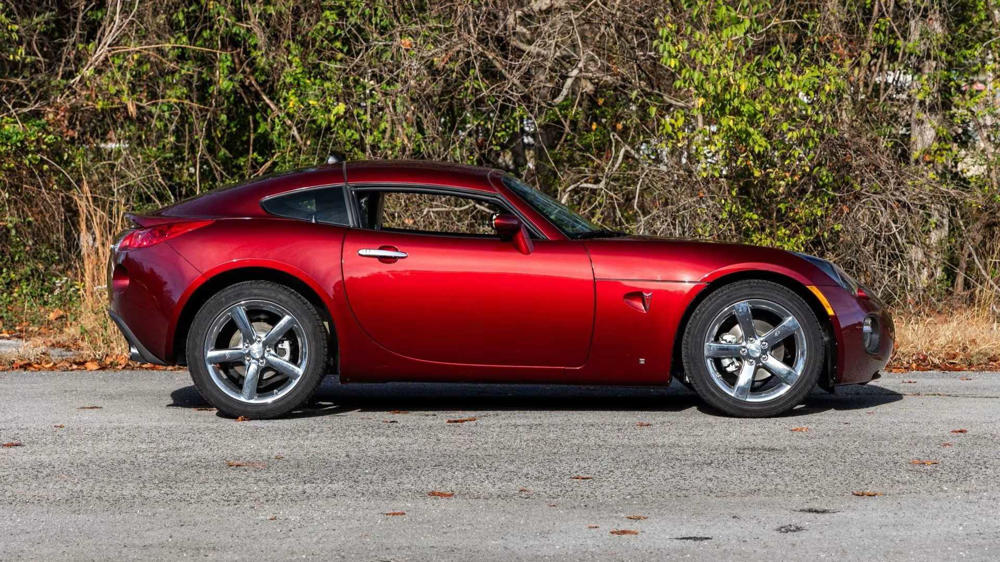
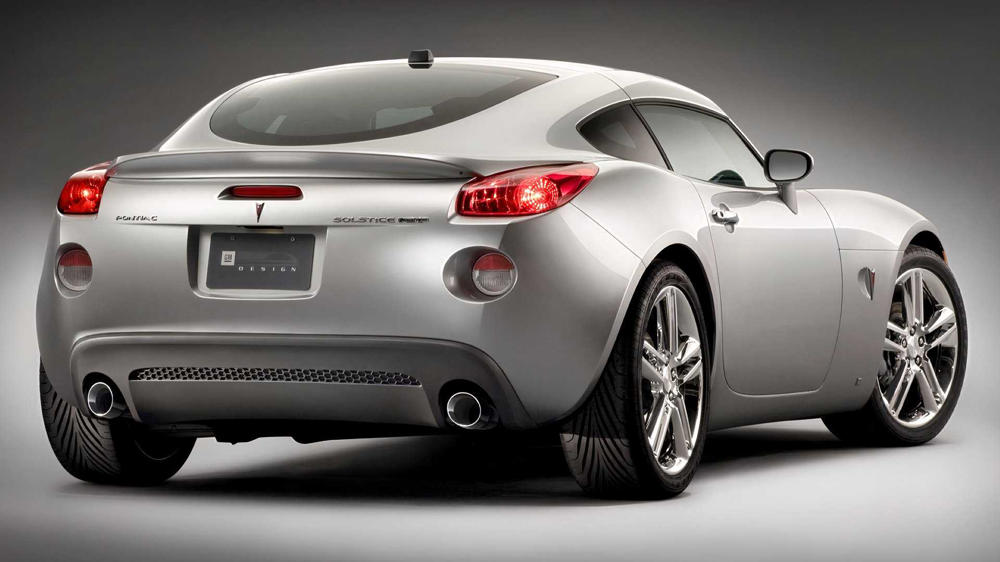
During and shortly after the global financial crisis of 2008, the new American sports car segment faced severe contraction as overall vehicle sales dropped nearly 40 percent. Tightened consumer credit and soaring fuel costs pushed buyers away from discretionary purchases. Meanwhile, federal restructuring forced domestic automakers to eliminate unprofitable niche platforms, shutter assembly plants, and dissolve entire performance divisions. As a result, low-volume rear-wheel-drive roadsters and coupes vanished before achieving sustainable production runs. Only a handful of core muscle and flagship performance models survived the downturn, emerging with leaner lineups, stricter efficiency targets, and reduced engineering budgets during the early recovery. A Bankrupt Pontiac Hits Supercar Value Territory A 2009 Pontiac Solstice GXP coupe with 33 miles on the odometer recently sold at auction for $86,500 via Mecum. That result places a bankrupt-era American compact sports car well past its original retail price. Collector trends in 2026 prioritize Japanese and German icons. However, this parts bin Pontiac achieved a production scarcity beyond even the likes of the Ferrari F40. General Motors collapsed in 2009 and closed the Wilmington Assembly plant in Delaware. Those events cut production short before the coupe reached commercial maturity. The Solstice was born from a mix of corporate desperation, engineering improvisation, and sudden extinction. Enthusiasts spent years dismissing the Solstice as a soft cruiser, but recent market data proves that low-mileage coupes tell a different story. Buyers separate the rare coupe from the common convertible and the delivery-mileage cars from daily drivers. Scarcity Caused By GM's Corporate Collapse General Motors built an estimated 1,200 to 1,266 Solstice coupes in total. That production run makes the fixed-roof Pontiac rarer than the 1,311 units of the Ferrari F40. This design was a response to buyers who wanted added structural rigidity and sleek fastback styling to the platform. Pontiac launched the model just as the global financial crisis destroyed the parent company. When GM filed for bankruptcy and shuttered Wilmington Assembly, the assembly line stopped. Exact production breakdowns vary across collector databases. Hagerty Marketplace cites 1,025 GXP coupes within the total run, while separate auction analysis reports 781 GXP coupes out of 1,266 total coupes built. Both figures confirm extreme scarcity for the turbocharged flagship trim. Manual transmission models represent an even smaller slice of that total. A 2019 report claims Pontiac built only 110 manual GXP coupes. Meanwhile, a 2026 analysis citing owner forum data puts the five-speed manual GXP coupe count at 234 units. Regardless of which registry figures a buyer trusts, fewer than 250 manual GXP coupes exist. That supply shortage drives fierce bidding when a preserved example crosses the block. Parts-Bin Engineering And Quiet Performance Former GM vice chairman Bob Lutz championed the Solstice as a rule-breaking passion project. The development team lacked a massive budget, so engineers raided the corporate parts bin to bring the car to market. The interior uses climate control dials from a Hummer H3 and door handles from a Chevrolet Cobalt. Underneath the body, the rear differential comes from a Cadillac CTS. Despite those humble components, the GXP coupe delivers serious speed. Pontiac fitted a 2.0-liter turbocharged Ecotec four-cylinder engine that produces 260 horsepower and 260 pound-feet of torque. Buyers could also order a dealer-installed GM Performance engine control unit update that raised output to 290 hp and 340 lb-ft of torque. That powertrain propels the 3,080-pound coupe from zero to 60 MPH in 5.2 seconds. The car clears the quarter-mile in 13.7 seconds at 102 MPH. Those acceleration figures rivaled far more expensive European roadsters of the late 2000s. Furthermore, the coupe carries only 49 pounds more weight than the open-top Solstice roadster while offering a stiffer chassis. The Solstice GXP Coupe's Flawed Roof Design And Ownership Realities Enthusiasts who treat the Solstice GXP coupe as a blue-chip investment must accept its functional compromises. The car features a removable targa-style roof panel made of lightweight magnesium. Removing the panel opens the cabin to the sky, yet the design suffers from a major packaging flaw. The rigid roof panel cannot fit inside the trunk or anywhere else inside the vehicle. Drivers who remove the hard panel must leave it in their garage. Pontiac supplied a folding emergency cloth soft top that stores in the trunk in case rain strikes during a trip. That compromise frustrates drivers who want spontaneous open-air motoring without weather anxiety. Potential buyers must also recognize that appreciation remains strictly bifurcated. The $86,500 auction sale involved a wrapper car with delivery mileage. Hagerty valuation data places a number-one concours example at $68,900 and a number-two excellent car at $37,100. High-mileage GXP coupes continue to depreciate like standard used sports cars. Future value growth is never guaranteed, and driven examples will not match the returns of a museum-grade unit. Separating The Coupe From The Convertible Shoppers entering the Solstice market must distinguish between body styles and trim levels before spending collector money. Pontiac built tens of thousands of Solstice convertibles between 2006 and 2009. Those roadsters remain affordable weekend toys because they lack the coupe's sudden production cutoff. Even a turbocharged GXP convertible trades at a fraction of the coupe's price. Base model coupes also trail the GXP in both performance and desirability. The standard coupe used a naturally aspirated 2.4-liter four-cylinder engine making 173 hp. Without the turbocharged Ecotec engine and upgraded suspension, the base coupe lacks the mechanical credentials that attract serious collectors. Buyers seeking a usable driver should target a number-two condition GXP coupe with a five-speed manual transmission. These cars offer the full 260-hp experience and the rare fastback roofline at roughly half the cost of a delivery-mileage example. Conversely, investors chasing record prices must demand documented low mileage, original paint, and complete factory accessories, including the emergency soft top. By matching the purchase price to the car's mileage and specification, buyers can enjoy the final triumph of Pontiac's performance era without overpaying for hype. Source: Pontiac, Mecum, Hagerty, Motogallery, and Car And Driver.

 Liked by Matthew Young, Thomas Clark


















 Liked by Matthew Young, Thomas Clark


