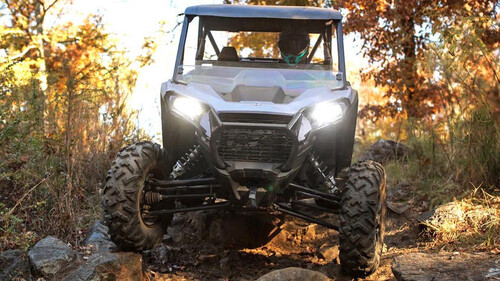
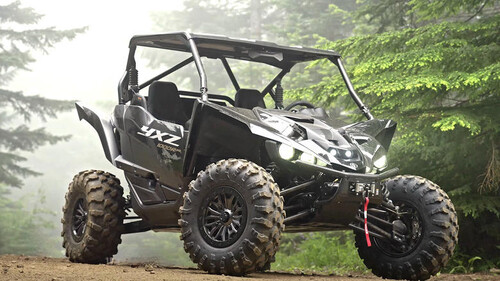
Polaris RZR Pro R Boost Turbo: What 275 HP Really Costs OwnersPolaris rolled out its 2027 off-road lineup on August 3, and the machine everyone is going to argue about is the RZR Pro R Boost — a Pro R with a turbocharger hung off the 2.0-liter ProStar Fury four and a claimed 275 horsepower. That's 50 more than the naturally aspirated Pro R's 225, and Polaris is calling it the most powerful production side-by-side you can buy.Before anyone reaches for the pitchforks: this is not Polaris's first boosted RZR. The company was already selling a model literally called the Turbo R when the Pro R launched in late 2021. What's new is that the big four-cylinder — the engine Polaris built specifically so it wouldn't need boost — is now boosted anyway.The number that actually matters is 215Horsepower sells brochures. Torque moves a 2,500-pound machine out of a whoop section.AdvertisementAdvertisementPolaris lists 275 hp at 7,000 rpm and 215 lb-ft at 4,000 rpm, and that second figure is the one that changes the driving experience. A naturally aspirated 2.0-liter making 225 hp has to spin hard to do it. Add boost and you get a fat midrange, which means the CVT can be clutched for lower engagement and the engine spends less of its life screaming. Polaris also claims the turbo holds peak output to 10,000 feet — that's the genuine mechanical advantage of forced induction, since a naturally aspirated engine loses roughly three percent of its power for every thousand feet you climb. Boost lets the compressor make up the difference until it runs out of wastegate authority.Related ArticlesFord's 1.0L EcoBoost Timing Belt Can Kill an Engine at 70,000 Miles. NHTSA Just Escalated Its Investigation.IHRA's Owner Claims Elon Musk's SpaceXAI Owes Him $570 Million — Racers Say He Still Owes Them, TooWorth flagging: Polaris's "up to 40 percent quieter" claim belongs to the XPEDITION's new transmission, not the RZR. The Boost gets new engine isolators and revised calibration, which should take the edge off. Don't expect a library."Industry-leading" depends on whose dynoKawasaki's supercharged Teryx H2 claims 250 hp from a 999cc inline-four. But Kawasaki states plainly that the figure was measured to ISO standard 4106, and that ISO numbers can read higher than the SAE numbers most American buyers are used to. Polaris doesn't publish which standard produced its 275. Can-Am's Maverick R sits at 240 hp from a turbo 999cc triple.AdvertisementAdvertisementSo yes, Polaris leads on paper. Just understand you're comparing three manufacturers' homework without seeing the grading rubric.Do the power-to-weight math on Polaris's own figures and the two-seat Ultimate comes out around 9.2 pounds per horsepower on a 2,531-pound estimated dry weight — respectable, but nowhere near as dramatic as the horsepower gap suggests, because dry weight went up too.Where the engineering money actually wentThe turbo is the headline. The supporting cast is the story.Boost makes heat, and heat is what kills side-by-sides. Polaris split the cooling into two circuits: a rear-mounted high-temperature radiator for the engine, and a front low-temperature radiator dedicated to the turbo and transmission. A roof scoop feeds the rear unit so a windshield or accessory can't starve it. Moving the hot radiator behind the occupants also keeps engine heat out of the footwells — a real complaint on hard desert days.AdvertisementAdvertisementThe spec sheet lists an actively cooled transmission, and the clutching gets 48 curved cooling fins, a larger belt, and a high-flow CVT case. Polaris also fitted strengthened half shafts, an upgraded front drive, and a new transmission.Read that list as an engineering confession: every one of those parts is something 275 horsepower would otherwise break. CVT belts are consumables that die from heat and slip, not mileage. If you buy one of these, budget for spare belts, learn the change procedure before you need it in the sand, and resist lugging it through slow technical terrain where the belt is slipping and there's no airflow.Turbo ownership adds its own homework. Oil is now a bearing coolant, not just a lubricant, so intervals are not optional. Air filter discipline matters more, because anything past the filter meets a compressor wheel spinning at very high rpm. And charge piping in a dust-and-vibration environment is a thing to inspect, not assume.The fuel tank grew to 14.7 gallons on the two-seater and 17.4 on the four-seat version. Nobody enlarges a tank for fun — that's a consumption number in disguise.The warranty and the legal fine printPolaris covers 2027 off-road vehicles with a one-year limited factory warranty. The extended two-year coverage applies to NorthStar models, which the RZR is not. On a fifty-thousand-dollar machine with a brand-new forced-induction driveline, twelve months goes fast. Price out the extended coverage before you sign, not after.AdvertisementAdvertisementThen there's where you can legally ride it. At 74 inches wide, the Pro R Boost exceeds the width limits that define a registrable UTV in several states — Wisconsin's DNR defines a UTV as no more than 65 inches wide with a dry weight of 3,500 pounds or less. Michigan sorts its trail system by 50-inch and 65-inch classes with wider routes as a separate category. The Boost clears the weight thresholds easily and fails the width ones. This is a desert, dune, and private-property machine. If your riding happens on Midwest or Eastern trail systems, check your state's width rule before you fall in love.Related ArticlesPortland's Freightliner Plant Is Closing — And Daimler Filed This Plan Once BeforeBMW Restructuring: What The Munich Cost Cuts Mean For Buyers And EnthusiastsInsurance is the other line item people forget. Powersports coverage on a $50,000 vehicle isn't an afterthought, and the factory anti-theft system plus the included three-year RIDE COMMAND+ subscription — which adds vehicle location and security alerts — are worth mentioning to your agent, since telematics sometimes moves the needle on theft premiums.What it costs and what else showed upThe Pro R Boost starts at $49,999 in Ultimate trim, plus a $1,995 destination charge — call it $51,994 before tax, title, and the first accessory you can't live without. Two- and four-seat configurations are offered in Ultimate and Ultra trims, the latter adding active sway bar links that adjust up to 200 times per second, 32-inch BFGoodrich tires, carbon fiber pieces, and exclusive graphics. Dealers get them in November 2026.AdvertisementAdvertisementFor context, the naturally aspirated 2026 Pro R lists at $43,999. Six grand for 50 horsepower and a substantially reworked driveline is, honestly, not a bad exchange rate in this segment.The quieter innovation in the announcement is NUMATIX, the pneumatic CVT debuting on the XPEDITION — a drive clutch regulated by air pressure rather than mechanical weights, adjusting up to 200 times per second, with an onboard air system that will inflate your tires through an auxiliary port. Polaris claims up to 40 percent less perceived noise at 35 mph versus previous models. That's arguably a bigger deal for the industry than another horsepower record, and it lands in August 2026 at $40,499. A $6,999 Sportsman 500 ATV rounds out the announcement in September.Practical takeaway: if you ride open desert or dunes and you were already shopping at this price point, the Boost's cooling and driveline upgrades are the reason to buy it, not the badge on the hood. If you ride anywhere with a 65-inch gate, none of this applies to you.Images Via: Polaris