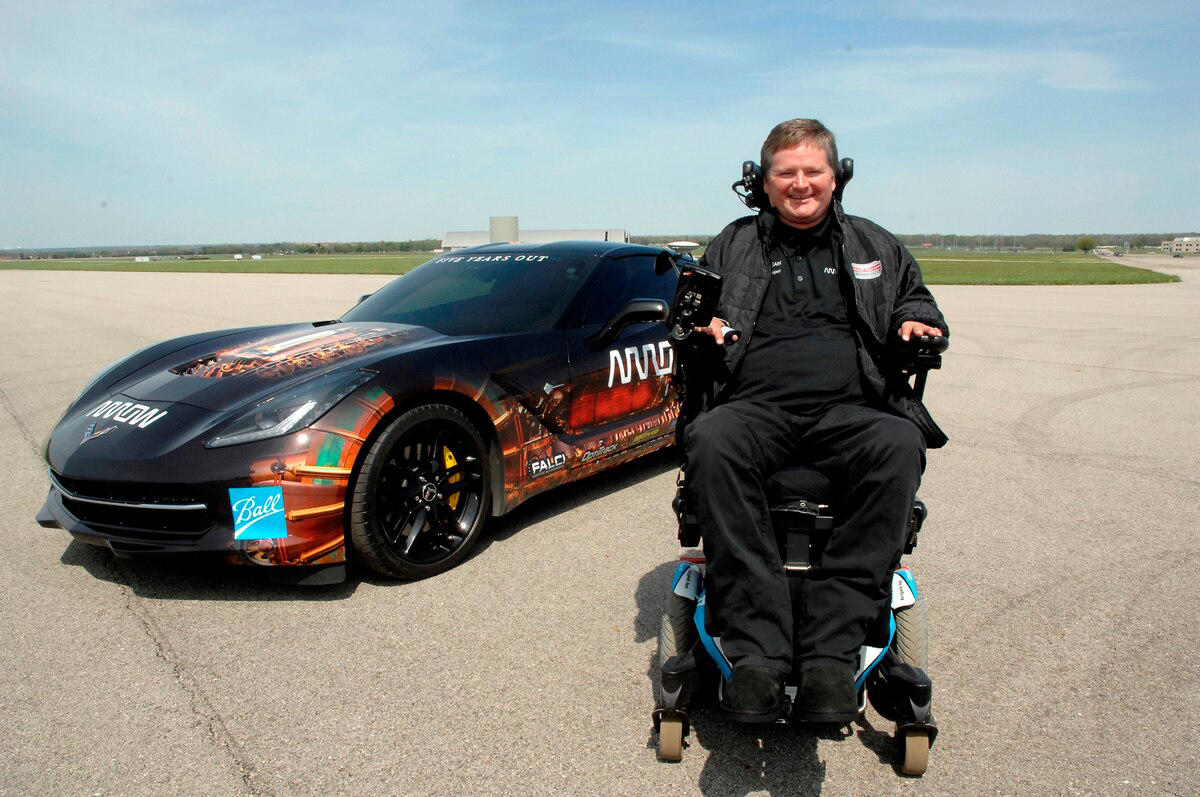
Paralyzed IndyCar Driver Went 107 MPH By Using His Head, Now the Corvette Behind It Is Heading to Auction Sam Schmidt was told his racing career was finished after a violent IndyCar crash left him paralyzed from the neck down in 2000. Fourteen years later, he blasted around Indianapolis Motor Speedway at 107 mph in a specially modified Corvette without touching a steering wheel, gas pedal, or brake pedal. Now the exact car that made that moment possible is heading to auction, and it carries far more weight than a normal collector car crossing the block at Mecum. More Stories Like This The $2 Million Tractor That’s Causing a Stir: Inside Lamborghini’s Most Controversial Centenario Creation The Real Story Behind Greg Biffle Crash Lawsuits: $25 Million Fight Erupts as Troubling Flight Failures Surface Adria (Force) Hight, Daughter of NHRA Legend John Force, Dies at 56 After Lifelong Role in Building Racing Dynasty The 2014 Chevrolet Corvette modified through the Semi-Autonomous Mobility project is set to sell May 15 during Mecum Auctions’ Spring Classic in Indianapolis. Roughly 2,500 collector cars are scheduled for the event at the Indiana State Fairgrounds, but this Corvette sits in a completely different category. It is not showing up because of rarity packages, celebrity ownership, or low production numbers. This car became proof that paralysis did not have to end someone’s ability to drive. That is where the story changes. Most adaptive driving technology stays buried in small engineering circles or medical discussions most enthusiasts never hear about. The SAM Corvette exploded directly into mainstream motorsport culture because Schmidt pushed it into one of the most intimidating places imaginable: Indianapolis Motor Speedway. Hitting triple-digit speeds there is difficult enough for able-bodied drivers. Schmidt did it using only head movement and a bite sensor. The car itself started life as a standard 2014 Corvette before engineers transformed it into something that sounded more like experimental aerospace tech than a production sports car. Infrared cameras mounted inside the cabin tracked Schmidt’s head movements. Looking left steered the car left. Looking right steered it right. Nodding forward added throttle input while a bite sensor controlled braking. No hands. No feet. No shortcuts. Arrow Electronics engineered the system in partnership with the SAM project, and the end result was not some low-speed demonstration vehicle crawling through a parking lot. Schmidt drove this Corvette at speeds that would make experienced drivers nervous even with full physical control. That detail matters because it proved the system was not symbolic technology built for publicity. It actually worked under pressure. And that is what makes this Corvette so different from the average museum piece or auction headline car. Schmidt’s accident in 2000 permanently altered his life, but he stayed deeply connected to racing afterward as an IndyCar owner. The competitive mindset never disappeared. Instead of accepting permanent limitations behind the wheel, Schmidt and his team attacked the problem like racers attack every other obstacle. They treated it as a technical challenge that needed solving. Five months after receiving the Corvette from Estes Chevrolet in December 2013, Schmidt was driving laps at Indianapolis Motor Speedway. By 2017, he had taken the SAM Corvette onto the Speedway road course to challenge Mario Andretti. That progression showed how quickly the technology evolved once engineers stopped thinking in terms of basic accessibility and started pushing for real-world performance. Here’s the part that matters. You Should Read This Next Texas Chop Shop Busted After Traffic Stop Unravels Network of Stolen Vehicles Pickup Truck Climbs Over $250K Lamborghini in Florida Gym Parking Lot The SAM Corvette did not just restore mobility to one person. It forced people inside and outside the automotive world to rethink what disabled drivers were capable of. Too often, adaptive technology gets treated like an afterthought. Companies build the bare minimum solution, check a compliance box, and move on. This project went in the opposite direction. Instead of building something limited and cautious, the SAM team built a Corvette capable of operating in one of the most demanding driving environments on earth. That decision completely changed the public conversation around adaptive driving systems. Suddenly this was not about sympathy or inspirational marketing campaigns. It became about engineering capability. Schmidt himself has compared the car to the DeLorean from “Back to the Future,” and honestly, the comparison fits. The Corvette looked like a glimpse into a future most people assumed was still decades away. A paralyzed driver operating a high-performance sports car using advanced sensors and semi-autonomous systems sounded impossible until Schmidt actually did it. The car also carried consequences far beyond motorsports. Schmidt later used the SAM Corvette to earn a driver’s license, turning what started as an engineering experiment into something deeply personal and practical. He drove the car at events around the world, using it to demonstrate that paralysis does not automatically mean surrendering independence. That broader message became central to Conquer Paralysis Now, the nonprofit Schmidt founded to support spinal cord research and pursue paralysis treatment advancements. All proceeds from the Corvette’s auction sale will benefit the organization. That changes the stakes surrounding this auction considerably. Collectors spend enormous money on vehicles tied to racing history, celebrity culture, or engineering milestones. The SAM Corvette combines all three while carrying a deeper human story than most cars could ever claim. It represents motorsports resilience, breakthrough engineering, and one man refusing to disappear after a catastrophic injury. There are also larger implications here for the automotive world itself. Modern cars increasingly rely on semi-autonomous systems, sensors, driver assistance technology, and computerized controls. Enthusiasts often push back against that shift because many fear it removes the driver from the experience. In plenty of cases, those concerns are justified. Overcomplicated technology has absolutely made some modern vehicles feel disconnected and sterile. But the SAM Corvette showed another side of advanced driving technology. Instead of removing freedom, the system restored it. Instead of making driving less personal, it gave someone access to driving again after a devastating injury. That distinction matters because it proves technology itself is not automatically the enemy. What matters is how automakers and engineers choose to apply it. And that is where this story becomes bigger than one yellow Corvette crossing an auction stage in Indianapolis. The SAM project demonstrated what becomes possible when engineering focuses on empowering drivers instead of replacing them. It showed that innovation can still serve enthusiasts and preserve the emotional connection people have with cars. In an era where the industry constantly talks about automation, autonomy, and removing human involvement, this Corvette delivered the exact opposite message. It put a driver back behind the wheel. Whoever buys the SAM Corvette at Mecum will take home more than a historic performance car. They will own a machine that fundamentally challenged assumptions about disability, mobility, and the future of driving itself. Few collector cars can claim they changed the conversation around what humans are capable of. This one absolutely did.



















 +46 others