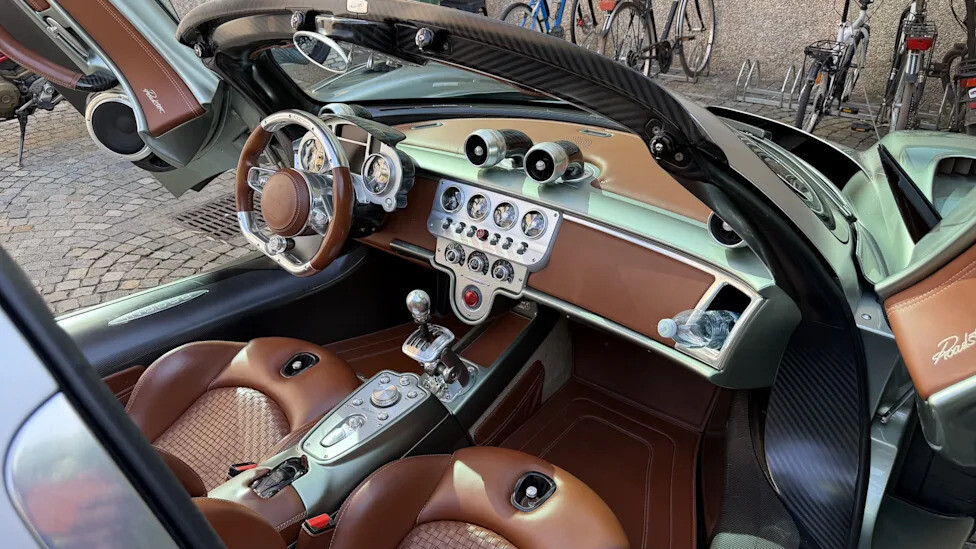
The Pagani Utopia Roadster is the latest hypercar from the Italian automaker Olga Trehub IG @OLIPHOTOPRO Pagani's Pursuit of Automotive Perfection In an automotive industry increasingly dominated by electric powertrains, digital interfaces, and computer-controlled driving experiences, Italian hypercar manufacturer Pagani continues to follow a different philosophy. Its vehicles, including the new Pagani Utopia Roadster, combine cutting-edge engineering with traditional craftsmanship, creating automobiles that are as much rolling sculptures as they are high-performance machines. Driving the Pagani Utopia Roadster in the mountains above Malibu was quite a treat Founded by Argentine-born Horacio Pagani, the company traces its roots to his work developing advanced composite materials at Lamborghini before establishing his own engineering and design business in Italy. Pagani's first production hypercar, the Zonda, debuted in 1999, followed by the Huayra in 2011 and the Utopia in 2022. The latest evolution of that lineage is the Pagani Utopia Roadster, a $3.4 million open-top hypercar combining an 852-horsepower V12, an available seven-speed manual transmission, and extraordinary attention to detail. I recently spent several hours with Horacio Pagani discussing his company's philosophy before driving the Utopia Roadster along California's Pacific Coast Highway and through the winding canyon roads above Malibu. Both experiences revealed why Pagani remains one of the automotive world's most prestigious manufacturers. The Utopia Roadster weighs no more than the coupe, with a 2,822 dry weight A Design Philosophy That Combines Art and Engineering Horacio Pagani approaches automotive design differently from most manufacturers. His philosophy is rooted in the relationship between art and engineering, with every component expected to serve a functional purpose while contributing to the vehicle's overall aesthetic. During our conversation, Pagani emphasized his company's extensive in-house design, engineering, and manufacturing capabilities. Rather than relying on outside styling studios, Pagani maintains direct control over the appearance and construction of its vehicles, including many of their intricate mechanical components. Sophisticated CNC machining equipment allows the company to produce complex metal components from solid blocks of aluminum and titanium. This manufacturing capability helps explain the remarkable consistency between the Utopia Roadster's exterior styling, interior materials, and mechanical systems. The Roadster also reflects an unusual development strategy. Unlike the previous Zonda and Huayra roadsters, which followed their coupe counterparts, the Utopia Coupe and Roadster were engineered simultaneously. That decision helped Pagani achieve something impressive: the Roadster maintains the Coupe's claimed 2,822-pound dry weight despite its removable hardtop and soft-top roofs. The Mercedes-AMG 6.0-liter V12 makes 852 horsepower and 811 pound-feet of torque An 852-Horsepower V12 With a Choice of Transmissions Powering the Utopia Roadster is a Mercedes-AMG-developed, 6.0-liter, twin-turbocharged V12 producing 852 horsepower and 811 pound-feet of torque. The mid-mounted engine sends power exclusively to the rear wheels, without any hybrid assistance. An electronically limited top speed of 217 mph places the Roadster firmly within the upper reaches of modern hypercar performance. But perhaps its most interesting mechanical feature is the transmission. Buyers can choose between a seven-speed automated manual transmission with paddle shifters or a genuine seven-speed manual gearbox with three pedals and an exposed shift mechanism. My test vehicle featured the traditional manual, including a dogleg shift pattern that places first gear in the lower-left shift gate. The polished metal shifter, exposed linkage, and mechanical engagement create a driving experience increasingly absent from modern performance cars. With 811 pound-feet of torque available across a broad engine-speed range, selecting the perfect gear is almost unnecessary. The V12 delivers tremendous acceleration regardless of gear choice. Yet the manual transmission makes that performance considerably more entertaining. What surprised me most was how approachable the Utopia Roadster felt. Initially, driving a $3.4 million automobile can carry understandable anxiety. Within approximately 15 minutes, however, that concern largely disappeared. The hydraulic steering delivers excellent feedback, while the transmission, throttle, and brake controls respond with remarkable consistency. Despite the car's substantial width, navigating narrow Malibu canyon roads felt natural and confidence-inspiring. The Utopia's greatest achievement isn't simply its extraordinary performance. It's the way that performance becomes accessible through intuitive driver controls. A rich engine note emanates from the Pagani Utopia Roadster's central, quad exhaust Sculpted Carbon Fiber Creates a Distinctive Exterior The Utopia Roadster's exterior combines classic Italian sports-car proportions with advanced aerodynamic engineering. Its flowing bodywork avoids the oversized wings and aggressive external aerodynamic elements common on contemporary hypercars. Instead, carefully shaped carbon-fiber panels manage airflow, supplemented by active aerodynamic flaps at the rear. Distinctive butterfly doors, centrally mounted quad exhaust outlets, and intricately designed wheels reinforce the car's unmistakable identity. The removable hardtop integrates cleanly into the exterior design and features a large glass panel. A secondary soft-top provides additional flexibility for open-air driving. Carbon fiber plays an especially important role in both the car's appearance and structure. Pagani has spent decades developing sophisticated composite materials, including the Carbo-Titanium and Carbo-Triax formulations used in the Utopia's monocoque chassis. More than 40 composite formulations contribute to the vehicle's impressive combination of strength and low weight. The example I drove featured an extraordinary exposed-carbon finish that revealed the woven material beneath translucent Habanero Red coloring. Depending on the sunlight, the bodywork transitioned between deep reddish-brown and brilliant crimson. Even the exterior reflects Pagani's belief that advanced materials shouldn't necessarily be hidden beneath conventional paint. The Pirelli Cyber Tire brings a new level of sophistication to the tire market The Roadster also introduces Pirelli's Cyber Tyre technology, incorporating sensors inside the tires that communicate information to the car's electronic control systems. This additional data helps the stability and traction-control systems respond more intelligently to driving conditions. The interior features high-quality materials and dedicated (non-touchscreen) controls An Interior That Celebrates Physical Controls If the exterior demonstrates Pagani's artistic philosophy, the interior makes that philosophy impossible to ignore. Where most contemporary manufacturers are moving toward expansive touchscreens and software-controlled interfaces, Pagani has embraced traditional analog gauges, dedicated switches, machined-metal controls, and visible mechanical components. The dashboard features prominent analog instrumentation, supplemented by a relatively small digital display providing navigation, vehicle information, and Apple CarPlay functionality in my test vehicle. Climate controls, window switches, door locks, and other frequently used functions retain individual physical interfaces. These aren't ordinary plastic buttons. They are carefully sculpted metal components with substantial, satisfying tactile feedback. The exposed manual shifter reinforces the mechanical character, while intricately finished vents, metallic trim, and beautifully upholstered seats contribute to a cockpit that feels more like an elaborate mechanical instrument than a conventional automobile. Even the steering wheel is remarkable. Pagani machines it from a single, approximately 95-pound block of aluminum through a 28-hour manufacturing process, producing a finished wheel weighing just 3.5 pounds. What's particularly impressive is that this extraordinary craftsmanship never compromises functionality. The controls fall naturally to hand, their operation feels intuitive, and the driver's attention remains focused on the road rather than a touchscreen. Driving the Utopia Roadster reiterates the appeal of tactile controls while laying bare the reason so many modern vehicles have abandoned this approach – cost. With only 130 examples being produced, Utopia Roadster buyers need to commit soon Just 130 Examples, Starting Around $3.4 Million Pagani plans to produce only 130 Utopia Roadsters worldwide, ensuring that each example will remain exceptionally rare. The company announced an original starting price of 3.1 million euros before local taxes, approximately $3.4 million at the vehicle's 2024 introduction. Extensive customization can push the final transaction price substantially higher. Each buyer can select from nearly limitless combinations of exterior finishes, exposed carbon fiber, interior materials, colors, and mechanical details. After spending time with Horacio Pagani and experiencing his latest creation firsthand, it's clear that the Utopia Roadster represents considerably more than another ultra-expensive performance car. It's the product of a manufacturer that has spent decades refining a consistent vision of automotive excellence. The Pagani Utopia Roadster delivers exceptional engineering, timeless styling, extraordinary craftsmanship, and an engaging driving experience. More importantly, it combines those attributes without sacrificing the fundamental pleasure of interacting with an automobile. In an industry increasingly focused on technological complexity, Pagani has demonstrated that some of the most satisfying automotive experiences still come from the simple, direct connection between a driver and a machine.

 Liked by Owen Hill, Caleb Girard















 Liked by Owen Hill, Caleb Girard