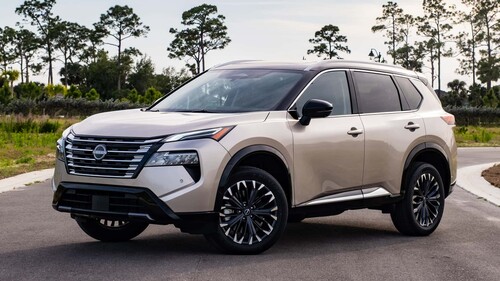
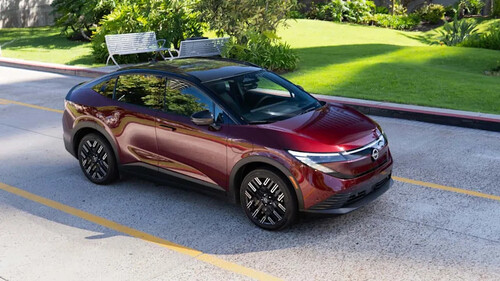
YOKOHAMA, Japan — Nissan’s redesigned Rogue will become what the Japanese automaker says is its first software-defined vehicle when the hybrid reaches U.S. showrooms next month, launching a multiyear effort to catch Chinese and Silicon Valley rivals.
Nissan Canada only says the vehicle arrives this fall.
The next-generation crossover, Nissan’s bestseller in both countries, will get advanced over-the-air update capabilities and use the company’s new software platform, Nissan software executives said Oct. 28.
Takashi Yoshizawa, corporate executive for SDVs, pitched the Rogue as the first step toward more sophisticated artificial intelligence-defined vehicles Nissan will bring to market starting in the fiscal year ending March 31, 2028. Nissan labels that next-step system AI-Drive technology.
Nissan’s AI-Drive technology will leverage what the company calls its Scalable Open Software Platform. The system will underpin the company’s next-generation ProPilot driver-assist system, Yoshizawa said during an Oct. 28 briefing at Nissan Motor Co.’s global headquarters here.

Keep up with product planning news with Automotive News' regularly updated database.
Future Product database: 5-year vehicle timelines
Future Product guide: Our 10-week series on future products by brand
Nissan will first deploy the next-generation ProPilot in the Elgrand van for Japan in the fiscal 2028 year. It has not announced timing or a nameplate for its U.S. introduction.
The Rogue’s software platform is the first piece of a multiyear plan to build Nissan’s brand around AI, and it gives the automaker a baseline as it works to close the gap with Tesla and Chinese rivals such as Xiaomi. CEO Ivan Espinosa outlined a vision in April to build Nissan’s brand image around AI by deploying its AI Drive technology across 90 percent of the lineup long term.
While Nissan’s technology doesn’t yet integrate control of zonal systems such as infotainment, powertrain and safety, Yoshizawa says the setup fits Nissan’s definition of “software defined” because it enables feature-on-demand downloads and more efficient, secure data uploads.
The new SDV setup uses two operating systems in its electronic control units. The first is BlackBerry’s QNX system, for handling cybersecurity and over-the-air updates. The other is Autosar, which oversees energy management of the vehicle’s 12-volt battery and body electronics, in such functions as vehicle diagnostics and inter-ECU communication.
Nissan also working on next-gen SDVs with Honda
Nissan says feature-on-demand downloads will allow the Rogue to add vehicle functions. Nissan’s previous OTA system enabled only rudimentary firmware updates, at slower speeds.
In previous Nissan systems, the scope of data uploaded was also predefined.
In the new Rogue, by contrast, data can be selected on demand, providing greater flexibility in determining what is uploaded to match individual user needs, the company said.
Looking ahead, Nissan’s AI-Drive technology will encompass the next-generation ProPilot, which will leverage AI software from Britain-based autonomous technology partner Wayve.
After AI-Drive, Nissan will introduce another layer of functionality called AI-Partner Technology. It will arrive after that as a cockpit AI agent that helps people customize their driving experience.
Yoshizawa compared it with the Grok AI assistant system deployed by Tesla.
Nissan’s AI focus is a bridge to a new era of SDV technology due to arrive starting around 2029.
That setup will encompass electronics hardware and operating systems jointly developed with Honda Motor Co. The companies agreed in August to combine forces to develop and standardize multiple electronic control units that will form the core of software-defined vehicles and in-vehicle operating systems. They will also develop the vehicle control software that run the ECUs.
The cooperation had been in discussions since 2024. In finalizing the agreement, Nissan and Honda said the technology will be deployed in vehicles from both companies from the 2029 fiscal year, which ends March 31, 2030, about two years later than originally envisioned.