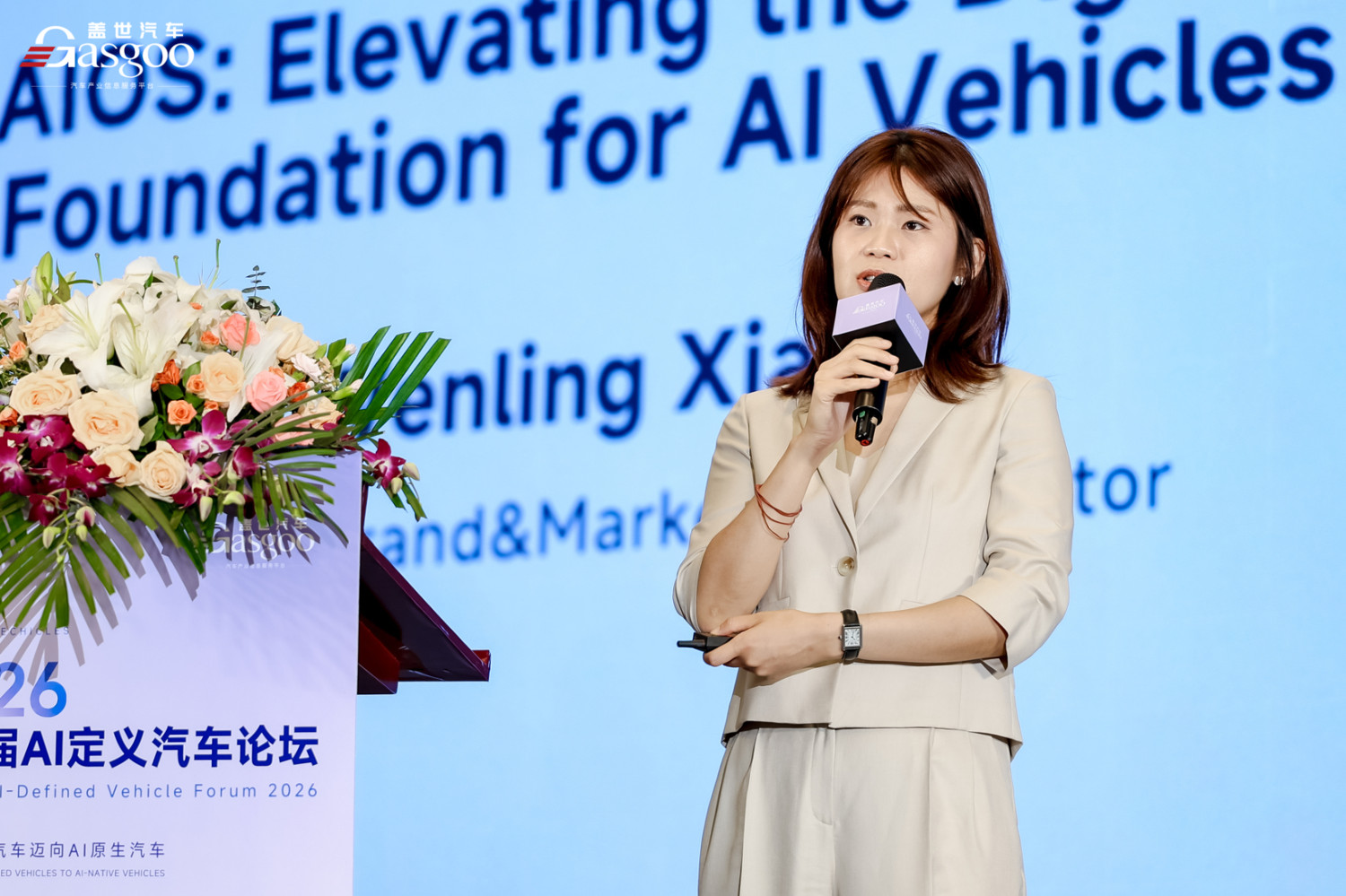



















Gasgoo Munich- As AI penetrates deeper into the vehicle, the foundation beneath it must be rock-solid.Speaking on September 17 at the 4th AI-Defined Vehicle Forum, Xiang Wenling, marketing director of the Reach brand, discussed the evolution of AI automotive operating systems. She noted that as the auto industry moves beyond software-defined vehicles toward AI-defined ones, the relationship between AI and the vehicle operating system is shifting.In her view, the automotive OS of the future won't just host AI applications—it must also unify the management and scheduling of models, data, computing power, and AI Agents. As AI capabilities penetrate deeper into the vehicle, the demands on the underlying software for stability, security, and standardization only intensify."AI OS needs a more solid foundation," Xiang said. While the integration of AI and vehicles will accelerate, the car remains a complex system with exacting requirements for safety, reliability, and real-time performance. AI capabilities may iterate rapidly, but the underlying operating system must first guarantee the vehicle's stable operation.To that end, Neusoft Reach is advancing its NeuSAR OS vehicle operating system architecture.At the foundational level, products like NeuSAR cCore and NeuSAR aCore—built on AUTOSAR standards—provide basic software capabilities for various controllers and computing platforms. Currently, Neusoft Reach’s foundational software supports over 100 mainstream automotive-grade chips from domestic and international suppliers, backed by extensive experience in mass production and reliability verification.Building on this, the vehicle software architecture is evolving further toward Service-Oriented Architecture (SOA) and AI integration.Xiang explained that Neusoft Reach uses the NeuSAR Service Framework to build vehicle-wide service capabilities, while the AI Framework unifies the management of data, models, and computing resources. This provides the underlying support that allows AI Agents to invoke vehicle functions.According to Neusoft Reach, the evolution of AI OS falls roughly into three stages: "AI in OS, AI for OS, and AI as OS."In the first stage, AI enters the vehicle primarily as isolated functions or applications. In the second, the operating system begins providing foundational capabilities like data, models, and computing power for AI. As evolution progresses, AI will embed itself deeper into the vehicle OS. The Agent will no longer be a standalone application but will be able to directly invoke capabilities across different vehicle domains and services.This shift is also extending into the automotive development process.Xiang noted that Neusoft Reach has already integrated AI into software development workflows, including requirements analysis, configuration, coding, test case generation, and fault diagnosis. Leveraging large models and intelligent development tools, tasks such as API retrieval, code assistance, issue localization, and test script generation can be further automated, thereby shortening development and testing cycles.This means that "AI-defined cars" involves more than simply adding a large model to the cockpit or upgrading intelligent driving capabilities. As AI gradually penetrates the depths of the vehicle architecture, the automotive software system itself requires redesign.For automakers, the challenge ahead isn't just "how to install AI in the car," but rather how to balance the rapid iteration of AI capabilities with the industry's long-standing standards for safety, reliability, and mass production. AI may move faster, but the foundation that supports it on the road cannot become more fragile.