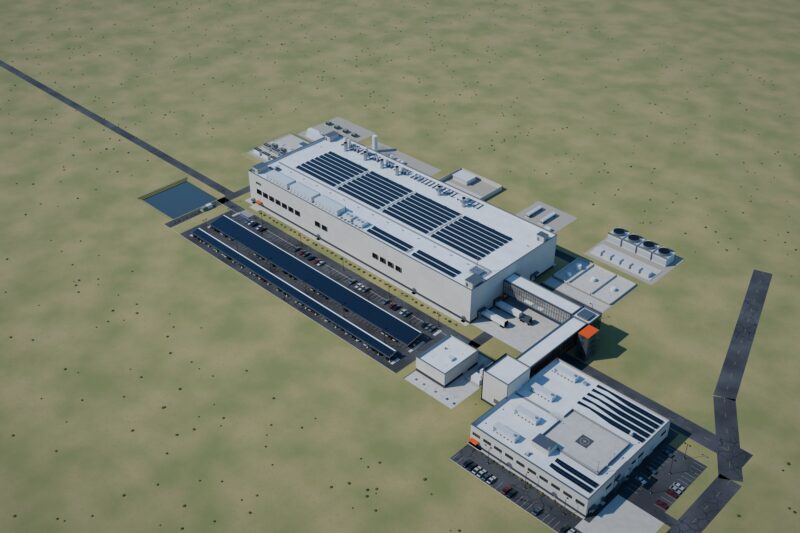
a Substack subscription, on Patreon, or on Stripe. Help us produce all of the high-quality, original content we publish week after weekdespite the challenges of content-scraping AI, antisocial media, inflation, and other hurdles. NAED Energy Holding Inc. (NAED) just published the rating of PV-1, its production line for T2X perovskite/silicon heterojunction tandem solar cells. Each PV-1 line is rated at 16,000 G12 half-cut wafers per hour: 400 wafers every 90-second index, a rate set by the line’s inline PVD tool (ITO-1). The line’s four PECVD modules are built for a faster 76-second index, about 18,950 wafers per hour. At NAED’s planning basis—85% availability, 97.5% yield, and the T2X programme target of 30% cell efficiency—one PV-1 line produces about 116 million cells and 0.77 GW of tandem cells a year. NAED’s six-line site, at 96,000 wafers per hour, has a rated capacity of about 4.6 GW a year. Throughput and capacity in this release are rated values, and cell efficiency is modelled. NAED will publish measured throughput, yield, and efficiency, with their test basis, as results are logged. For all technical information on PV-1 and the T2X cell, contact cto.fusion@naedcorp.com. At a glance The 34.4% figure is NAED’s modelled T2X cell (Voc 1.969 V, Jsc 20.18 mA/cm², fill factor 0.867, 217.2 cm² half-cell). For context, the highest published efficiencies for perovskite/silicon tandem cells of this size are in the 32–33% range, including Maxwell’s certified 32.38% on a G12 half-cell reported in January 2026. NAED’s planning figures use the 30% programme target. How PV-1 compares with published equipment The comparisons below are rate-to-rate. A PV-1 figure describes a complete integrated line, while some benchmarks describe a single tool; supplier figures are the suppliers’ own published ratings. A single PV-1 line runs at or above the rate of leading single deposition tools while carrying the full tandem process — wet clean, PECVD, PVD, top-cell deposition, printing and test — in one line. Six lines carry the output of about three large HJT lines or seven to eight commercial tandem lines. What the output looks like One year of output from the six-line site is enough cells for about 7.7 million 600-watt panels, which would generate roughly enough electricity for about 650,000 U.S. homes for a year (17% capacity factor, 10,500 kWh per home; typical U.S. values, not site data). Panels keep generating for 25–30 years, so each year of production adds to that total. Basis and assumptions Rating: 16,000 G12 half-cut wafers per hour per line, 400 wafers per 90-second index (NAED-PV1-000, decision D4); 200 windowed trays of 80 wafers an hour at the top-cell stage. Cell: G12 half-cut, 210 × 105 mm; power per cell at 1,000 W/m²: 6.61 W at 30% (220.5 cm² planning basis), 7.47 W at the modelled 34.4% (217.2 cm²), 5.62 W at 25.5%. Operating basis: 85% availability and 97.5% yield over 8,760 hours (7,446 running hours a year)—NAED planning assumptions. Capacity is cell-level DC at standard test conditions; module output is lower after cell-to-module losses. Supplier figures are the suppliers’ published ratings as reported in the sources below; NAED has not tested them. For all technical information, including the basis of any figure in this release: cto.fusion@naedcorp.com. News from NAED Energy Holding Inc.

 Liked by Charlotte Hall, Emily Tremblay
 Liked by Charlotte Hall, Emily Tremblay