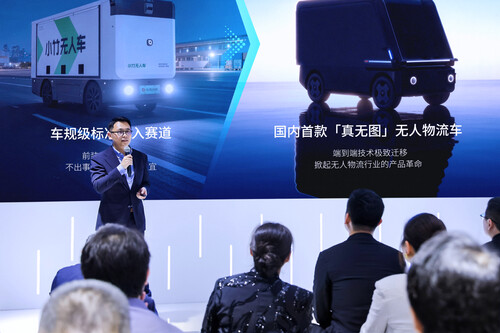
Gasgoo Munich- MINIEYE recently formed a strategic partnership with StarCharge to develop automated charging hubs for driverless vehicles, extending their focus beyond vehicle autonomy to the infrastructure needed for large-scale fleet operations, according to a post MINIEYE issued on July 17 via its WeChat account.The companies plan to integrate autonomous driving systems aboard vehicles with automated energy services at charging sites, creating an operating model that requires little or no on-site human intervention. They also intend to make the underlying infrastructure standards available to other industry participants, with potential applications spanning autonomous urban delivery, industrial park logistics and Level 4 passenger vehicles.The agreement targets an infrastructure gap that is becoming more visible as driverless logistics fleets move from limited trials toward broader commercial deployment. While vehicle technology has advanced, operators continue to face slow or inefficient charging, high labor costs and a shortage of urban sites capable of accommodating large numbers of vehicles.Concentrated fleet charging can also place pressure on the power grid when vehicle schedules and local electricity capacity are poorly coordinated. These constraints mean that expanding a driverless fleet depends not only on deploying more vehicles, but also on establishing charging and parking facilities that can support them reliably.For MINIEYE, the partnership adds a critical infrastructure component to its autonomous logistics business. As deployments expand from individual demonstration projects to repeatable city-level operations, the commercial test is shifting from whether a vehicle can navigate public roads to whether an entire fleet can be dispatched, parked, charged and maintained economically.Charging efficiency, large-scale parking capacity and coordination among vehicles, electricity networks and operating sites are therefore emerging as important measures of whether autonomous delivery services can scale sustainably.The project will combine MINIEYE's Level 4 driving technology and fleet-dispatch capabilities with StarCharge's charging equipment and station-operating resources. MINIEYE's system covers autonomous return-to-base functions and the positioning required for a vehicle to connect with charging equipment without manual assistance.Image source: MINIEYEThe two companies aim to build an end-to-end operating loop for MINIEYE's Bamboo Robovan, encompassing delivery assignments, autonomous parking, automated charging, vehicle inspection and maintenance. MINIEYE markets the Bamboo Robovan as a driverless logistics vehicle designed for urban last-mile and short-haul delivery.The rollout is expected to proceed in stages. StarCharge will initially match its existing charging sites with cities where MINIEYE has deployed autonomous vehicles, allowing Bamboo Robovans to charge at designated locations according to fixed schedules.As fleet volumes increase, the partners plan to develop dedicated charging centers where vehicles can enter, connect to chargers and leave autonomously. A later phase could introduce mobile energy-storage vehicles and combine solar generation, battery storage, charging and fleet dispatch within a single energy-management system, subject to commercial conditions.The StarCharge agreement follows a separate partnership MINIEYE announced with DiDi Delivery on July 13. That collaboration is intended to connect Bamboo Robovans with delivery orders through DiDi's freight platform, bringing together demand aggregation and Level 4 delivery vehicles.The two deals address opposite ends of the same operating chain. DiDi Delivery can provide access to freight demand, while StarCharge can support the physical infrastructure required to keep the vehicles in service. That combination is relevant to high-frequency applications such as express delivery, intra-city freight, on-demand retail distribution, supermarket logistics and transport within industrial parks.Taken together, the partnerships could help MINIEYE assemble a more complete ecosystem for Level 4 logistics, stretching from order intake and autonomous delivery to parking, charging and maintenance.The approach illustrates how competition in autonomous logistics is broadening beyond driving algorithms. Commercial success will also depend on whether operators can coordinate orders, vehicles, charging facilities and maintenance services as one continuous system.MINIEYE said it will continue developing map-free Level 4 driving algorithms, intelligent fleet dispatch and commercial operating capabilities across different logistics scenarios. Working with StarCharge and other industry partners, the company plans to further integrate vehicles, charging sites, energy systems and dispatch platforms.Whether the model can be replicated at scale will depend on factors including infrastructure investment, site availability, utilization rates and coordination with local power networks. If those elements can be aligned, automated charging hubs could remove a significant operational constraint on the wider deployment of driverless urban logistics fleets.