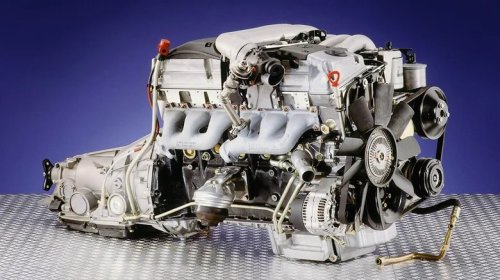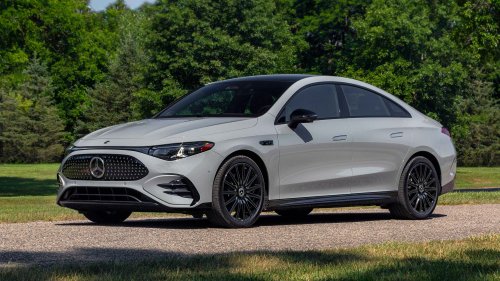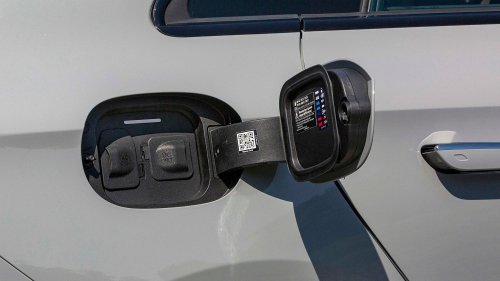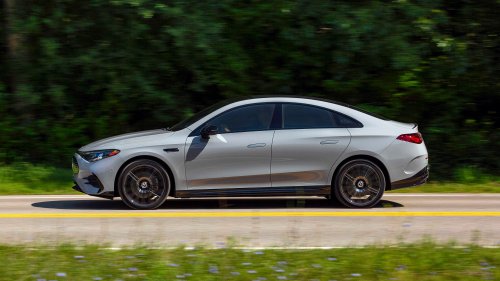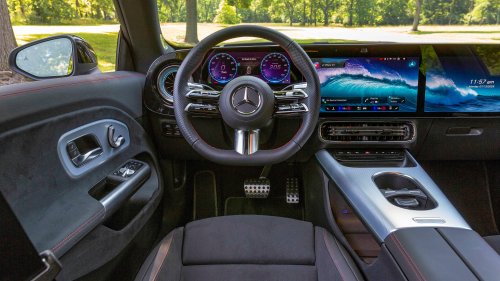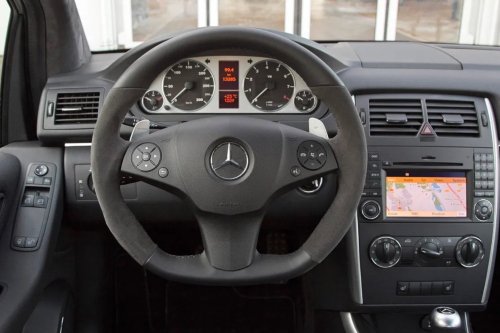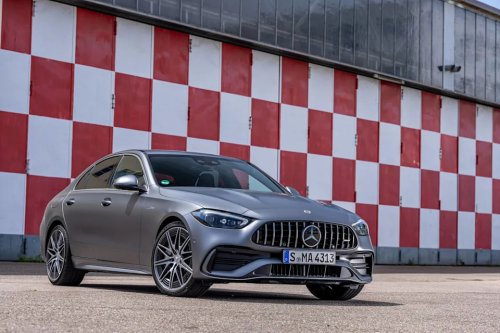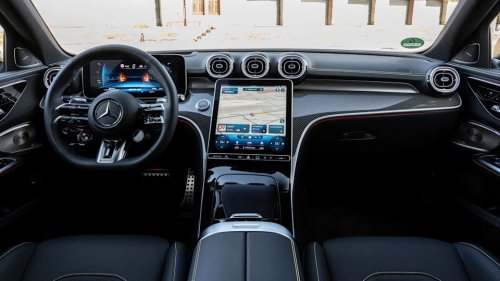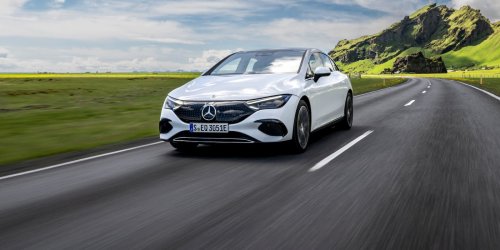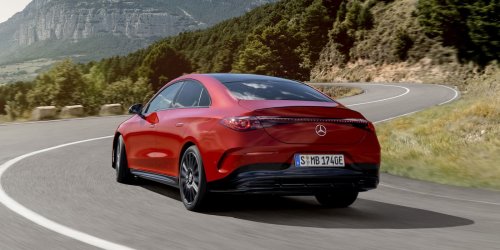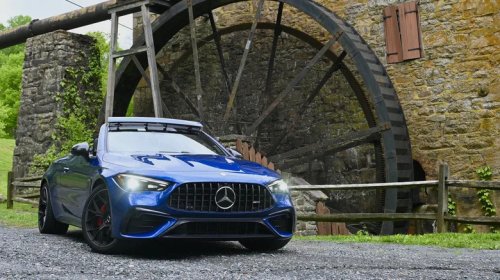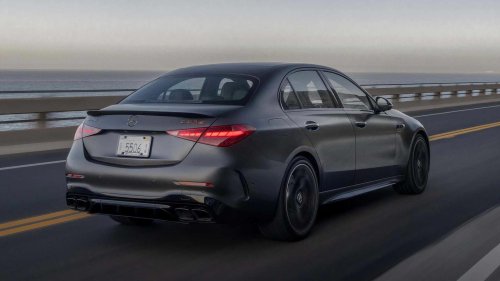
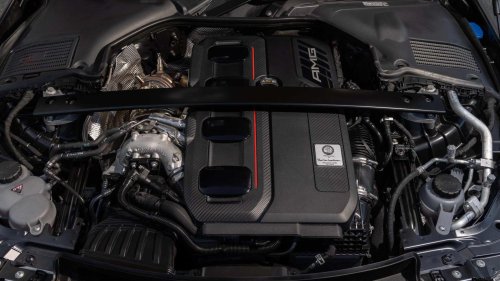
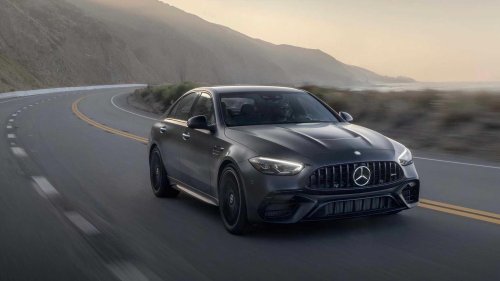
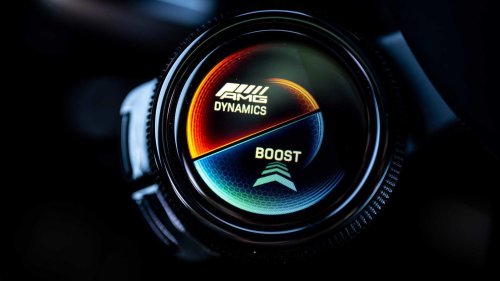
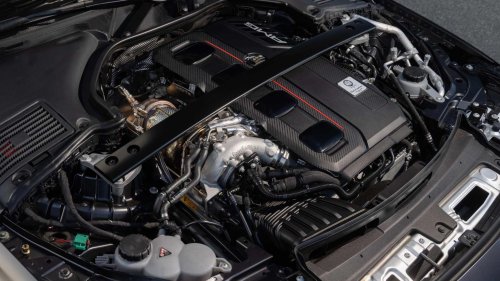
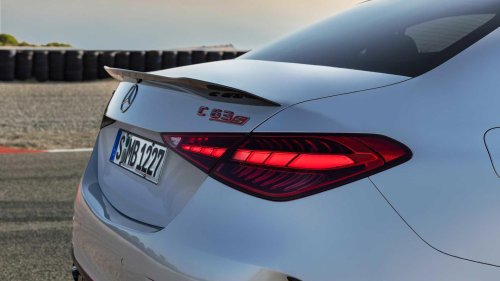
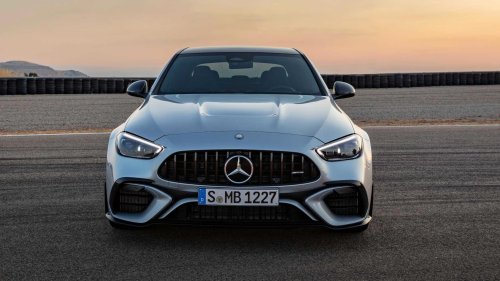
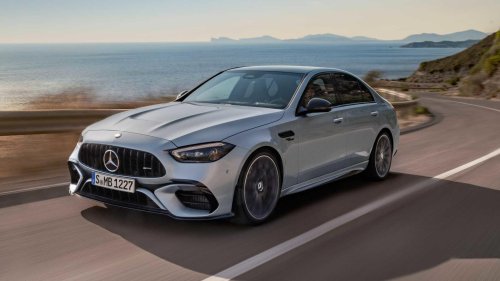
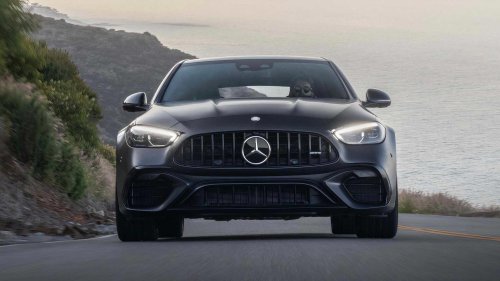
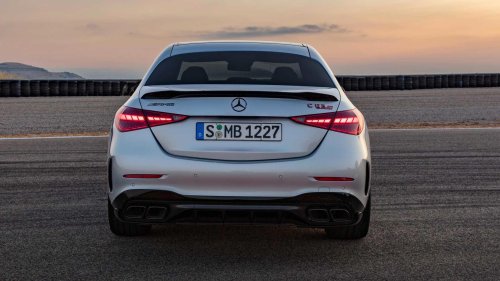



















The most powerful four-cylinder powertrain on the market today can be found in the Mercedes-AMG C63 S E Performance. On its own, the turbocharged M139 four-cylinder makes 469 horsepower, that's almost as much (94%) as the Coyote V8 in the Ford Mustang, but from just 40 percent of the displacement. It’s a similar story against the Corvette Stingray’s LT2 V8: the AMG four’s 469 horsepower packs about 95% of the Stingray’s 495‑horsepower output, from barely a third of the liters.Mercedes-BenzThat's only part of the story. Recent technology transfers from the world of motorsports have added a major (and controversial) electrified boost to the M139 engine. With the addition of some high-output electric componentry that first appeared in 2023, the M139 now supports an electrified drivetrain that packs 671 total horsepower and a crushing 752 lb-ft of torque. That makes it not only the first four-cylinder platform to push past 500 lb-ft of torque, but it's also the most powerful four-cylinder powertrain on the road today.Below, we'll dig into how AMG hunted the four-cylinder power-density crown with the M139 engine, and how it evolved into the most outrageous small-displacement performers on sale today. M139's Early Days As A Power Per Liter Champ Mercedes When the M139 first arrived for model year 2020, a collection of technologies and advancements had come together to give AMG the spiciest factory four-cylinder around. Years of development with turbocharging, GDI, electronic tuning, and management of combustion chamber temperatures had allowed for the creation of a 2-liter, 416-hp turbo four with 369 lb-ft of torque, on pump gas, with a warranty.For context, other big-power four-cylinder engines weren't uncommon at the time, but the M139 really raised the bar. It's predecessor, the M133, was a 2-liter, 375-hp four-cylinder turbo with 350 lb-ft of torque.Back in 2010, the Mitsubishi Lancer Evolution X's 4B11T turbo-four engine made 291 hp and 300 lb-ft of torque from two liters displacement. In 2015, the Subaru WRX STI made 305 hp and 290 lb-t from a 2.5-liter Boxer unit. The K20C1 in the Honda Civic Type R (2017) was right in the same ballpark as a smaller 2-liter unit. Hyundai would sell you a high-output Theta-II in their Veloster N for 2019, this version cranking out 275 hp and 260 lb-ft of torque.Mercedes-BenzThat same year, GM's L3B 2.7T engine launched in the Silverado and Sierra. Though not a sports car engine, this big-boost four-cylinder made 310 hp and a very mighty 348 lb-ft of torque at launch, and climbed to 430 lb-ft of torque with a 2022 update. Like the M139, GM's four-cylinder truck engine was all about pushing this compact engine to its limits. The M139 enjoyed years at the top of the power-per-liter and torque-per-liter charts, and a major power boost was yet to arrive. Big Electric Boost Arrives In 2023 MercedesWith the addition of F1-inspired hybrid tech, the M139 engine was joined by various power-adders throughout the driveline. From the basis of the world's most powerful series-production four-cylinder with 469 hp, a rear axle electric motor was added. It doesn't make the M139 engine itself any more powerful, though it boosts total horsepower output available to the driver up to 671 hp, a 202-hp boost if you're counting. Oh, and don't forget 752 lb-ft of torque.Mercedes The electrified turbocharger can be pre-spun to generate boost before engine exhaust flow takes over. This eliminates turbo-lag, not that you'd likely notice any anyway on account of the added push from the electric rear axle. The electrics are powered by a 400-volt performance battery born of exclusive in-house developments. The battery was specifically selected for its power density, enabling fast recharging and powerful high-output bursts. The electrically assisted turbocharger helps add to the on-demand torque as well. MercedesThis precisely integrated propulsion system took the AMG character into the hybrid era with a powerplant that always feels like it's on boost and ready to strike. The 400-volt battery has a capacity of 6.1 kWh, a continuous output of 94 hp, and a peak output of 201 hp in 10-second bursts. The pack itself weighs 196 lbs, helping deliver very high power density. According to the engineers, this battery is designed for fast power delivery and draw rather than the longest possible range.The rear motor acts directly on the axle, and can convert its power more directly into propulsion for an extra boost from standstill, or while overtaking or accelerating out of a bend. A limited-slip differential with torque-vectoring capability helps optimize rear axle traction at all times.All this power flow required some massive cooling technology. Engineers created impossibly thin cooling modules that help circulate 3.7 gallons of high-tech battery coolant around every cell in the pack, and through an oil/water heat exchanger attached to it. This helps keep the battery within a consistent, optimum operating temperature window that averages 113 degrees Fahrenheit, no matter how often it is charged or discharged.MercedesThis all caused some technological whiplash when the hybrid AMG M139 engine took over from the previous M133 that ran from 2013 to 2019. Now with half the cylinders, half the displacement, and half the turbochargers of its predecessor, the hybrid four‑cylinder setup offered a third more total horsepower and a massive 46% improvement to torque output, sufficient to send the machine to 60 mph about a 10th of a second quicker than the outgoing twin turbo V8. All the while, the four-cylinder hybrid cut your annual fuel spend by 17 percent.MercedesCool numbers, but AMG had been powering their hottest rides with rip-snorting V8 engines for years, partially because the US market loved them so much. Remember: during at least two points in history, AMG defined entire eras of their high-performance lineup with iconic V8 engines designed to earn favor with North American drivers. In the early 2000s, a supercharged V8 powered an entire generation of AMG products, and later, the M156 V8 engine came along to give fans another entire generation of lusty V8s, this time powering cars with a big-displacement, all-motor unit. The Torque War Isn't Going Anywhere Mercedes-Benz These days, automakers are getting more creative than ever to deliver more power using less fuel. The M139's highly electrified approach is one of the various ways to do it. Hybrid technology is breathing new life into high-performance engines that might not otherwise meet tightening emissions and fuel consumption regulations.The high-torque electric motors and characteristically high torque output of a turbocharged engine go hand in hand together. The two technologies work especially nicely as a team, since electric motors can fill in for the turbocharger at low revs to give drivers a smoother and more EV-like power curve that still delivers the thrill of combustion.Of course, adding hybrid tech is just one approach in use. Other automakers are launching exciting new pre-chamber ignition technologies, including BMW with its M-Ignite system, and Stellantis with its new Turbulent Jet Ignition (TJI) system. Like the M139's engine adoption of hybrid power, these pre-chamber systems are foundational advancements to engine design that support improved performance, reduced consumption, and lower emissions, just in a different way.Mercedes Though horsepower output is the go-to performance figure for many, automakers shifting to electrification and advanced combustion systems for their latest offerings are quietly pushing torque output higher and higher with engines that can handle more boost, more heat, higher compression ratios, and – more commonly – an electric motor or two added to the mix. Remember: torque is the all-important metric when it comes to getting a heavy object up to speed. Also, engines with more torque need fewer revs and less throttle to get the job done, helping light-footed drivers save fuel if they can fight the urge to stay out of the boost. Sources: Mercedes-Benz