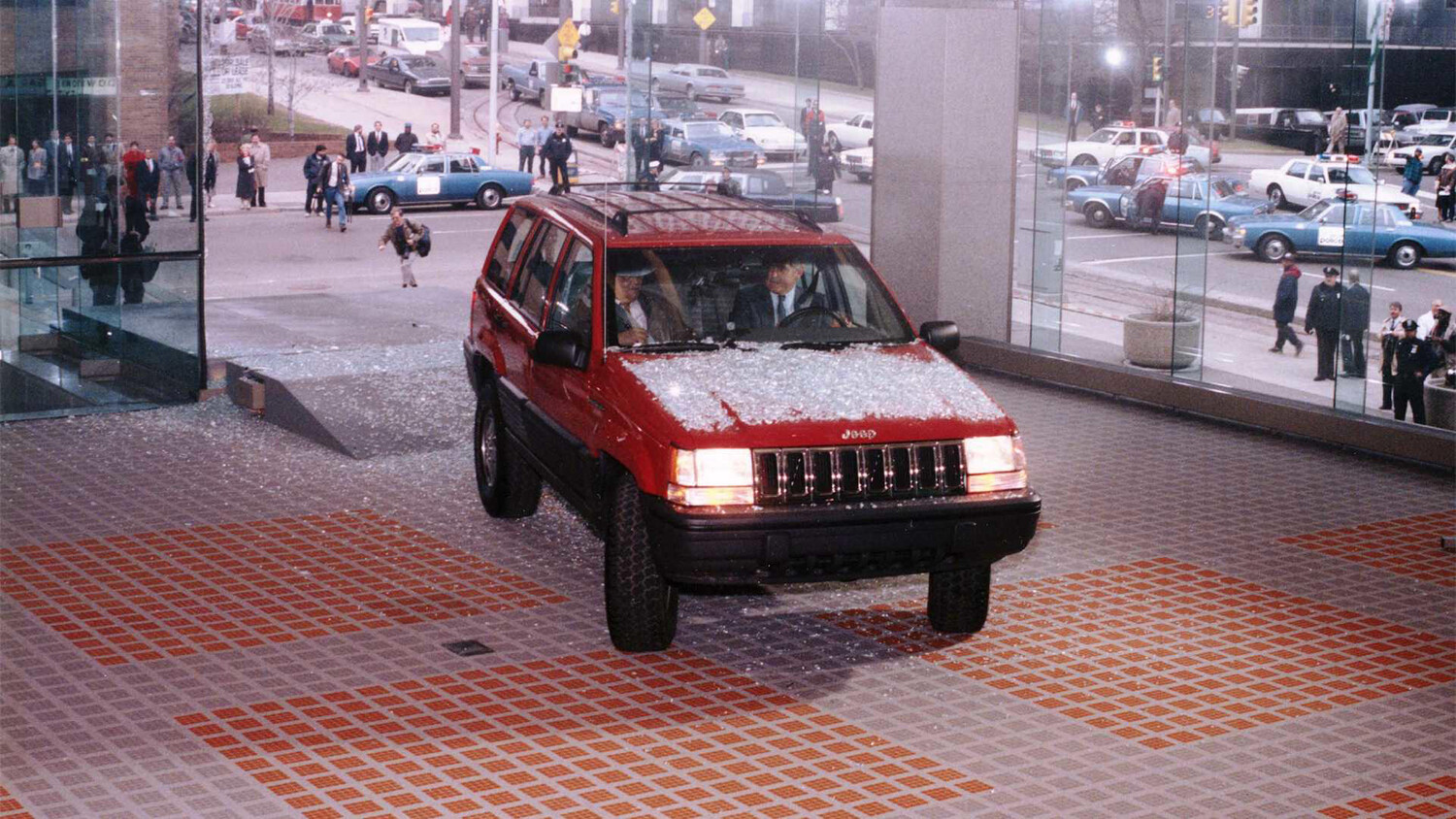
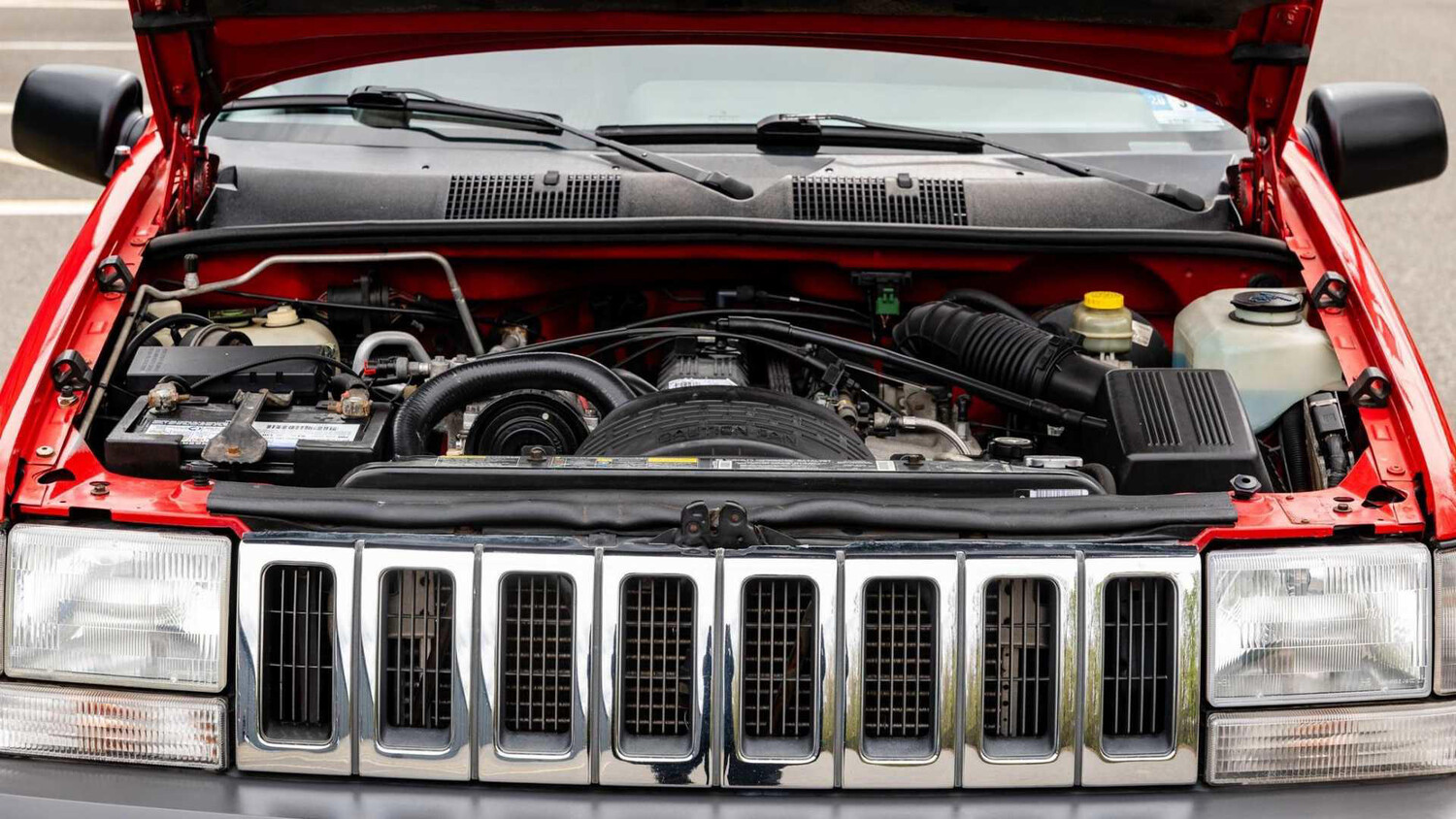
Beginning in the 1980s, the entire scope of the American automotive market started changing rapidly. That's because, in 1984, Chrysler introduced the Plymouth Voyager and Dodge Caravan. They were the first minivans that managed to catch on, and their combined fame dealt a major blow to the station wagon and large sedan, both of which were popular family haulers for decades. Then, in early 1991, the Ford Explorer came along, kicking off the SUV revolution we're still experiencing today.Once it was obvious that the Explorer was selling like hotcakes, other domestic and international automakers were keen to build their own, mid-size family SUVs. One of which was the Grand Cherokee, Jeep's answer to the burgeoning SUV market beginning in 1993. It slotted right above the Cherokee in Jeep's SUV lineup, and was outfitted with numerous luxuries not seen in the former. Not to mention, its underhood area housed the 4.0-liter AMC straight-six; arguably one of the most reliable engines ever produced. The Grand Cherokee's Inline-Six: A Long Time Coming Cars & BidsIf you include every single AMC straight-six that the famous 4.0-liter is related to in some way, the family lineage stretched a total of 42 years. However, the first iteration of the 4.0-liter itself came about in 1986, after roughly 26 months of development. It took some of its mechanical make-up from the AMC 258 CID straight-six, making the latter its spiritual predecessor. It didn't take long for the motoring world to notice just how durable the 4.0-liter six actually was.As far as the first-gen (ZJ) Jeep Grand Cherokee's use of the mill is concerned, it began back in 1993, coinciding with the model's debut year. The mill itself boasts a rather simple construction, something that – at the time – was beginning to look like a thing of the past. For starters, its engine block was made from cast iron, along with its cylinder head. It also didn't have any sort of overhead-cam valvetrain setup, opting for an old-school, push rod, overhead-valve configuration.Also, part of the 4.0-liter straight-six's reliability stew is its extremely robust bottom end. Its crankshaft is supported by seven main bearings, more than most other four or six-pot engines, which significantly ups the strength factor. It also came equipped with forged steel connecting rods and a hardened cast iron camshaft. It was an over square engine, meaning its cylinder bores are wider than its piston stroke is long.Stellantis As for the rest of the ZJ Grand Cherokee's mechanical make-up, it came with either a four-speed automatic or a five-speed manual transmission, although the stick was discontinued following the 1995 model year. You could have the ZJ with either the standard rear-wheel drive or one of three optional four-wheel drive systems, those being the Selec-Trac, Quadra-Trac, and Command-Trac systems.It's important to note that RWD ZJ Grand Cherokees are exceedingly rare. Jeep's Quadra-Coil suspension system, which takes advantage of a coil spring and shock absorber at each wheel, is standard. Reliability StellantisAccording to CarSurvey.org, the entire first-gen Grand Cherokee, produced between 1993 and 1998, receives a 7.0 out of 10 reliability rating, decidedly average. It's also below the Ford Explorer's average rating of 7.4 out of 10 throughout the same years from the same source. How The Ford Explorer Compared 1993 Jeep Grand CherokeeTwo years prior to the Jeep Grand Cherokee's debut, the Ford Explorer's first model year hit the market in 1991. At its core, the Explorer was heavily based on the Ford Ranger Compact pickup truck. In essence, Ford took the Ranger platform and outfitted it with a softer, more car-like rear suspension setup, but kept the front the same. The Explorer also gained a more robust 31-spline rear axle as standard. The Ranger enjoyed the beefier rear end as an optional upgrade.As far as powertrain is concerned, the first-gen Explorer offered just a single engine, that being a 4.0-liter V6. Like the Jeep, the Explorer offered a choice between a four-speed automatic and a five-speed manual transmission, although the Ford kept its stick shift option past 1995. Both rear-wheel drive and four-wheel drive were offered, with the former serving as the standard setup. The Explorer's truck-based chassis meant it rode, mostly, like a truck. The Jeep utilized a unibody construction, which naturally lends itself to a softer, more car-like ride.1994 jeep grand cherokee dashboard tanOne spot where the Explorer fell behind the Jeep was in its interior and options list. For starters, the Jeep could be outfitted with a digital interface, called the Electronic Vehicle Information Center (EVIC), that displayed diagnostic and trip data. The EVIC was offered in higher trims, but the first-gen Explorer didn't offer anything like it. In addition, the Grand Cherokee was designed to offer a much more car-like interior with more comfortable seats, a console-mounted shifter, and even heated front seats. The Explorer didn't gain seat heating until the introduction of the second-gen iteration in 1995.To sum up, the table above tells us that the Jeep is more powerful and a bit daintier, and the Explorer is more like a tank, with its higher towing capacity, larger interior space, and much slower 0–60 mph time. Common Issues Cars & BIdsThe Jeep 4.0-liter straight-six is an extremely reliable engine, and things like extremely inexpensive parts and the fact that it's extremely DIY-friendly helped catapult it to stardom. However, the rest of the ZJ Grand Cherokee that surrounds the engine isn't as reliable by any stretch. Reportedly, the ZJ Grand Cherokee is particularly prone to automatic transmission slippage, rust issues, and the infamous "Death Wobble" caused by worn front-end components, among them the steering stabilizer.There are also numerous reports of electrical gremlins. One often-cited problem stems from the driver's door wire boot, which is a moveable rubber tube that houses wires for things like the power windows, locks, and mirror controls. The wires within are known to snap, rendering all amenities listed previously inoperable once this occurs. Alongside the wiring issue, there are also numerous reports of problems stemming from bad electrical ground connections. These ground failures can cause widespread and hard-to-trace faults. Other issues include a failing neutral safety switch, a dome light power draw, and dead or failing instrument clusters. What You'll Pay For One Bring A TrailerDespite the possibility of electrical issues and worn front-end parts, a 4.0-liter-equipped ZJ Grand Cherokee can still serve as an adequately reliable model, even though it's over 28 years old in its youngest model year. Numerous folks still drive them, and aftermarket support is still widespread. According to Classic.com, the average sale price of a ZJ Grand Cherokee from any model year is roughly $11,114 and has been trending steadily downwards over the past five years. It seems that, if you're dead set on one, now may be the time to pull the trigger. A Worthy Contender StellantisThe Ford Explorer took the American automotive market by storm, leaving a trail of crumbs behind for other automakers to follow. Jeep picked up these crumbs and produced the Grand Cherokee in a way that was softer and more car-like than the Explorer. With its 4.0-liter base engine equipped, the ZJ Grand Cherokee was an adequate competitor at the time. However, without the iconic straight-six, we simply cannot say it could hold a candle to the big, brutish, tough-nuts Ford Explorer.