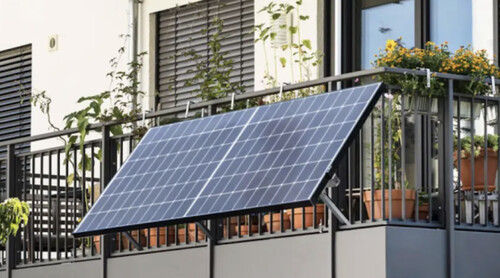
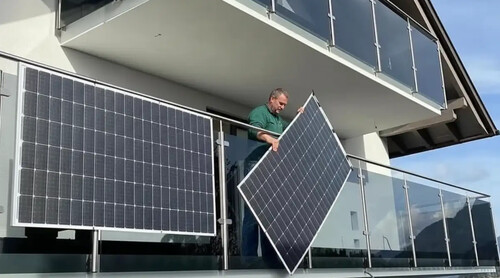
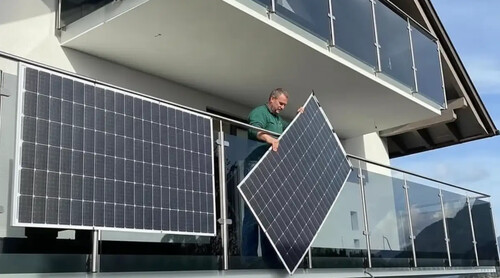
I recently had the opportunity to attend InterSolar Europe in Munich, the headlining show of The smarter E Europe. The show was both overwhelming and encouraging. Battery storage is becoming essential to solar power. Balcony solar is extending the benefits of solar and storage to new customers, like people who live in apartments. With their strength in customer-centric design, Jackery is well positioned in this rapidly expanding market. Jackery FridgeGuard. Photo by Larry Evans While visiting their booth, Jackery, who hosted me at the show, walked me through their different products for the European market. I had seen the Solar Gazebo and Solar Roof before at CES. In Munich, many of the homes have red terracotta tile roofs, and Jackery’s roofing tiles would integrate seamlessly with this traditional aesthetic. I also saw the sleek FridgeGuard in person, which I have written about before. However, Jackery’s SolarVault 3 was a highlight of the show. Solar Vault 3. Image credit: Jackery SolarVault 3 is plug and play, offering energy storage as the core of a balcony solar system. Panels can simply plug directly into the SolarVault 3, and the device plugs into a regular outlet. Four MPPT connections can be used with up to 4 kW of PV input. No separate inverter is needed. However, if you already have solar with an inverter, Jackery offers a version (Pro Max AC) with just AC input. The battery can output 800W to the grid, which is the maximum allowed under Germany’s plug-in balcony solar regulations. The focus on batteries allows customers to add more than 800W of solar panels to discharge over an extended time, while remaining below the regulatory limitation. However, those numbers can change based on different local regulations. SolarVault 3 can output and charge bidirectionally up to 1200W in the Pro and 2500W in the Pro Max through the same plug. If disconnected from the utility, it can supply up to 3680W of off-grid power. Solar Vault 3. Image credit: Jackery The SolarVault 3 system is modular and expandable to meet user needs. Beyond the core 2.52 kWh module, additional battery storage can be added by stacking 2.52 kWh, 21 kg expansion battery modules, up to 45.36 kWh total. Although those battery modules may be heavier than you might want to carry around with you on a daily basis, the modularity makes it far easier to move and position compared to a single large battery, especially in tight apartment spaces. In addition, the modularity makes it relatively easy to disassemble and transport to a new residence in the future. Solar Vault 3. Image credit: Jackery Jackery estimates that the SolarVault 3 can potentially save users over €2000 per year, depending on application and configuration. With Germany’s high electricity prices, those savings will be a welcome relief. SolarVault 3 prices in Germany currently start at €699 (€999 MSRP) for the SolarVault 3 Pro, up to €899 (€1,199 MSRP) for the SolarVault 3 Pro Max. Bundles are available, with a basic plug-in solar system with two 500W panels priced at €799 (€1,698 MSRP). That is an affordable entry point for balcony solar, which can be expanded with additional panels and battery capacity as needs arise and household budgets become available. SolarVault 3 uses high grade LFP batteries engineered to top safety standards to provide long life and prevent thermal events. The unit is designed for over 15 years of use and is backed by a 10-year warranty. If something were to go wrong, built-in aerosol fire suppression keeps the battery safe. However, for plug in devices that move a lot of power, the outlet can often be the source of fires. A built-in terminal temperature monitor detects when heat builds up and can prevent fires at the outlet. With an IP65 rating, Jackery’s SolarVault 3 has the flexibility to be mounted outside, although you wouldn’t want to place it in a location where it could be submerged in water. The case construction feels robust and should be durable in a range of applications. Jackery SolarVault 3. Image credit: Jackery The design is attractive, with attention to detail. The silver case is somewhat reminiscent of Jackery’s FridgeGuard, but not quite as sleek due to the need for greater capacity and the need to stack battery units. It also represents a design improvement over the more angular model it replaces. The top unit has an LCD screen on the front to display system information, a power button and an IoT button that allows customers to connect to the Jackery App to control the system. Design becomes more important in apartments, where space is limited and people have fewer places to hide battery storage. Jackery ultralightweight solar panel. Photo by Larry Evans Jackery also offers lightweight and bifacial solar panels. The ultralightweight panels are impact resistant with a double sided fiberglass construction, making them easy to move and mount. Meanwhile, bifacial panels can collect light from both sides, letting them still be effective when the angle to the sun in the application isn’t ideal. For Example, a vertical positioning attached to a balcony railing. The system can also work with Jackery’s flexible portable SolarSaga panels or existing solar panels. In Germany, balcony solar is growing at a rapid rate. People in apartments and other living situations that may not have had access to solar now can see the benefits. The plug and play installation reduces costs. As more jurisdictions around the world start allowing balcony solar, the growth potential is massive. Jackery Solar Gazebo. Photo by Larry Evans However, the system is not limited to balconies and apartments. It could be implemented in a variety of use cases where plug-and-play simplicity is valuable. For example, someone could combine the SolarVault3 with Jackery’s Solar Gazebo to add generation to a detached house. Image Credit: Synergy Duck Hunter As residential solar became popular, the “duck curve” emerged, named for its resemblance to the shape of a duck. Energy demand tends to be a little higher in the morning as people get ready for work (tail of the duck). Then demand drops as the sun comes up and solar reaches peak production, often leading to oversupply (back). Spot prices in Germany frequently drop below zero. German utilities can shut off or throttle inverters from feeding into the grid during periods of oversupply. In addition, solar fed into the grid by residential inverters often leads to utility scale solar curtailment elsewhere. Regardless of where the solar generation is being shut off, renewable energy is wasted. Then, as people get home and the sun goes down, demand shoots up (head). Electricity spot prices shoot up (even if the cost fluctuation is not passed directly on to rate payers) and thermal generation tends to ramp up. Storage can solve much of the challenge globally. A recent Bloomberg NEF study looking at the “stall” in US residential solar concluded, “battery storage is the future of home solar.” As some utilities change their policies to pay less or not pay at all for excess home generation fed into the grid, storage makes residential solar more valuable to the customer. In addition, with electricity prices during the head of the duck curve set to increase, the value in reducing peak grid electricity consumption is amplified. Solar Vault 3. Image credit: Jackery While many plug-in balcony solar systems are limited in output by regulations, adding storage lets people use more solar power to collect energy during the day and deploy that energy when it is needed most or is most financially advantageous. In a way, the regulatory power limit of balcony solar places more emphasis on storage, ensuring more electricity originally generated by solar is used when the sun isn’t shining. Meanwhile the added battery capacity can also be used as a UPS and increases potential home backup power, with the combination of solar and storage providing backup over extended outages. However, unlike the portable power stations with multiple outlets, there’s only one on-grid terminal and one off-grid terminal. Jackery SolarVault 3. Photo by Larry Evans Intelligent Energy Management Overall, storage is only as effective as how it is managed. Charging and delivering energy at the right time maximizes the economic benefit. SolarVault 3 is equipped with Wi-Fi, Bluetooth and Ethernet connectivity. Smart plugs monitor and control energy uses in the home, communicating back to the Jackery App. The Jackery App can control multiple devices and coordinate between them. As such, storage at points of use, such as a FridgeGuard, and other storage could be coordinated to amplify the effect. When combined with smart plugs and smart meters, the system can provide a more precise way to monitor and control how energy flows in your home. Added capability comes from the Jackery Ark AI EMS, which debuted at InterSolar Europe. While many often criticize AI for its energy consumption, this application is set to actually save energy. Jackery describes it as “an AI-powered Home Energy Management System (HEMS) designed to serve as the intelligent brain of the modern home. Built to think, optimize, and manage, it acts as a dedicated home energy manager, transforming passive electricity consumption into intelligent energy orchestration with smart scheduling, precise control, and whole-home optimization.” The system uses real world 24-hour predictive forecasting to manage charging and power delivery based on real-world conditions like upcoming sunlight and home energy use behavior, increasing savings up to 75% over solar installations without batteries. Jackery claims this represents “a major evolution into an AI-powered energy ecosystem provider.” The system enables intelligent energy scheduling, peak load management and autonomous energy distribution. The intended result is improved efficiency, reduced costs and increased energy independence. Greater sustainability is achieved while the system operates and optimizes in the background, without inconvenience to the customer. While I did not get to try out the system, given Jackery’s focus on customer-centric design, I predict it will be capable but easy to use. Jackery’s new AI-driven Ark AI EMS is currently only being offered with the SolarVault 3. However, Jackery is working to eventually be able to integrate it with all their devices and home energy uses, to have intelligent management for all aspects of home energy. Solar Vault 3. Image credit: Jackery Growth Potential While this was Jackery’s debut at InterSolar Europe, they are not new to solar or battery storage. Over the past 14 years, Jackery has sold over 7 million units. With their latest products and the growth of home battery storage, I expect those sales numbers to accelerate. Balcony solar received a lot of attention at InterSolar. Jackery’s customer-centric design combines stylish packaging and user friendliness with technologically advanced capabilities. Jackery is already seeing strong demand for the new SolarVault 3, with first-month sales up 4,896% compared to the previous generation. But Germany is just the start. SolarVault 3 is set to launch in the United States in Q1 2027. While the jurisdictions in the US that allow balcony solar are currently a bit limited, regulations are changing. The ability to simply plug in battery-backed solar power could soon become a reality for many Americans.