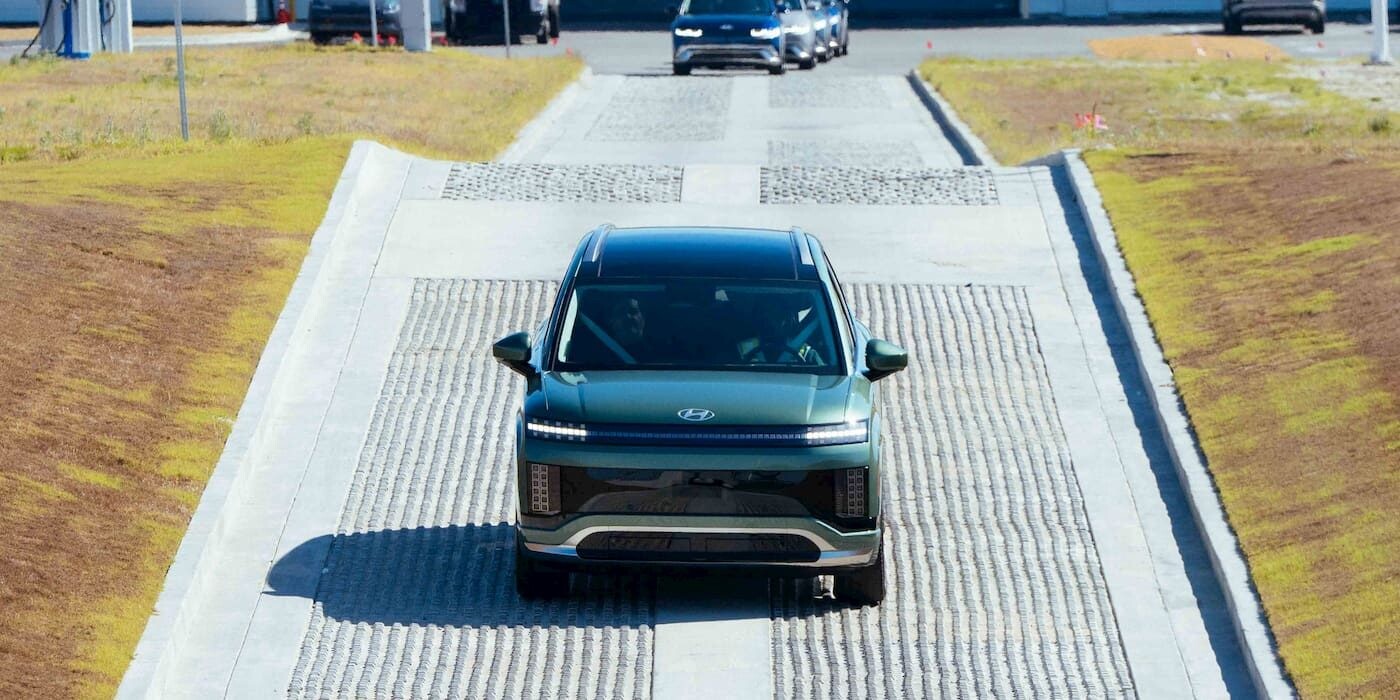
Credit: John Velasco / Tom's Guide Quite frankly, the Hyundai Ioniq 9 gets a bad rap for the way it looks. In fact, I said in my 2026 Hyundai Ioniq 9 review that the design is an "odd mashup featuring a curvy front bumper with an even stranger-looking arched rear." It's one of the last SUVs I'd expect to win any beauty awards. That's why I drove the Hyundai Ioniq 9 Calligraphy Design for the second time this year — just to convince myself that there are better 3-row midsize SUVs out there. I've spent more time testing 3-row SUVs than any other vehicle type this year, with models like the Kia Telluride, Volvo XC90, Volkswagen Atlas, and Lucid Gravity getting my seal of approval. But after another week behind the wheel, I can tell you firsthand that judging the Ioniq 9 by its cover is a mistake. Here's what I realized. It's even more efficient First test drive Second test drive Price tested $79,540 $79,540 Total miles driven 413.6 miles 130.5 miles Average Efficiency 3 mi/kWh 3.3 mi/kWh Best long distance driving efficiency 3.6 mi/kWh 3 mi/kWh Best short distance driving efficiency 3.8 mi/kWh 4.5 mi/kWh As with most vehicles, fuel economy and efficiency tend to dwindle over time — which is why I'm shocked that the Ioniq 9 is an exception. I was already impressed by the 3 mi/kWh average I got when I drove it last year, yet my second run delivered even better results. Across 130.5 miles of mixed driving, my second go-around with the Ioniq 9 yielded an impressive 3.3 mi/kWh. What surprised me even more was the substantial improvement in city driving, where I recorded a peak tally of 4.5 mi/kWh — up from my previous best of 3.8 mi/kWh. Considering it's marketed as a three-row family hauler, it's remarkable that the Ioniq 9 can post numbers like this. That extra efficiency is critical, too: while this trim carries an EPA-estimated range of 311 miles, averaging 3.3 mi/kWh puts its real-world range closer to 363 miles. Its quirky design grew on me I'll admit I was harsh on the Hyundai Ioniq 9's styling the first time around. While it certainly takes cues from the subcompact Hyundai Kona, I argued that it was an odd mashup that was confused about what aesthetic it was trying to go after. After spending another week with it, though, its unconventional look slowly grew on me — even if that appreciation is mostly isolated to the front of the EV. That's due to Hyundai's signature Parametric Pixel LED light bar, which stretches across the nose like something straight out of a sci-fi movie. Those individual blocks give it a retro look that becomes even more dazzling from dusk into the night. In a sea of generic crossovers, this one certainly commands road presence. That said, I still haven't come to terms with the back half of this electric SUV. That tapered, upright rear end remains the hardest pill to swallow, giving it the look of a boat tail. Despite this, I now appreciate that the shape is doing the heavy lifting to make it aerodynamic — and subsequently boosting its efficiency. Comfortable ride for mostly everyone Whether I'm making a quick stop at the local grocery store or on my 30+ mile commute to work, the 2026 Hyundai Ioniq 9 doesn't skimp on the comforts. Step inside, and it's clear Hyundai prioritized first-class comfort for the people riding up front and in the middle. For example, the plush H-Tex seats strike a great balance of softness and support — which, for the driver, includes extra pampering courtesy of Hyundai's Ergo Motion seat. When activated, it slowly adjusts the firmness of the cushion, sort of like getting a mini massage while driving, all to deter fatigue on longer hauls. Still, the real VIP treatment belongs to the second-row captain's chairs. With both heating and ventilation, plus power-reclining backrests and extendable footrests, they turn the middle row into a rolling lounge. However, the third row leaves more to be desired. Although I still appreciate having the extra seating capacity in a pinch, the legroom back there is practically nonexistent for adults — so I'd much rather keep that rear bench folded flat to make way for more trunk space. Just about every premium feature you can imagine At nearly $80,000 as tested, the Ioniq 9 Calligraphy Design comes loaded with just about every luxury and tech perk anyone could ask for — and rightfully so. I still absolutely love Hyundai's adaptive cruise control, which makes long drives bearable and includes a dedicated lane-centering button on the steering wheel that also happens to work on local roads. Adding to that is a crisp Head-Up Display that projects my speed and navigation right onto the windshield. Changing lanes is effortless thanks to the Blind-Spot View Monitor (which streams a live camera feed straight into the digital gauge cluster) and a digital rearview mirror that offers a wider field of view than a conventional glass mirror. Back-seat passengers get plenty of love, too, with built-in rear side-window sunshades, a massive panoramic sunroof, and dazzling customizable ambient lighting that sets an upscale mood after dark. There's also practical utility in the form of a handy 120V outlet accessible right in the trunk, letting me power laptops, tailgating gear, or small appliances straight off the SUV's battery. Bottom Line Credit: John Velasco / Tom's Guide At nearly $80,000 as tested, the 2026 Hyundai Ioniq 9 Calligraphy Design is easily one of the most expensive vehicles in Hyundai's entire lineup — and that price tag has long made me a skeptic. Yet spending a second week behind the wheel proved that judging it at face value is a mistake. Between its even better real-world efficiency, spacious cabin suited for families, and a laundry list of thoughtful luxury features, the Ioniq 9 delivers where it counts most: a family hauler that's rich in utility and backed by an efficient drive.

 Liked by Evan Anderson, Charlotte Roy




 Liked by Evan Anderson, Charlotte Roy