Hyundai is preparing a major transformation of one of Canada’s most recognizable compact sedans, bringing a completely redesigned Elantra with more passenger space, advanced technology, and a new generation of hybrid efficiency.
Unveiled at the Los Angeles Auto Show on November 19, 2026, the eighth-generation Hyundai Elantra introduces a dramatically different exterior, a more spacious interior, and an upgraded hybrid powertrain designed to make everyday driving more efficient.
The redesigned gasoline-powered Elantra is expected to reach Canada in early 2027, while the next-generation hybrid will follow later in the year as a 2028 model. For Canadian drivers balancing affordability, fuel costs, and practicality, Hyundai’s latest announcement signals a significant evolution of a familiar nameplate.
A Major Redesign for a Familiar Canadian Sedan
The Elantra has long been an important part of Hyundai’s Canadian vehicle lineup, appealing to motorists seeking practical transportation without moving into the higher price range of many SUVs. Now entering its eighth generation, the sedan is receiving a comprehensive redesign rather than a routine styling update. Hyundai introduced the vehicle in South Korea under the Avante name in August 2026 before presenting its North American version in Los Angeles on November 19. The unveiling marks an important moment for a model that continues to serve buyers who prefer traditional passenger cars.
Hyundai’s approach combines a completely revised exterior with substantial improvements in cabin space, connectivity, and electrified powertrain technology. Company president and CEO José Muñoz emphasized the importance of the Elantra as an introduction to the Hyundai brand for many first-time customers. The redesign reflects that strategy, attempting to deliver a more sophisticated experience while preserving the sedan’s everyday practicality. For Canadian buyers, the announcement also confirms that the Elantra will remain part of Hyundai’s future lineup rather than disappearing as the automotive industry continues expanding its SUV offerings.
A Bigger Cabin Could Make Everyday Driving More Comfortable
One of the most significant changes involves the Elantra’s physical dimensions. The redesigned sedan measures 4,795 millimetres long and 1,855 millimetres wide, representing increases of 85 millimetres and 30 millimetres, respectively. Its wheelbase grows by another 30 millimetres to 2,750 millimetres. Those measurements translate into meaningful passenger-space improvements, particularly in the second row. Hyundai reports rear legroom of 993 millimetres, an increase of 29 millimetres, while shoulder room expands by 22 millimetres. Rear headroom also improves, with the gasoline version offering 958 millimetres, although the hybrid’s measurement is slightly lower at 953 millimetres.
These improvements could matter considerably for families and commuters who regularly carry passengers. More rear legroom can make longer journeys less uncomfortable, especially when taller adults occupy the front seats. Hyundai is also emphasizing a roomier, more refined cabin without abandoning the compact sedan’s manageable footprint. Cargo capacity is listed at 479 litres for the gasoline model and 467 litres for the hybrid under the VDA measurement standard. Together, the larger passenger compartment and practical trunk give the redesigned Elantra a stronger argument for buyers who need additional space but do not necessarily want a crossover.
Bold New Styling Gives the Elantra a Different Identity
The redesigned Elantra introduces Hyundai’s latest Art of Steel design philosophy, emphasizing sharp bodywork, muscular fenders, and a more substantial road presence. Its traditional three-box sedan proportions remain, but the exterior looks considerably more futuristic than the outgoing generation. The front features distinctive H-Edge lighting, including horizontal daytime running lights that emphasize the vehicle’s width. At the rear, sculpted vertical lighting elements create a recognizable signature. Hyundai has also introduced flush, lift-up door handles and slimmer exterior mirrors, giving the vehicle a more contemporary appearance.
Importantly, the styling changes are not entirely cosmetic. Hyundai reports a drag coefficient of 0.26 for both the gasoline and hybrid models, reflecting the attention paid to aerodynamic performance. The manufacturer has also introduced new colours, including Graphene Green Pearl and Kodiak Blue Pearl, although Canadian availability will depend on final market specifications. The broader design direction could appeal to motorists who previously considered compact sedans too conservative. Rather than disguising the Elantra as a crossover, Hyundai is emphasizing the distinctive proportions and practical advantages of a conventional passenger car.
Next-Generation Hybrid Technology Brings More Power and Smarter Energy Management
Hyundai’s updated hybrid system represents one of the most substantial engineering developments in the redesigned Elantra. The 2028 Elantra Hybrid will combine a 1.6-litre gasoline engine with a more powerful electric motor and a six-speed dual-clutch automatic transmission. Combined output increases from 139 horsepower in the outgoing generation to 155 horsepower in the new version. Electric motor output rises from 32 kilowatts to 45 kilowatts, while the hybrid battery’s capacity increases from 1.32 kilowatt-hours to 1.49 kilowatt-hours. These changes provide additional electrical assistance while preserving the familiar operation of a gasoline-electric hybrid.
The system also introduces more sophisticated energy management. Hyundai’s Smart Regeneration System 3.0 captures energy during braking and deceleration, while steering-wheel paddles allow drivers to adjust regenerative braking intensity. Under appropriate conditions, the strongest setting can bring the vehicle to a complete stop. Another feature, called the Hybrid Hierarchical Predictive Control System, anticipates driving patterns and road conditions to manage energy use more efficiently. For Canadian motorists navigating congested city streets and long highway journeys, these technologies could help make the hybrid feel more responsive and economical, although real-world performance will require independent testing.
Fuel-Economy Targets Show Promise, but Canadian Ratings Are Still Pending
Fuel efficiency remains central to the Elantra’s appeal, particularly as Canadian households consider the long-term cost of vehicle ownership. Hyundai is targeting up to 53 miles per U.S. gallon combined for the redesigned hybrid, equivalent to approximately 4.4 litres per 100 kilometres. However, that figure is based on preliminary manufacturer testing and is not a finalized Canadian fuel-consumption rating. For comparison, the 2026 Elantra Hybrid currently sold in Canada carries a combined rating of 4.7 litres per 100 kilometres. The new model’s official Canadian efficiency figures will therefore be important in determining whether its updated technology delivers a measurable improvement.
The gasoline-powered Elantra will continue using a 2.0-litre four-cylinder engine producing approximately 147 horsepower, paired with an Intelligent Variable Transmission. Hyundai is targeting up to 35 miles per U.S. gallon combined for the new gasoline model, subject to final certification and market specifications. The engine incorporates changes to its thermal management, ignition, and lubrication systems, while the transmission receives refinements intended to reduce friction. These improvements suggest Hyundai is pursuing efficiency and everyday refinement rather than dramatically increasing gasoline-engine performance. Buyers will ultimately need to compare Canadian fuel ratings, purchase prices, and expected driving distances to determine which powertrain offers better value.
New Stay Mode Could Make Waiting in a Parked Car More Comfortable
A particularly interesting feature of the redesigned Elantra Hybrid is its new Stay Mode, which allows certain electrical systems to operate while the vehicle is parked without continuously running the gasoline engine. The system uses energy stored in the hybrid battery to power climate control, lighting, audio equipment, charging ports, and selected convenience features. Hyundai says the technology can operate for up to 30 minutes, with approximately 20 to 30 minutes possible under favourable conditions with a fully charged battery. That could be useful for everyday situations such as waiting at an airport pickup area or taking a short break during a longer journey.
Stay Mode does have important operating limitations. Hyundai specifies that a destination must be entered into the navigation system, allowing the vehicle to manage battery charging before arrival. The car must remain in Park while the feature operates, and the available time depends on battery charge, outside temperature, and electrical demand. Once driving resumes, the hybrid system manages battery charging automatically. For Canadian drivers, the feature represents a practical application of electrification beyond reducing gasoline consumption. Nevertheless, its usefulness during extremely cold or hot weather, along with availability on specific Canadian trims, will need to be established when the model reaches dealerships.
A Modernized Interior Balances Digital Screens With Physical Controls
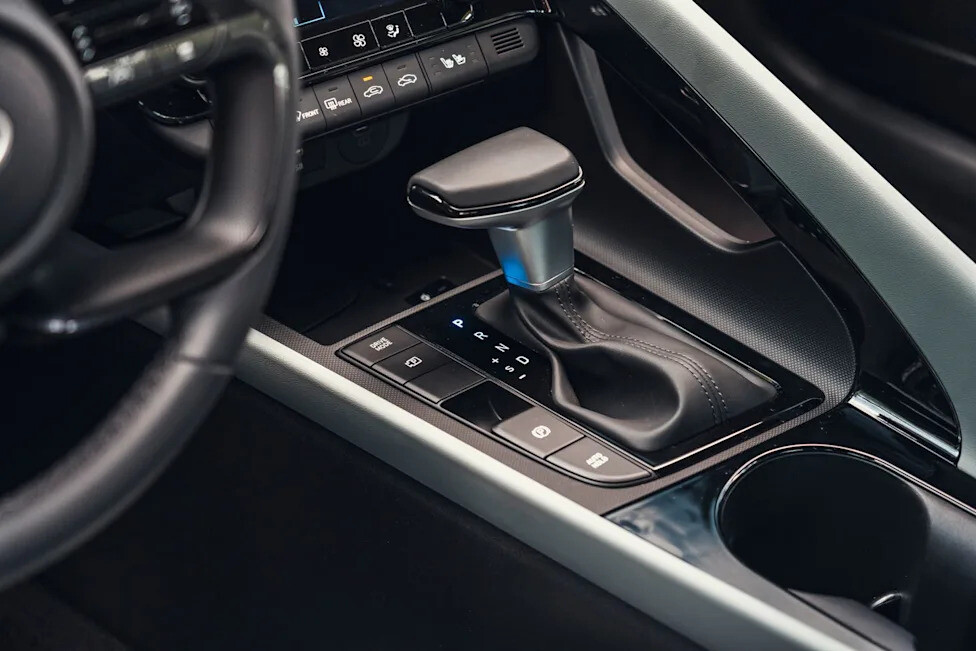
Hyundai has substantially reworked the Elantra’s dashboard, replacing the previous generation’s prominent twin-screen arrangement with a new, driver-focused layout. A 12.9-inch Full HD central display anchors the redesigned interior, while a slim information screen places important driving details closer to the driver’s natural line of sight. Hyundai has also identified a larger 14.6-inch display for the top hybrid trim in Canada, a configuration the company says will be exclusive to the Canadian market within North America. The cabin introduces furniture-inspired upholstery shapes and a more streamlined appearance intended to create a refined atmosphere.
Despite the increased emphasis on digital technology, Hyundai has retained physical controls for essential functions such as climate settings and audio volume. That decision could be particularly welcome during Canadian winters, when adjusting cabin temperature and windshield defrosting is a routine part of driving. The company is also emphasizing improvements in cabin refinement, including structural reinforcement, additional sound insulation, and updated suspension components. Available equipment in the broader North American lineup includes heated and ventilated front seats, upgraded upholstery, and premium audio systems. Final Canadian trim specifications will determine how many of those features are included at different price points.
Smarter Connectivity and Artificial Intelligence Move Into the Elantra
Beyond the redesigned dashboard, Hyundai is introducing Pleos Connect, a next-generation infotainment platform built on Android Automotive OS. The system is designed to provide a more customizable interface, expanded connected services, and over-the-air software updates that can improve supported functions without requiring a dealership visit. Wireless Apple CarPlay and Android Auto are also included in the announced North American equipment, allowing drivers to integrate compatible smartphones with the vehicle’s central display. For daily commuters, these capabilities could make navigation, communication, and entertainment more convenient without requiring a complicated setup.
Another significant addition is Gleo AI, Hyundai’s conversational voice assistant. Unlike basic voice-command systems that rely primarily on predefined phrases, Gleo is designed to interpret natural-language requests and contextual information. Hyundai says the system can assist with supported vehicle settings, navigation searches, and other connected functions. Additional available technology includes Digital Key 2, wireless phone charging, and a Bang & Olufsen audio system with 12 speakers. However, not every advertised feature is destined for Canada. Hyundai’s global specifications specifically exclude Canadian models from the newly advertised 100-watt USB-C charging capability, illustrating why buyers should check local equipment lists rather than assuming every North American feature will be included.
Expanded Safety Technology Adds Another Layer of Driver Protection
Safety is another important focus of the redesigned Elantra, with Hyundai introducing an extensive range of SmartSense driver-assistance technologies. The announced North American lineup includes forward collision-avoidance assistance capable of detecting pedestrians and cyclists, blind-spot collision warnings, rear cross-traffic collision avoidance, and lane-keeping assistance. Other technologies include driver-attention monitoring, safe-exit warnings, and smart cruise control with stop-and-go functionality. These systems are intended to help drivers recognize potential hazards and respond to situations that can become dangerous during daily travel.
Hyundai is also strengthening the vehicle’s underlying structure through greater use of ultra-high-strength steel and reinforced structural components. The manufacturer says these changes support improved collision protection while contributing to a more refined driving experience. However, the exact safety equipment available to Canadian buyers remains an important consideration. Hyundai’s global specifications describe certain advanced systems that will not be offered in North America, making it essential to distinguish international announcements from locally confirmed features. Ultimately, independent crash-testing results, Canadian trim specifications, and real-world performance will help establish how the redesigned Elantra compares with its compact-sedan competitors.
Canadian Launch Timing and Pricing Will Determine the Elantra’s Competitive Position
Hyundai has confirmed that the redesigned Elantra is coming to North America in early 2027, with Canadian automotive publication AutoTrader reporting an expected first-quarter Canadian launch. The gasoline-powered model will arrive first, followed by the 2028 Elantra Hybrid later in 2027. Canadian pricing and final equipment packages have not yet been announced. For context, Hyundai currently lists the 2026 Elantra with a starting manufacturer’s suggested retail price of $23,499 in Canada, while the 2026 Elantra Hybrid starts at $31,999 before additional charges. These existing prices provide a useful reference point but should not be treated as predictions for the redesigned models.
The larger cabin, upgraded technology, and more sophisticated hybrid system could strengthen Hyundai’s position against established competitors such as the Honda Civic and Toyota Corolla. However, affordability will remain critical, particularly for consumers choosing a compact sedan specifically to control transportation expenses. The redesigned Elantra’s appeal will ultimately depend on the difference between gasoline and hybrid pricing, the availability of desirable equipment on lower trims, and confirmed Canadian fuel-economy ratings. With more interior space and an expanded technology package, Hyundai has established an ambitious direction for its next-generation sedan. The remaining question is whether it can deliver those improvements at prices that continue to make the Elantra an attractive option for Canadian households.