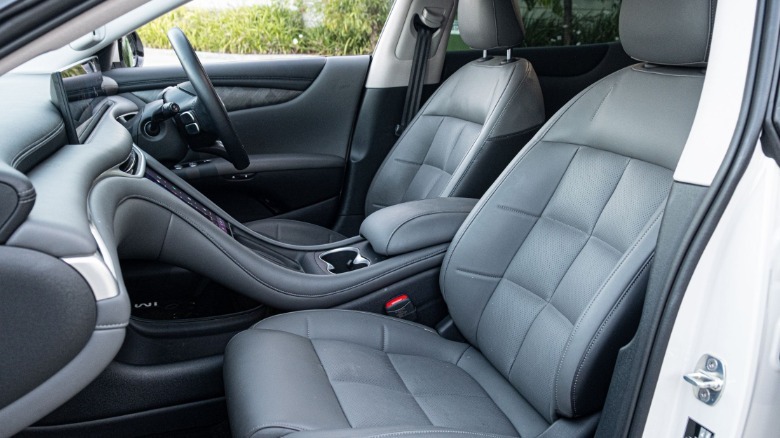
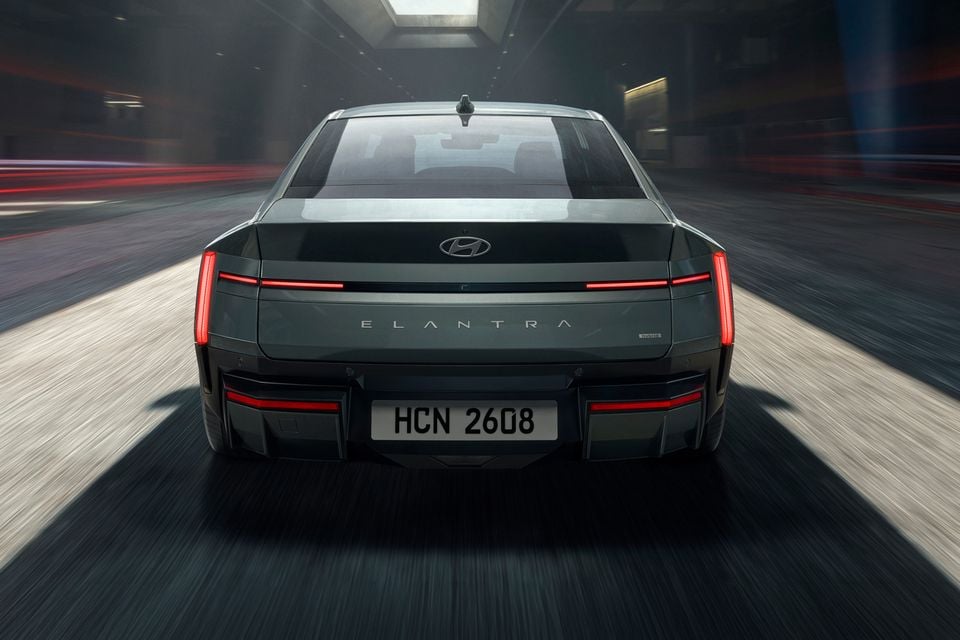
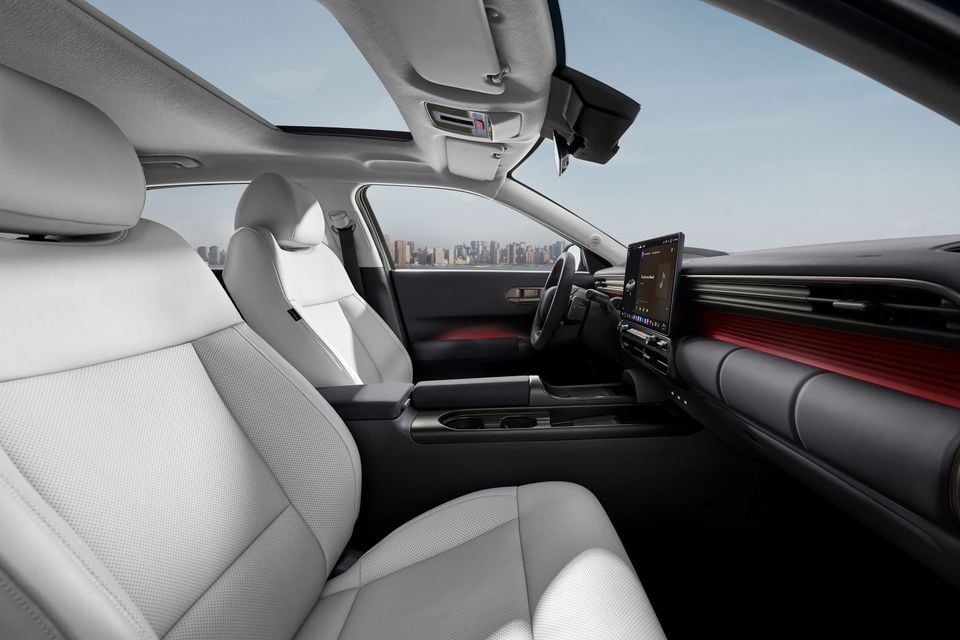
The new Elantra gets standout styling, a posh interior, advanced infotainment, and a revised hybrid drivetrain for 2028. Our year with a sub-$25k Kia K4 has taught us how technologically advanced inexpensive sedans can be, but the new Hyundai Elantra—carrying the 2027 model year for the gas-powered model and 2028 for the Elantra Hybrid—is about to make these affordable cars a hell of a lot more interesting. Not only does the new Elantra offer Hyundai’s latest and greatest infotainment system, but it wraps it in head-turning sheetmetal with a high-luxe interior. Are Inexpensive Cars Allowed to Be This Interesting? The new 2027 Elantra features a take on Hyundai’s emerging Art of Steel exterior styling theme as first seen on the 2027 Tucson. A riot of flat surfaces and sharp creases, Art of Steel is meant to celebrate the look of the raw sheetmetal from which the Elantra is made. We love the front end, especially the knife-edge prow, but things get a bit heavy and fussy as you move toward the back of the car. We’d prefer a proper two-box profile over the Elantra’s long roofline, but we imagine that’d kill the aerodynamics (as well as the intended resemblance to the N Vision 74 concept). The design redeems itself out back, however, thanks to an exaggerated lip spoiler and the diffuser-like rear bumper that’s almost a parody of a hypercar, and it hints at a cheeky sense of humor. Inside, the Elantra’s cabin incorporates many of the same components as the Tucson, including the furniture-inspired rounded elements on the armrests and the dashboard. The biggest difference between the two vehicles is the center console; while the Tucson goes split-level, the Elantra uses a single-level affair with a pair of wireless chargers. The Elantra’s dashboard, meanwhile, is nearly identical to the Tucson’s. The example we got to crawl around in—no doubt a top-of-the-line model though it wasn’t marked as such—had rich-feeling upholstery, which we assume is H-Tex (Hyundai’s convincing fake leather), highlighted with dramatic ambient lighting. Hyundai, Don’t Give in to the Dark Side What really drew our eyes, though, was the Elantra’s massive center screen, which runs Hyundai’s new AI-enhanced Pleos system. We’ve covered Pleos extensively in this article and talked about it in our 2027 Tucson first look, but there’s a significant difference as far as the Elantra is concerned. Like the Tucson, the Elantra divides that center screen 30/70, Tesla-style, with the speedometer and basic car information on the left third and everything else (infotainment, navigation, Apple CarPlay and Android Auto) on the right two-thirds. The primary difference between the Tesla central-screen-only setup and what Hyundai does is the addition of a small, ribbon-style driver’s display located above and ahead of the steering wheel. But the entry-level Elantra won’t get it, which means you’ll have to rely on the center screen for speed, turn signals, and the like. We don’t mind central displays, but some of us have struggled with the single-screen setups used by Tesla, Ineos, and the Volvo EX30, especially those of us who rely on reading glasses. (Perhaps Hyundai thinks only young people with good vision will buy the cheapest Elantra?) Admittedly, it’s not fair to condemn this setup until we’ve had a chance to try it, but given our experiences up until now, we hope Hyundai won’t follow Tesla into this tempting ocean of cost-cutting. There be sharks, Hyundai.

 Liked by Isabelle Bouchard, Lily Lavoie






 Liked by Isabelle Bouchard, Lily Lavoie