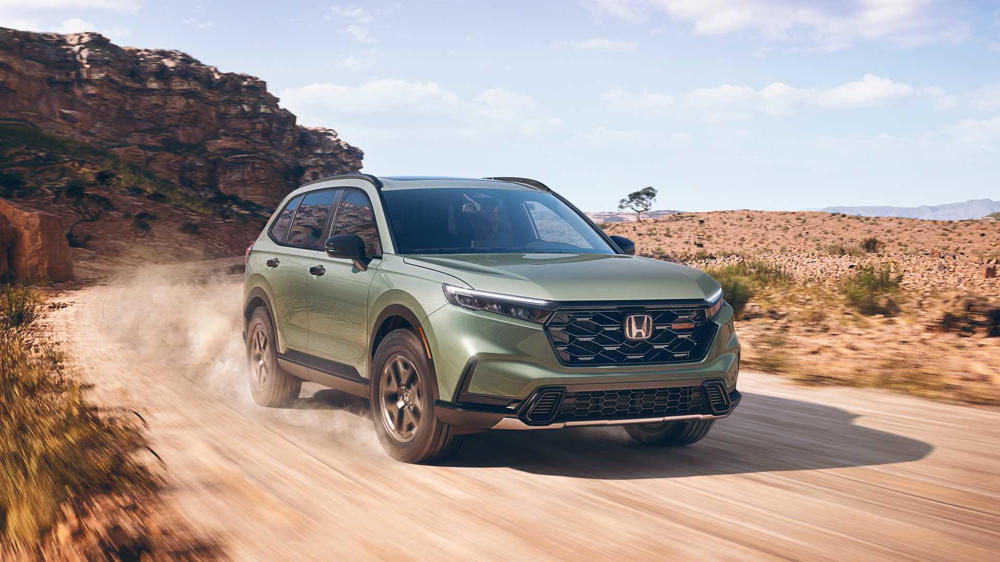
The Honda CR-V is a cornerstone of the American car market, often trading bestselling SUV accolades with its closest rival, the Toyota RAV4. If you're considering one, you've considered the other, and you're almost certainly here because you've landed on the Honda. As much as it's done to earn its sterling reputation over the past 30 years, though, not every single one is a smart buy. New Generations Bring New Problems It's a good rule of thumb with any car purchase to take a wait-and-see approach when a new-generation vehicle is launched. Automakers spend years putting millions of miles on test vehicles before new models are released, but still, problems can emerge later that didn't show up in testing. CR-Vs, as good as they are historically, compared to the other compact SUVs in its class, are not immune to this. According to research by extended warranty provider CoverageX (which is very motivated to know which used cars it should or shouldn't give extended warranties to), the CR-V fits this pattern of notable issues occurring with its new-generation model launches. Its research goes back to 2007, which saw the birth of the third-generation CR-V. For that and each successive generation (not including the too-new-for-data sixth generation), there's a serious mechanical issue to be on the lookout for. In each case, the issue is resolved within two to three years, so if you're looking at a CR-V from the earlier part of its generation, make sure those issues have been professionally repaired. MotorTrend Notable Issues to Watch For Early third-generation CR-Vs from the 2007 to 2009 model years have a known issue with the air conditioning compressor, potentially causing it to fail in fewer than 90,000 miles. You'll be hard-pressed to find a CR-V that old with so few miles on it, so there's a good chance the compressor has already been replaced, but it never hurts to check the paperwork. The 2010 and 2011 models have upgraded compressors, though on those models, you'll still want to listen for a rattling timing chain on cold starts that may need work. Similarly, early fourth-generation CR-Vs have their own quirks. The 2012 to 2014 model years are known to wear out their engine mounts in fewer than 110,000 miles. Here, again, they'll likely have been replaced by now, but you should still ask. The most serious CR-V issue affects early fifth-generation models, including the 2017, 2018, and 2019 model years equipped with the 1.5-liter turbocharged four-cylinder engine, which suffered from oil dilution, particularly in cold climates. On cold engine starts, gasoline can seep past the piston rings and into the crankcase, diluting the oil and reducing its lubricating properties. Left untreated, it can lead to sludge in the oil and engine damage where things aren't properly lubricated. The 2020 and 2021 CR-Vs received updated software to improve cold starting, which reduced the incidence of problems, and by the 2022 model year it had been fixed. Those same early fifth-generation years (2017 to 2019) are also known for a shuddering in the continuously variable automatic transmission (CVT) under acceleration. It's a less common problem and often fixed by changing the transmission fluid, but it's worth keeping an eye out for. Honda Safety Considerations Generally, the older a car, the less safe it is compared to a newer version. All those airbags and electronic control gizmos do add weight, cost, and complexity to modern cars, but they also keep us exponentially safer than in the past in the event of a crash. All Honda CR-Vs have come equipped with front, side, and side curtain airbags (at a minimum), as well as stability and traction control since 2005. Prior to that, it was just front airbags and traction control. Honda introduced its signature ACE body structure in the CR-V in 2007 with the third-generation SUV, greatly improving its front crash protection. For the fourth-generation model in 2012, Honda tied the all-wheel-drive system and the stability control system together for the first time, enhancing the stability control computer's ability to correct a skid. Later, during a 2015 midcycle update, Honda introduced its Honda Sensing suite of active and passive safety aids to the top trim CR-V Touring. Honda Sensing would become standard on all CR-V trim levels above LX starting in 2017 and would subsequently gain additional functions and features in intervening years. (Honda Sensing is now standard on all Honda automobiles today.) MotorTrend Fuel Economy Newer cars generally get better fuel economy than the ones they replace, but the CR-V has always been relatively efficient, so it hasn't always improved by leaps and bounds. Since the day it went on sale in 1997, the CR-V has never returned worse than 21 mpg combined. Things didn't really take off until the third generation, however, when combined fuel economy improved by 2 mpg. The 2017 model saw another 2-mpg gain, but that jumped to a 4-mpg improvement if you got the new 1.5-liter turbo engine (which had its own issues, as we've discussed). The biggest improvement came in 2020 with the introduction of the CR-V Hybrid. This brought fuel economy up to 38 mpg combined, and it now sits as high as 40 mpg. MotorTrend Convenience Features Unless you're prepared to install aftermarket equipment, the older your car, the less features it's likely to have. Before you look at old CR-Vs, consider which features you can't live without. For example, the first CR-V to have Bluetooth connectivity for your phone was the 2012 model. The first to get Apple CarPlay and Android Auto was the 2017 model, and wireless CarPlay and Android Auto didn't arrive until the 2023 model, which was also the first to get a wireless phone charger. Then there are the more basic features. The CR-V didn't get a power driver's seat until 2008, the same year it got dual-zone climate control for the first time. The 60/40 split-folding rear seat didn't become standard equipment until 2012. Darren Martin - MotorTrend Years to Look For 2010–2011: Late third-generation cars have the air conditioning problem ironed out, plus the benefit of the updated body structure for better crash protection. 2015–2016: The refreshed fourth-generation models are a high point in CR-V history, with no major problems, good fuel economy, and modern crash avoidance technologies. 2022–2026: The last year of the fifth generation had all its problems resolved, CarPlay and Android Auto built-in, and a hybrid model with excellent fuel economy. The sixth-generation cars (starting in 2023) have only improved upon the 2022 model with even better fuel economy, wireless CarPlay and Android Auto, and the most up-to-date safety equipment. MotorTrend Years to Avoid 2007–2009: A bad A/C compressor is an expensive fix, so if you're looking at these model years, make sure it's already been professionally replaced. 2012–2014: Cracked engine mounts can lead to bigger problems, so make sure they've been inspected or replaced if you're shopping these years. 2017–2019: Oil dilution can, if left untreated long enough, lead to engine failure, so make sure any car from these years—especially one suspected of having made short trips in cold weather—has had all its software updates and regular oil changes before you buy. Don't forget to feel for that transmission shudder, as well.