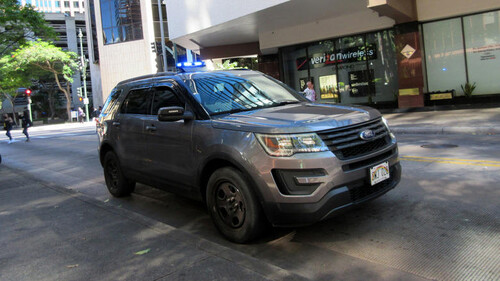
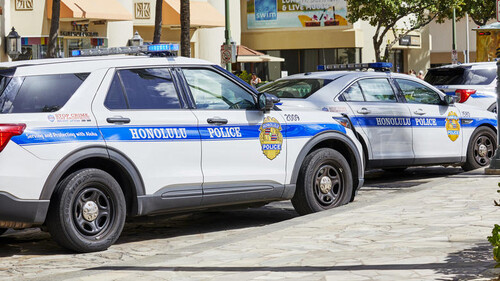
Eric Broder Van Dyke/Getty Images When thinking about Hawaii, images of pristine beaches with powdered-sugar sand, hiking trails through verdant mountains, and heaping bowls of authentic poke come to mind. An urban metropolis? Isn't that what we left on the mainland? Yet, Hawaii has more than 950 centerline miles of roadways across its eight major islands. A disproportionate amount of that asphalt is relegated to the island of Oahu, where the capital city of Honolulu resides, along with nearly 70 percent of the state's 1.4 million kama'aina (locals). True, there are American cities with more people than the entire state of Hawaii. Also true is that Hawaii ranks 46th by total area. However, its diminutive dimensions and overload of humanity put Hawaii 15th in terms of population density, per U.S. Census Bureau data from 2020. Lots of people need lots of roads. So, like every state in the U.S., Hawaii has highways. City, county, state, and federal — the archipelago has them all. By federal, yes, that includes interstates, but more on that later. What our nation's 50th state doesn't have, though, is a highway patrol, despite the fact there are local officers, state sheriffs, and military cops roaming around. Still, there's been a push for change. The Department of Law Enforcement (DLE), which already operates as the de facto state police, has recommended and begun implementing dedicated traffic patrol. In addition to airports, the DLE Sheriff Division also handles some traffic enforcement around harbors and state buildings. The unit would target speeding, drunk drivers, and distracted motorists on Oahu highways, as well as ensure large commercial trucks are in regulatory compliance. Who can pull you over on Hawaii highways, and Is a new traffic unit coming? Michael Vi/Getty Images Having numerous agencies looks like a free-for-all on paper, but it doesn't mean freedom to act like a babooze (fool) on the roads. So, who's the lucky patrol that gets to pull you over when you do? Definitely not the state police, because Hawaii's the only state without one. Even the District of Columbia has a review board for officer training. You might cheer that fact but consider how this could be problematic if there is no overarching statewide standard in training officers, from protocols and policies to weapons handling and suspect detention. While Act 220 of 2018 established the Law Enforcement Standards Board across the state, recent legislation pushed the deadline for that certification program back to 2028. Circling back to the Hawaii interstates, all four are found on Oahu. Simply put, their existence is a national defense measure. However, these federally funded freeways are not patrolled by military police, whose jurisdiction remains on-base. This leaves the interstates and all Oahu roads, for that matter, largely under the eye of the Honolulu Police Department. Don't be surprised if you see telltale blue lights behind you coming from a lifted Tacoma. The Honolulu agency is notorious for its use of privately owned vehicles as patrol cars. The Hawaii (Island) Police Department also subsidizes personal pickups as police units, but the sheer size of the Honolulu squad makes it a tad more prolific. With so much ground to cover, a statewide traffic enforcement agency would do wonders, no? When asked by Hawaii Civil Beat for the Honolulu Police Department's take on the DLE's proposal, the city/county cops gave big nope vibes while offering no further comment. From Kapu to Cuffs, Why Hawaii's Law Enforcement Is Fractured Halbergman/Getty Images Despite the current state of confusion, law enforcement existed in Hawaii long before its ancient people came into contact with seafaring explorers. Pre-contact, the kapu system was in place, a defined set of rules and restrictions that dictated daily life of all Hawaiian people, including high-ranking chiefs and priests. Fast forward to 1846 when King Kamehameha III instituted a kingdom marshal who would nominate and oversee sheriffs appointed to the islands of Hawaii (Big Island), Kauai, Maui, and Oahu. The sheriffs in turn could appoint constables. The group was a 36-man police force by the following year. After the Kingdom of Hawaii was overthrown in 1893, a different police organization was formed by the incoming government. In the end, though, policing was handled per the monarchy's original recommendation that each island maintain separate forces. This division remains today with four police departments overseeing their respective counties and encompassing islands: Kauai (Kauai, Niihau), Maui (Maui, Molokai, Lanai, Kahoolawe), Hawaii (Big Island), and Honolulu (Oahu). The DLE Sheriff Division has nevertheless bolstered operations to support police departments statewide as needed, focusing near schools and state buildings. But for the most part, on Oahu, it's HPD's asphalt. The Hawaii Department of Transportation reported that statewide traffic deaths have climbed in both 2024 and 2025, with 2025 ending as the year with the most traffic fatalities since 2007. Hopefully, the standards set by the Law Enforcement Standards Board can help reduce friction between departments, as the silo mentality creates opportunities where things can be lost in translation. I mean, even mac salad ingredients differ from island to island, which can lead to near fisticuffs between locals. Ask me how I know.