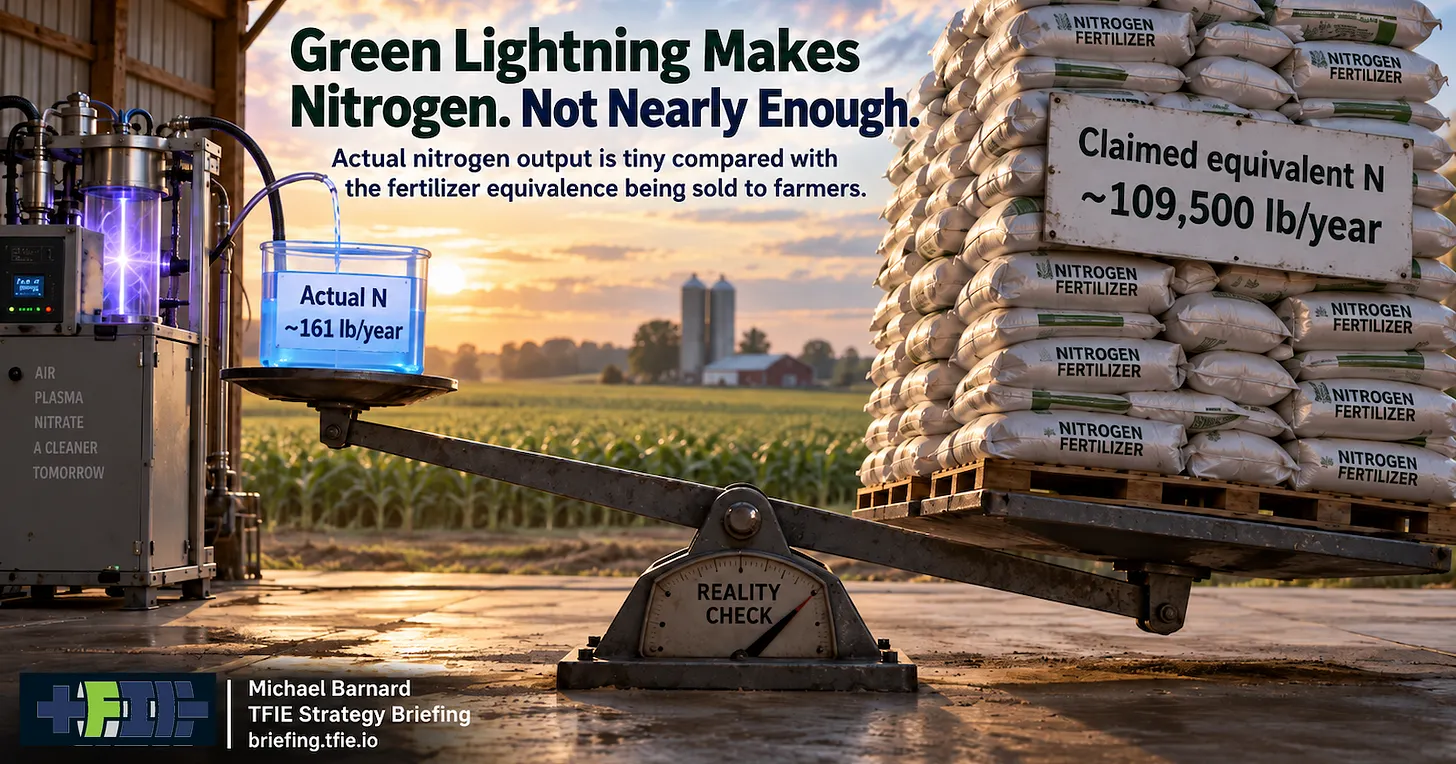
Green Lightning really does make nitrogen fertilizer from air and electricity, but it makes very little of it compared with what its marketing says it can replace. Nitrogen is not merely something that encourages a plant to grow. Nitrogen atoms become part of the plant itself, incorporated into proteins, chlorophyll, DNA and other cellular material. Conventional fertilizers such as urea and urea-ammonium nitrate, commonly called UAN, supply those atoms in forms crops can use. At the nitrate concentration reported by Washington State University Extension, a Green Lightning machine producing 100 gallons a day would fix about 161 pounds of actual nitrogen per year. The product has also been described as equivalent to about three pounds of conventional nitrogen per gallon, which at the same production rate comes to 109,500 pounds of claimed conventional-nitrogen replacement per year. That is roughly a 680-fold difference between nitrogen physically created by the machine and nitrogen supposedly replaced in the field. Fertilizer efficiency can certainly be improved. Better timing, placement and application can reduce losses, and farmers routinely get more useful crop growth from a pound of nitrogen by managing it better. None of those improvements create nitrogen atoms. If a crop maintains its yield after a large amount of conventional fertilizer is removed while Green Lightning supplies only a small amount of new nitrogen, the remainder has to come from soil organic matter, residual fertilizer, manure, previous crops or some other source already present in the field. The full TFIE Strategy Briefing analysis follows that missing nitrogen through the soil, tests whether claims of higher nitrate concentrations materially change the arithmetic, checks the plasma-energy numbers and works through the independent field evidence. The central question is how a small quantity of newly fixed nitrogen is supposed to replace vastly more conventional fertilizer nitrogen. The underlying plasma chemistry is genuine. Green Lightning uses electricity to oxidize nitrogen from the air and create nitrate in water, a modern variation on nitrogen-fixation chemistry with roots stretching back more than a century. A farmer can run the machine and obtain water containing newly fixed nitrogen. The difficulty comes when that modest physical output is converted into a much larger claim about how much conventional fertilizer it can replace. A direct field test illustrates the distinction. Precision Planting tested complete replacement of its conventional nitrogen program with Green Lightning in 2024. The Green Lightning treatment applied 120 gallons per acre over six applications and produced 235.9 bushels of corn per acre. The conventional UAN program produced 280.7 bushels per acre. Precision Planting noted operating issues, including hard water and difficulty maintaining a consistent product, so the result should not be treated as proof that every future machine will perform identically. It is nevertheless a direct test of the replacement proposition, and it did not show Green Lightning matching the conventional nitrogen program. Nytro has reported more favourable results from other trials and says newer equipment can produce higher nitrate concentrations. Those claims deserve proper testing. They do not remove the need for a mass balance or for controlled experiments that establish where the nitrogen in the crop came from. If substantially less nitrogen is being added to the field, researchers have to distinguish the machine’s contribution from nitrogen that the soil was already capable of supplying. That distinction becomes especially important when a technology moves from experiment to commercial sale. Farmers do not buy fertilizer-equivalence claims in the abstract. They buy equipment to replace some portion of an input they already understand, and the value of that equipment depends on how much fertilizer it can reliably displace without reducing yield. A machine that produces a useful supplemental stream of nitrate could still have applications. That is a much smaller proposition than one in which a few hundred pounds of newly fixed nitrogen reliably substitute for tens of thousands of pounds of conventional fertilizer nitrogen. The evidence available so far does not establish that larger proposition. Green Lightning produces measurable nitrogen, but the quantity publicly demonstrated is tiny beside the fertilizer replacement attributed to it, and a direct independent replacement trial produced substantially less corn than the conventional UAN treatment. Crops still need nitrogen atoms from somewhere. If Green Lightning supplies only a tiny fraction of them, the rest must come from soil nitrogen, fertilizer residues, manure, biological fixation or another source. Read the full TFIE Strategy Briefing analysis for the complete nitrogen accounting, the energy sanity check, the broader field-trial record and the evidence still required to substantiate the fertilizer-replacement claim.




















 +37 others