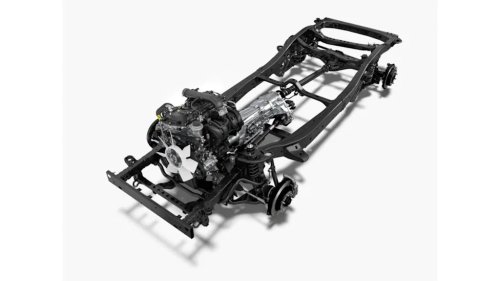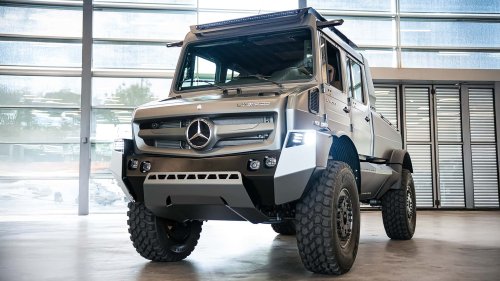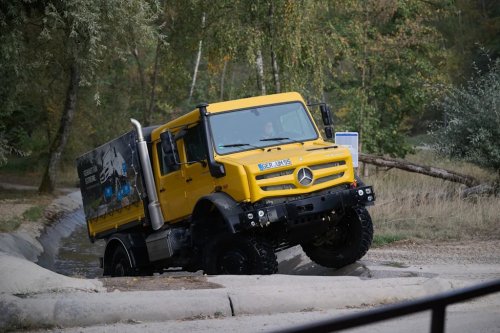
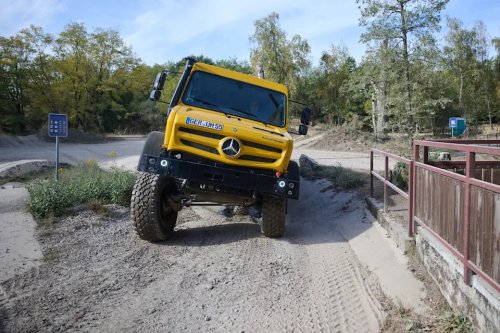
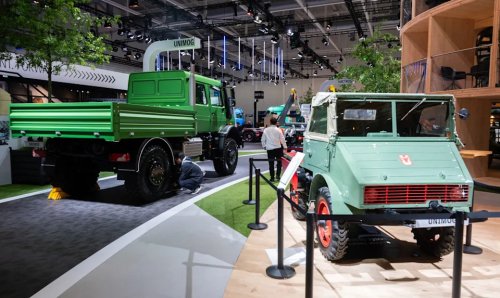
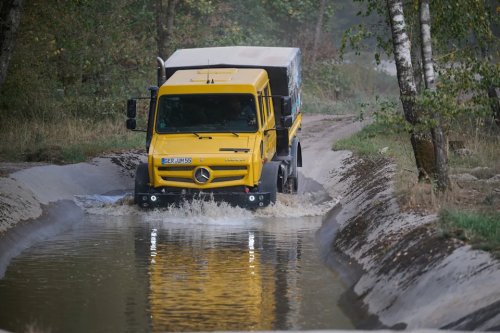
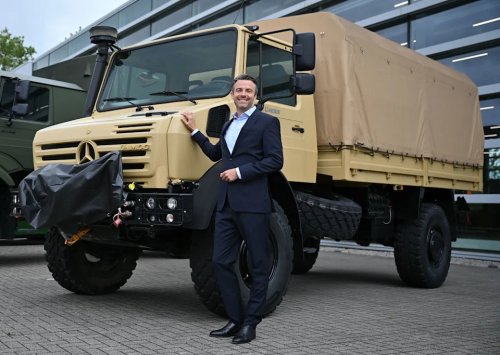




















Few machines earn as much customer loyalty as the Mercedes-Benz Unimog. A cross between a tractor and a lorry, the high-riding Unimog has been the machine of choice for farmers, armed forces and contractors for decades. Eighty years on, demand is still strong. Marijan Murat/dpaIf you go down to the woods today near the B3 motorway in the small southern-German municipality of Ötigheim, you are in for a big surprise.For there amid the tall trees is Germany's official Unimog test track. Clamber up into the tall driver's cab of this machine, fasten your seatbelt and hold on tight before you trundle off.What follows is a lively jaunt through deep water pits and massive potholes, with the Unimog tilting crazily as it lumbers along. The off-roader tackles gradients that would be madness in a car and defies gravity as it descends steep inclines, rumbling away with apparent ease.It is worth remembering that the rugged Unimog isn't really a vehicle designed with fun in mind. Its origins were long before the advent of the sports utility vehicle or the modern SUV which is more of a lifestyle accessory.The Unimog (short for the German Universal-Motor-Gerät, or "universal motorised implement") was conceived in 1944 in response to the US Morgenthau Plan for governing postwar Germany. Former Daimler-Benz aeroplane engine engineers developed prototypes.The first test drive took place in October 1946. Two years later, series production began at the Boehringer brothers' factory in Göppingen, Swabia. At that time, the bonnet still bore a distinctive ox's head with horns forming a "U" as its trademark.When larger production numbers were needed, Daimler-Benz took over manufacture of the Unimog in 1951 and first produced it at its Gaggenau plant, where the Unimog was sold under the Mercedes-Benz brand. It is now built in Wörth am Rhein in Germany with many others assembled at local plants around the world.While bouncing across rough terrain occupants might reflect on how this vehicle, which was originally intended for use in the potato fields, managed to evolve into one of the most versatile four-wheelers ever built. As a result, the rugged Unimog has lost none of its appeal."The real success of the Unimog lies in the fact that a basic concept developed in 1946 is still relevant 80 years later," said Stefan Reindl, Director of the Institute for Automotive Economics in Geislingen, Swabia.Since the first prototype, almost every technical aspect of the vehicle has been further developed, but the essence is still "to provide a vehicle that can operate where conventional vehicles reach their limits."Like the Land Rover, the Unimog is a remarkable example of a product concept whose technical basics have remained relevant for decades, said expert Reindl.Germany's Bundeswehr armed forces have bought more than 36,000 military issue Unimogs down the years and they also serve in armies in Switzerland, Argentina, Chile and Turkey.The Unimog is a growth area for Daimler Truck, said Dennis Kinzelmann, who, as head of the Mercedes-Benz Special Trucks division, is also responsible for the Unimog business.He seems genuinely enthusiastic about the chunky Unimog with its ladder frame, portal axles and high-visibility cab."Demand for the Unimog will rise because, on the one hand, there is a need to ensure Europe's defence capabilities," said Kinzelmann. "And on the other hand, we can see that the Unimog is needed during forest fires, floods and other natural disasters, which are unfortunately likely to increase as a result of climate change."Not that Daimler Truck is making any specific forecasts regarding future sales trends. In total, more than 375,000 Unimogs have been produced and sold in recent years. Kinzelmann said annual Unimog sales are on target at a low four-figure number.For professional users, the particular value of the Unimog lies in its "multifunctionality, robustness and reliability", said motoring expert Reindl. A Unimog is often not purchased for a single task, but as a platform for a wide variety of applications.For example, local authorities can use it for grounds maintenance as well as winter road clearance. The decisive factor is therefore not just the price, but the potential utilisation rate throughout the year.According to Daimler Truck, the base model starts at roughly the high five-figure range. Depending on the specification, the price range can vary considerably. For private individuals, the question of price usually doesn't arise anyway. Even though a concept car for the luxury segment was recently unveiled, it is still a long way from actually coming onto the market.That said, anyone who would like to enjoy a spin in the woods in an Unimog can do so not far from the test track in Ötigheim, in the outdoor area of the Unimog Museum in Gaggenau. The cost is €9.50 ($10.60) per person.The Unimog (short for the German Universal-Motor-Gerät, or "universal motorised implement") was conceived in 1944 in response to the US Morgenthau Plan for governing post-war Germany. Marijan Murat/dpaAn extreme off-road Unimog (left) and a historic Unimog from 1946 on display at the Daimler Trucks stand at the 2026 IAA trade fair in Hanover. Julian Stratenschulte/dpaThe off-roader tackles gradients and terrain that would be madness in a car and defies gravity as it descends steep inclines, rumbling away with apparent ease. Marijan Murat/dpaThe Unimog is a growth area for Daimler Truck, says Dennis Kinzelmann, who, as head of Mercedes-Benz Special Trucks division, is also responsible for the Unimog business. Katharina Kausche/dpa