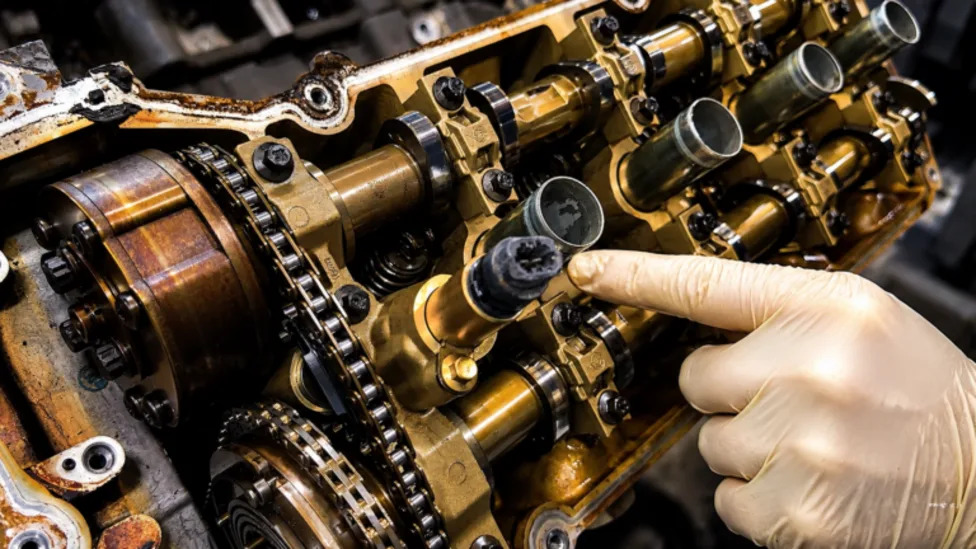
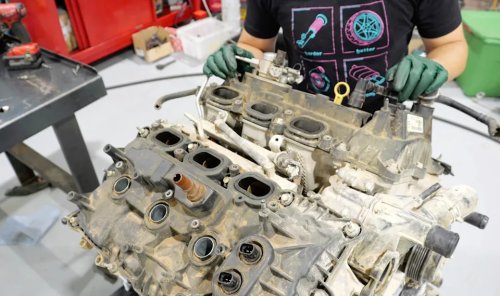
Failed Ford F-150 Coyote Engine Teardown Reveals A Costly Rebuild MistakeA Ford F-150 Coyote engine that arrived at a shop for teardown appeared, by most measures, to be in decent shape: no sludge, no catastrophic scoring, visible crosshatch still present on the cylinder walls. It had clearly been rebuilt at some point. Heat tabs on the block and heads told that story. What the rebuild apparently didn't include, according to the mechanic tearing it down, was the one thing that actually needed fixing.The Gen 3 Coyote's reputation for oil consumption is well established, with certain Ford F-150s from model years 2018 through 2020 burning through far more oil than owners expected.Ford itself acknowledged the problem in a 2019 Technical Service Bulletin, noting affected engines could consume more than a quart of oil every 3,000 miles with no external leaks.AdvertisementAdvertisementSo when mechanic Dave pulled this particular engine apart, he wasn't surprised to find an oil burner. He was surprised by what the previous rebuild had – and hadn't – done about it."The Gen 3 Coyote motor, this came out of a Ford F-150," he said. "Third-generation Coyote motor. What's it famous for? It's famous for oil burning. It's an oil-burning disaster for Ford."What the Profilometer Actually RevealedThe teardown confirmed the rebuild quickly. Standard-size pistons, standard main and rod bearings, and no evidence the crank had been turned. The walls still showed crosshatch. To anyone glancing at the bores, it might have looked fine. It wasn't.A profilometer measures the roughness average, the RA, of a cylinder wall by calculating the mean of the peaks and valleys across the cross-hatch pattern.AdvertisementAdvertisementMost OEM and ring manufacturers specify a surface finish of 15 to 25 RA for moly-faced rings. The reading Dave pulled from this engine was 9.6 – well below that threshold.When a cylinder wall finish is too smooth, rings can glaze over the surface rather than bed in properly, which prevents them from ever fully sealing.That's not a ring problem. That's a surface problem that makes the rings irrelevant.Dave added: "Just because you got a cross-hatch doesn't mean you got the right surface finish." And the reading confirmed it. Nine-point-six RA is, in his words, "way, way, way too smooth for the rings."AdvertisementAdvertisementThe piston inspection backed the diagnosis up. Oil had packed into the groove between the first and second rings – coked, carboned, bound up. The ring wasn't floating freely in the land anymore. Dave explained why that matters specifically on this engine: "The ring tension is so light in these motors, the ring is so thin that there's no tension on the ring where it pushes up against the cylinder wall. So, if you ever have any kind of a blockage… that blockage causes that ring to stick in the land, and that's basically a leaking seal from the crankcase."The cylinder walls hadn't been properly re-honed after the rings were swapped in, and because the surface was too glassy to retain an oil film, the cylinder finish – which is critical to engine performance because it retains the oil film the piston rings ride on during combustion – was never right from the moment it left whoever rebuilt it.Dave's conclusion on what happened: "Somebody got a — we call it a cheap rebuild. They basically maybe re-gasketed it, threw some rings in it, put some bearings in it, tapped it on its butt, and sent it on its way."The Warning Worth RememberingThe larger point from this teardown isn't just that one engine got a bad rebuild. It's that a bad rebuild can look entirely convincing to anyone who doesn't have a profilometer and knows what to do with it. Crosshatch is visible to the eye. RA is not. A shop that ball-hones a wall, slaps in fresh rings, and buttons it back up can produce an engine that looks rebuilt and behaves like it was never touched – because for the purpose of ring seal, it effectively wasn't.AdvertisementAdvertisementDave's parting advice is this: "Be careful where you buy stuff like this. People can tear this stuff apart, put it back together – sometimes they don't even tear it apart, they just pressure wash it, and they say it's a rebuild."Ford's own TSB response to the Gen 3 oil consumption issue drew criticism for seemingly adjusting acceptable oil level parameters rather than addressing the mechanical root cause.An engine that was rebuilt without resolving the cylinder wall finish isn't in a better position than one that was never touched – it's arguably in a worse one, because someone already paid for a fix that didn't fix anything.