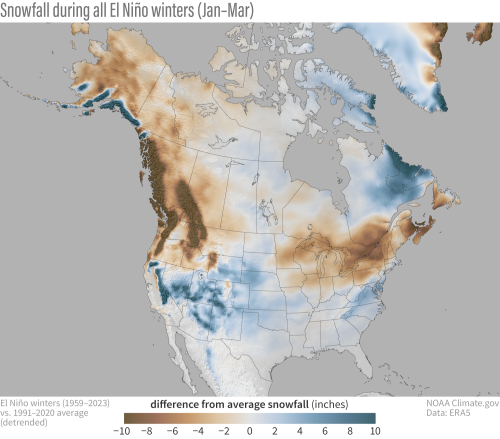
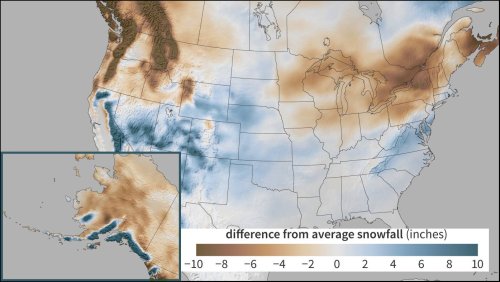
Talk about a vicious circle. A team of climate scientists lead by Judith Cole at the University of Michigan has published new research in the journal Science this week. Here’s what Cole told The Guardian about that research. “We are seeing a trend of stronger El Niños and the one we have now is consistent with that trend — it’s not a fluke. We are seeing a shift where El Niño doesn’t look like what it did prior to industrial times. That is bad news for climate hazards and for people, particularly those who are badly impacted and yet have done little to cause climate change. Our findings suggest El Niño can supercharge global warming but also global warming can supercharge El Niño — that is what we are seeing,” Cole said. The research involved a painstaking analysis of the composition of large boulder-like deposits of coral fossils found on the Galápagos Islands which date back a thousand years of more. The chemical composition of those coral provided clues as to what sea surface temperatures when the coral was alive. Think of it as how the rings of a tree can provide clues to the environment as the tree grew from a sapling to maturity. The Galápagos islands are situated off the coast of mainland Ecuador, which is “right in the heart of El Niño country,” Cole said. El Niño means “the child” in Spanish, and in particular the Christ Child, because Peruvian fishermen in the 1800s noticed that warmer water temperatures roughly coincided with Christmas. James Hansen On “Super Duper El Niño” Dr. James Hansen, one of the world’s preeminent climate scientists and his colleague posted on Substack recently, “The El Niño has blossomed. It is off the charts. Usual measures of El Niño have blown past prior record levels in the period with good data, even though maximum effects are still several months in the future. Our preferred metric, the heat anomaly in the upper 300 meters of the Equatorial Pacific Ocean, already exceeds the 1997–98 super El Nino.” While El Niños remained fairly stable for most of this long period, things started to change around the time the world started to mass industrialize in the late 19th century. This process has become even more extreme in the past 40 years, with El Niños’ variability now around 37 percent higher than during pre-industrial times, Hansen and his colleagues wrote. The researchers working with Hansen wrote that “many living spaces occupied based on 20th century climate will not be well-suited to habitation later in the 21st century, if we allow climate change to continue. The extreme heat and drought anomalies in the Mediterranean and neighboring European regions, as well as conditions in the Southwest United States, where drought has intensified and the levels of Lake Mead and Lake Powell keep falling, will continue to worsen unless we reverse the trends of human-made climate forcings. Living conditions for large populations in South Asia, Gulf nations and Africa threaten to become intolerable.” Climate Extremes “After the El Niño in 1982, we start seeing much more variability; it’s a lot more extreme and looks like nothing in the previous 1,000 years,” said Cole, whose team managed to rule out any random or naturally occurring reason for this switch. “What surprised me was how consistent it was. There is just such a large, distinct difference between what has been happening in the last 40 years compared to pre-industrial times.” The findings could help provide an answer to one of the more vexing questions in climate science — is the climate crisis significantly changing the strength of El Niño events. “This is a strong indication that climate change may already be amplifying El Niño events,” said Samantha Stevenson-Karl, a University of California, Santa Barbara scientist and study co-author. “If that’s true, then really large events like the one that seems to be brewing in the tropical Pacific right now might become more common in the future.” And yet, MAGA lunatics continue spending tax dollars to discourage companies from building wind farms and instead are requiring those same companies to invest hundreds of millions of dollars in LNG facilities in the Gulf of Mexico. Insanity! Knock On Effects Of El Niño The El Niño this year is expected to bring heavier rainfall and flooding to parts of South America and the southern US. In India, El Niño years typically see less monsoon activity, while countries such as Indonesia and Australia face drier conditions and droughts. The huge El Niño event that is currently taking place could push about 50 million people worldwide into acute hunger before the end of next year due to the impact upon food production, according to the World Food Programme at the UN. The understanding that the climate crisis is also making El Niño more severe should prompt countries to ramp up their adaption ahead of such events, such as the food stockpiling that India is currently undertaking, Cole said. “We can prepare and try to adapt,” she added. “But we also need to look at the root cause, which is the fossil fuels we are burning every day. We need to get away from greenhouse gas-producing technologies as quickly as possible.” Andrew Dessler, a climate scientist at Texas A&M University, who was not involved in the research, said the paper was an “important validation” of model predictions that El Niño events would strengthen with global heating. “It underscores that a substantial share of the damage from the upcoming El Niño should be linked to our fossil fuel driven economy. The findings reinforce the urgent need to transition away from fossil fuels to climate-safe renewable energy.” Dessler is correct, but is anyone listening to what he is saying? Certainly no one in the US government is paying any attention.