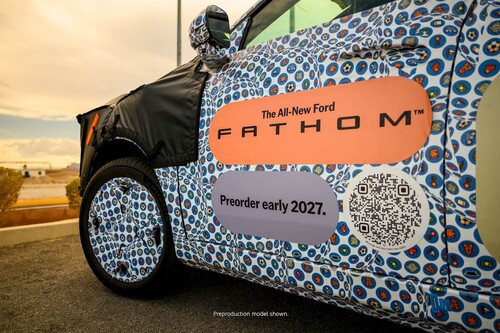
More and more people are spotting Ford Motor Co.'s yet-to-be unveiled all-electric midsize pickup truck camouflaged on roadways, and some speculate it could carry a historic Blue Oval name.The vehicle, expected to start around $30,000, will be the first built on the Dearborn automaker's Universal Electric Vehicle platform that executives have said will revolutionize how the 123-year-old company assembles its products and position it to compete better with Chinese rivals and EV maker Tesla Inc. Ford is retooling its Louisville Assembly Plant in Kentucky to launch the affordable truck next year.Hidden inside the black-and-white camo print on the pre-production vehicles are QR codes that take people who spot what Ford is calling the unicorns to a website with a video featuring the disguised vehicle, more information on it and a way to sign up to receive more updates.AdvertisementAdvertisement"This is about reimagining how we develop and build vehicles," Alan Clarke, Ford's vice president of advanced development projects, says in the video. "This website will be your exclusive window into our progress — a place where we show you how we're doing things differently as our team develops an electric vehicle that's accessible and exciting, one innovation at a time."Screen captures from a Ford marketing video appear to show and provide hints about the company's yet-to-be unveiled all-electric midsize pickup truck.Ford hasn't shared what nameplate the vehicle will bear, but some speculate it could be called "Ranchero" after the company filed the trademark in August 2025. The Ranchero previously was a two-door pickup based on a car platform that the automaker sold from the mid-1950s through the late 1970s.The Maverick, Lightning and Bronco all resurrected names from Ford's storied portfolio. And a pixeled image on the UEV website depicting a road through a desert with cacti certainly gives a western feel like the Ranchero name does.Ford spokesperson Emma Bergg said trademarking a name doesn't guarantee it will appear on a product and declined to comment on the speculation.AdvertisementAdvertisementFord hasn't shared many details on the UEV's specs. The company described the midsize truck as similar in size to the Maverick, but having more passenger room than the latest Toyota RAV4, the most popular SUV in the United States. Ford expects a 0-60 mph time on the truck to be as fast as the Mustang EcoBoost with more downforce. Like the Tesla Cybertruck, a 48-volt system will replace the traditional 12-volt battery that operates in-vehicle electronics.Executives have said the pickup will support drivers who travel less than 300 miles, similar to the EVs it already has offered but with a third of the battery cells. The truck will be able to power a house for six days in the event of an outage with bidirectional charging.The midsize truck will use batteries from the $3 billion BlueOval Battery Park Michigan in Marshall that began pre-production manufacturing earlier this year. It's producing lithium-iron-phosphate batteries, which don't use cobalt or nickel, making them less expensive than traditional EV batteries. They also are less likely to catch fire, though they also are less energy dense. The technology is licensed from China's Contemporary Amperex Technology Co. Ltd. Ford expects to be the first manufacturer of LFP batteries for automobiles in the United States.The truck will be a test for Ford. EV demand has missed expectations as consumers remain wary of their range, cost, speed to charge, and reliability. The elimination of federal tax credits didn't help. But Chinese companies are expanding globally with subsidized, affordable electrified vehicles, and Ford doesn't want to be left in the dust.AdvertisementAdvertisementFord is investing $2 billion into Louisville Assembly for the UEV and is abandoning the traditional moving assembly line developed by founder Henry Ford in 1913. The new tree-shaped manufacturing design brings together three sub-assemblies and reduces parts by 20%. It will be Ford's most automated assembly plant, and the investment secures 2,200 hourly jobs at Louisville Assembly.Large, single-piece aluminum unicastings replace dozens of smaller parts so the front and rear of the vehicle can be assembled separately. They then combine with the structural battery, which is assembled independently with seats, consoles and carpeting.The UEV is a simplified underpinning developed by Ford's California-based EV hardware and software "skunkworks" team, a group launched in 2022 at a tenth of the size of what Ford typically would hire for this kind of work. The intentional separation of the group was done for the sake of innovation outside of the legacy, bureaucratic system, executives have said.bnoble@detroitnews.com@BreanaCNobleThis article originally appeared on The Detroit News: Does Ford website hidden in electric truck camo hint at vintage name?