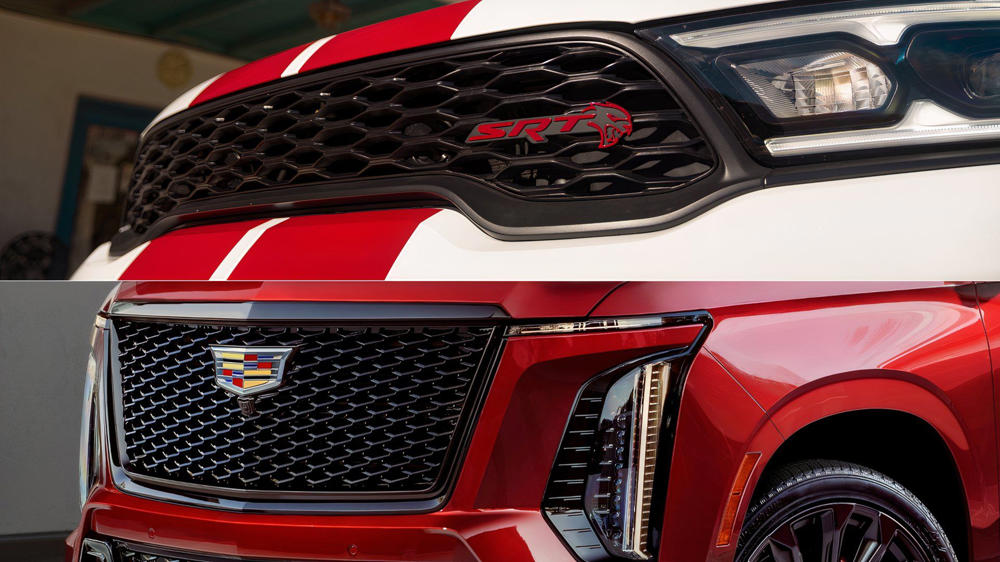
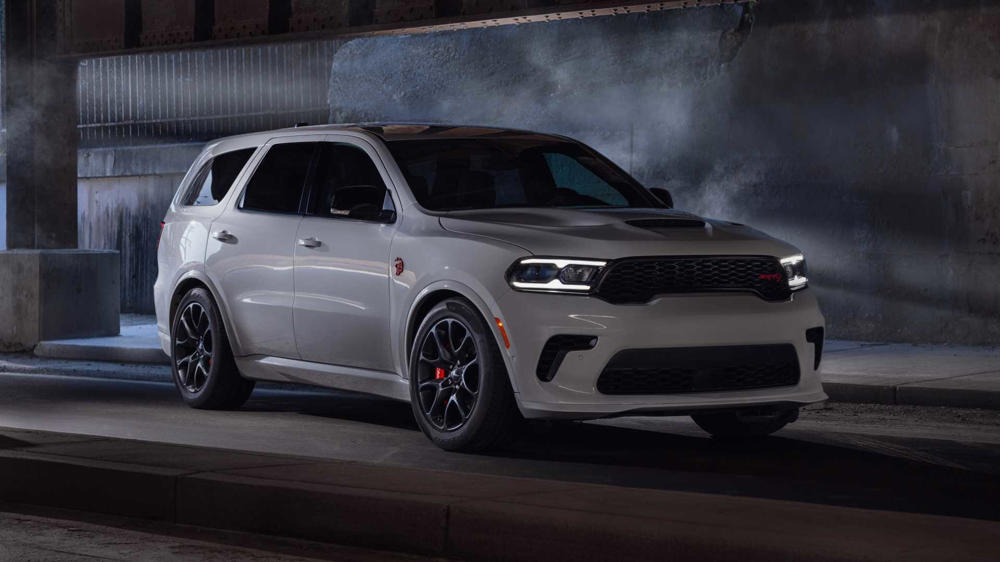
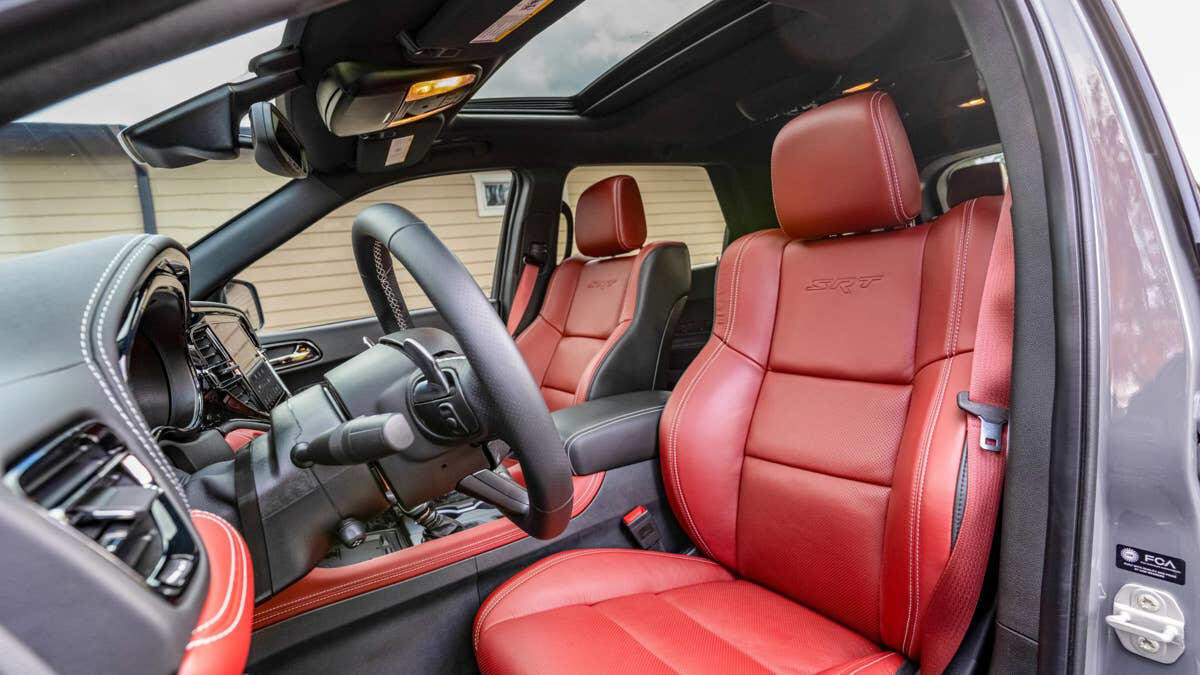
Family duties may dictate that you buy a three-row SUV, but that doesn't mean you have to give up on driving fun. The 2026 Dodge Durango SRT Hellcat and 2026 Cadillac Escalade-V prove that point by delivering muscle-car thrills in family-friendly packages. Sure, they differ wildly in price, positioning, and size, but both share the same mission: hauling the family in comfort while putting a huge smile on the driver's face. Here's a closer look at how these supercharged V8 American behemoths compare. Two Supercharged Takes On The Family SUV The current third-generation Dodge Durango first arrived for the 2011 model year, making it one of the oldest new vehicles still on sale in America. However, it didn't gain supercharged V8 power until 2021, when Dodge introduced the SRT Hellcat powered by the famous supercharged 6.2-liter Hellcat V8, rated here at 710 horsepower. Age clearly hasn't hurt its appeal. The past year was the current Durango's best year on record, with deliveries climbing 37% to more than 81,000 units. Stellantis isn't in a hurry to replace it, either. A redesigned model isn't due until the end of the decade, leaving plenty of time for more updates to the current SUV. V8 versions of the Durango were once a relatively affordable way to get into a high-performance SUV, but prices have crept up over the years. For 2027, the SRT Hellcat starts at $82,490 before destination, putting it well above its original price point, though it's still a bargain against the Cadillac Escalade-V's $171,000 sticker. The Durango is still the smaller and more mainstream option here, though. It's a midsize SUV and uses unibody construction, sharing its basic underpinnings with the Jeep Grand Cherokee. That gives it a very different foundation from the much larger Cadillac. The Escalade-V occupies an entirely different part of the market. As a high-performance version of Cadillac's flagship SUV, it brings a level of prestige and equipment that the Durango doesn't aim to match, and its starting price reflects that. You're also paying for a considerably larger vehicle. The Escalade is a full-size SUV with traditional body-on-frame construction. But don't mistake that for old-school truck manners. Independent rear suspension, all-wheel drive, and adaptive air suspension help the Escalade deliver a surprisingly composed ride for something of its size. The current fifth-generation Escalade arrived for the 2021 model year and received a substantial mid-cycle refresh for 2025, making it considerably newer than the Durango. Cadillac has also expanded the nameplate with an all-electric alternative, the Escalade IQ. Its dual-motor setup produces up to 750 hp, outmuscling the gas-powered Escalade-V's 682 hp. Yet the V still gets to 60 mph quicker. Cadillac quotes 4.4 seconds for the supercharged V, while the IQ takes 4.7 seconds, according to the automaker's estimates. Performance Specifications Compared The Durango has the clear performance advantage. It's the more powerful SUV here, and it's also smaller and considerably lighter. That combination delivers quicker acceleration and makes the Durango feel surprisingly nimble for its size. Adaptive dampers and standard Brembo brakes at all four corners (the Cadillac only has front Brembos) help keep it composed, although the ride may be too firm for some. The engine delivers a relentless surge of power from pretty much anywhere in the rev range, accompanied by the familiar whine of the blower and a thunderous exhaust note, while the automatic responds quickly. 2026 Dodge Durango SRT Hellcat 2026 Cadillac Escalade-V* Engine Supercharged 6.2-liter V8 Transmission 8-speed automatic 10-speed automatic Drivetrain AWD Output 710 hp | 645 lb-ft 682 hp | 653 lb-ft 0–60 mph 3.5 seconds 4.4 seconds Top speed 180 mph 125 mph (governed) Curb weight 5,575 lbs 6,352 lbs EPA fuel economy (MPG) 12 city/17 highway/13 combined 11 city/17 highway/13 combined Towing Capacity 8,700 lbs 7,200 lbs MSRP $82,490 $171,000 *Cadillac Escalade-V figures are for standard wheelbase model. The Escalade-V is definitely in a different performance league. While its engine is only slightly down in the power department, the SUV still sounds great, and its automatic shifts quickly when you put your foot down. But with more than 6,300 pounds to move, the Cadillac feels less explosive than the Dodge, even if its acceleration is still shockingly quick for something this large. Its combination of adaptive air suspension with magnetic dampers also delivers a level of ride comfort that's a step above the Dodge, resulting in an SUV that feels more like a fast, luxurious grand tourer rather than something that could hold its own on a racetrack. Anyone concerned about fuel economy should take cover now. Both SUVs are among the thirstiest vehicles on sale, but the Escalade-V actually has a slight advantage. It matches the Dodge on the EPA's highway and combined cycles, despite its considerably bigger size and weight, and its city rating is only 1 mpg worse. The advantage is likely helped somewhat by its automatic having more ratios to work with. If towing matters more, however, the Dodge wins with an 8,700-pound rating against the Cadillac's 7,200 pounds. Interior Features And Dimensions The Durango SRT Hellcat has a functional, if somewhat dated, cabin that reflects its age. It comes standard with Nappa leather and Alcantara trim, eight-way power front seats, heating and ventilation up front, and a 10.1-inch touchscreen for an infotainment system that supports wireless Apple CarPlay and Android Auto. The standard layout seats five, while an optional third row increases capacity to seven. The Escalade-V has a huge technological lead over the Dodge, especially since its 2025 facelift. It comes standard with three rows, including second-row captain's chairs, seating up to seven (a second-row bench is available on non-V models). Standard equipment includes semi-aniline leather, 16-way power front seats with heating, ventilation, and massage, a massive 55-inch display combining the instrument cluster and infotainment, a 38-speaker AKG audio system, rear-seat entertainment, and GM's Super Cruise hands-free driving technology. The difference in size is just as significant. The Durango measures 200.8 inches long and offers 17.2 cubic feet of cargo space behind the third row, expanding to 85.1 cubic feet with the rear seats folded. The Escalade-V stretches 211.9 inches and provides 25.5 cubic feet behind its third row, or 120.5 cu ft with the rear seats folded. However, Cadillac also offers theEscalade-V ESV, which grows to a mammoth 227 inches long and increases the cargo space to 41.5 cu ft behind the third row and 142.2 cu ft with the rear seats folded flat. Which One Is Right For You Nobody does vehicular excess quite like America, and few vehicles embody that philosophy better than the Dodge Durango SRT Hellcat and Cadillac Escalade-V. Both SUVs will turn heads, but the Escalade-V makes a much bigger statement. The Durango SRT Hellcat looks much like any other Durango to the average observer, while the Cadillac is an established American land yacht, only now with a supercharged V8 and the performance to match. If outright performance is your priority, and you don't need the space of a full-size SUV, the Durango is the way to go. It's quicker, more powerful, and considerably cheaper. The Escalade-V is unquestionably the more luxurious choice, but you'd expect that from a vehicle costing more than twice as much. Ultimately, the Dodge delivers more performance for your money, while the Cadillac delivers considerably more of everything else. Sources: Cadillac, Dodge