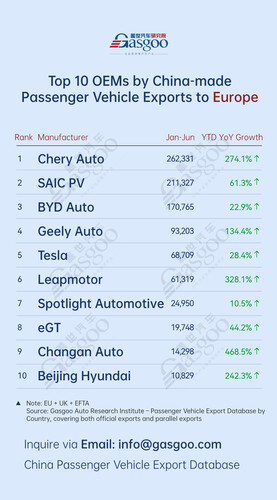
Gabriel Carter · 2 months ago@gabrielcarter247Chinese brands to take over half of Australia’s new car market by 2035, dealers’ group forecasts Liked by+31 othersBYDCheryGeelyTeslaPost commentRelated PostsCanada's second Chinese EV quota window opens Sept. 1 with over 11,000 permits still unused 87 · Madeleine Bouchard · 2 months agoGeely's AI fast charging 'heals' EV batteries for 20% more cycle life 40 · Carter Clark · 28 days agoIt Has An Odd Name, But The Deepal S07 Surprises | ReviewNicole Anderson · 19 days agoParis Motor Show 2026 live: Citroen 2CV reborn, next-gen Vauxhall Astra and so much moreAbigail Campbell · 12 days agoThese 6 Chinese automakers are the likeliest to enter the Canadian market next year 54 · Audrey Scott · 2 months agoUruguay EV Sales Report: Sales Soar in August as Market Share Reaches 56%! 29 · Sarah Turner · 29 days agoThis Chinese Car Brand Was Co-Created By Mercedes-Benz (And Is Now Competing With Them Directly)Owen Fortin · 20 days agoAmerica’s Biggest Non-Tesla EV Fast Charging Network Just Hit A New MilestoneCaleb Harris · 12 days agoChina's passenger vehicle exporters overview (Jan.-Jun. 2026): Chery Auto surges 274.1% in Europe丨Gasgoo Automotive Research Institute 87 · Lucas Hill · 2 months agoTesla’s Semi Plant Opens, Rivian Recalls Nearly 99,000 EVs, and What Else Moved 31 · Lucas Lavoie · 29 days agoUK EV sales surge 36% to record 99,199 as Tesla Model 3 leadsOwen Tremblay · 21 days agoPssst! Wanna See A Driverless Electric Truck?Aiden Martin · 12 days agoChina’s July NEV Sales Hit 1.47 Million 26 · Camille Tremblay · 2 months agoGeely one-ups BYD with 2.2MW charger, allowing 4-minute EV charges 65 · Zoë Labelle · 1 months agoFord's $30,000 EV pickup production launch faces uncertainty 35 · Owen Green · 23 days agoAre Aero Caps A Worthwhile Upgrade for Electric Vehicles? Testing the HALOBLK HALODISCSAva Macdonald · 12 days agoH1 2026 China Passenger Vehicle Exports: Who is Leading? Geely Surges 445.6% in Central & South America, Leapmotor Soars 302.1% in Southeast Asia | Gasgoo Institute 74 · Camille Green · 2 months agoChina Passenger Car Retail Falls 23% in Aug, SUVs Lead Growth 91 · Caleb Clark · 1 months agoNew BMW i3 gets a huge £10k price cut with arrival of 40 xDrive model 75 · Oliver Rogers · 24 days agoStudy Finds Many New Cars Share Your Data With Third-Party CompaniesAdam Turner · 12 days ago


 +31 others+31 others
 +31 others