CATL Chief Scientist Wu Kai has positioned lithium-air batteries as a long-term research focus for the company at the Equipment Powerhouse Forum 2026. Sodium-ion and solid-state technologies remain closer to commercialisation at CATL. Current attention is primarily drawn to the potential for ranges of up to 2,000 km. The basis for such projections is the very high theoretical specific energy of lithium-air chemistry, at around 3,505 Wh/kg. However, this value describes the electrochemical potential of the reaction, not the energy density of a complete vehicle battery.
The difference from conventional lithium-ion cells lies in the structure. Lithium-air systems use metallic lithium as the negative electrode and oxygen from the surrounding environment as the reaction partner. During discharge, lithium peroxide forms in a porous cathode; during charging, the reaction is reversed, and oxygen is released again.
Because the oxygen does not need to be carried as a traditional cathode material within the battery, this theoretically results in a very high specific energy. However, for a real battery system, electrolyte, electrodes, housing, protective systems, and – above all – components for air processing must be added. Even higher theoretical values of around 12,000 Wh/kg are based on calculations that exclude the mass of the required oxygen.
The gap between theoretical energy density and a production-ready vehicle battery is significant, as demonstrated by current laboratory results. In 2024, researchers from Jilin University and the Chinese Academy of Sciences achieved 757.5 Wh/kg and 241 charge cycles with a lithium-air pouch cell under defined laboratory conditions.
CATL’s lithium-air Batteries still face challenges
Another approach comes from Argonne National Laboratory and the Illinois Institute of Technology. A solid-state lithium-air cell introduced in 2023 completed at least 1,000 charge and discharge cycles at room temperature. The architecture used was said to have a theoretical potential of around 1,200 Wh/kg. Both results show progress but are not equivalent to a validated battery for production vehicles.
A central challenge remains the air supply. The battery requires oxygen, while moisture and carbon dioxide must be reliably kept out. Both substances can cause unwanted chemical reactions, damaging electrodes and electrolytes. A vehicle would therefore need a controlled air supply system with filtration and humidity management. This peripheral equipment, in turn, increases weight, space requirements, and energy consumption. Additional unresolved or only partially solved issues include cycle stability, charging efficiency, and the stability of the lithium-metal anode.
The reaction products in the cathode are also problematic. Lithium peroxide can deposit in the pores, hindering oxygen transport. During charging, it must be completely removed without side reactions damaging the electrolyte or electrodes.
A high specific energy alone is not sufficient for use in electric vehicles. Volumetric energy density, power output, fast-charging capability, safety, lifespan, and the weight of the overall system are also decisive. The frequently cited 2,000 km cannot, therefore, currently be applied to a concrete vehicle.
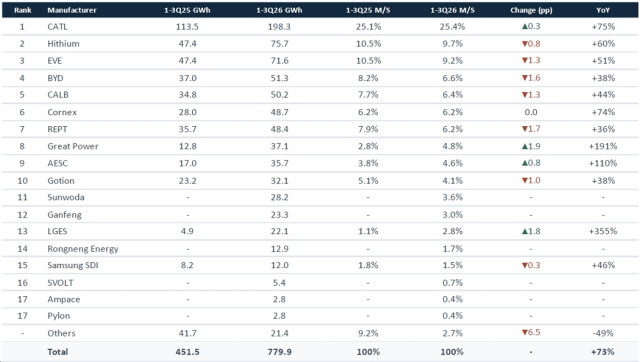
CATL is simultaneously pursuing significantly more market-ready technologies. Sodium-ion batteries and solid-state cells are much further along in the company’s development roadmap. At the same time, CATL is already the clear market leader with established lithium-ion systems. According to SNE Research, the company installed 143.7 GWh of battery capacity outside China in the first nine months of 2026, achieving a market share of 33.7 per cent.
The current trend towards LFP also shows how strongly the battery market is evolving with already available cell chemistries. According to SNE Research, the LFP share of the market outside China increased from 15.8 to 27.7 per cent within a year. Chinese manufacturers, in particular, are benefiting from this development.
The technology remains a long-term research option for CATL. Whether it will eventually lead to electric vehicles with four-digit ranges depends less on the theoretical energy density and more on whether the numerous chemical and technical challenges can be resolved in a long-lasting, safe, and affordable battery system.