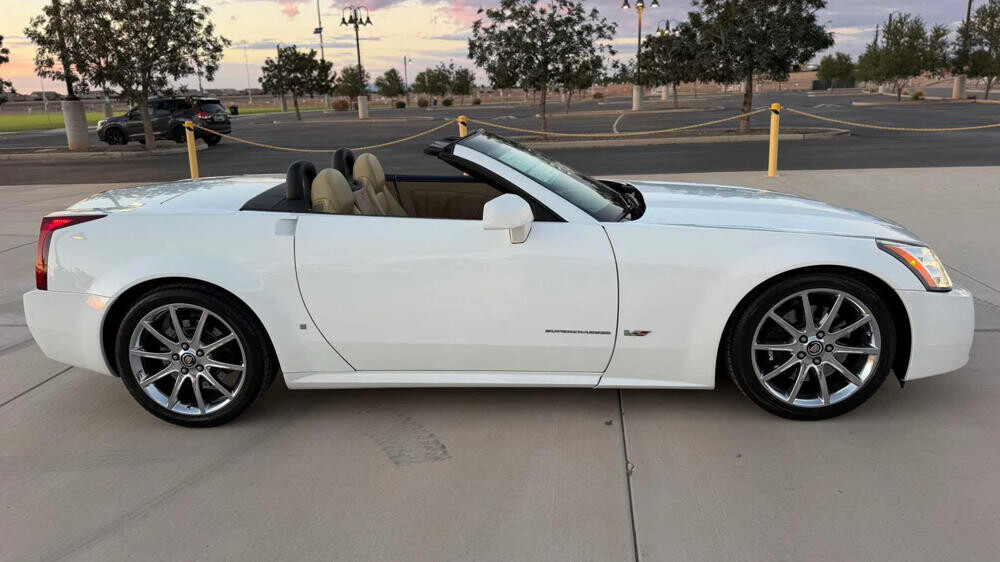
I hail from a household where “XLR” means something different to many of us. Where my sister thinks of audio equipment, I conjure an image of Cadillac’s misunderstood muscle machine. Whether it prompts discussion of it being a copycat Corvette, or one dressed to the nines in a tailored suit, the Cadillac XLR is many things to many people. To fans of fast Cadillacs, this low-volume roadster is the car no collection is complete without. Especially if your intent is to honor the lesser-known cars born of the “try anything” attitude of the 2000s, something Detroit took to heart a little more than others. Built Beside The Corvette – But Treated Completely Differently Part of what made this car worth $57,000 in 2026 starts on the factory floor in Bowling Green — where the XLR got treatment no Corvette ever received. A common misconception about the XLR is that it rode the same production line as the Corvette in the mid-2000s. While it was assembled under the same roof, cars were built off the line by separate assembly workers. The chassis were rolled by hand to different stations for component installation, making their way onto an automated production line for measurement checks. Then, they would be pulled off the line, mated to the bodies, and returned to the line as complete units for further assembly, painting, and quality checks. Compared to the C6 Corvette assembled just yards away, which remained on the same automated line for the entire process, the XLR received a white glove treatment. It might have shared a chassis and suspension with the Corvette, but the Cadillac had a handful of tricks tucked exclusively up its pressed sleeves. Every XLR was built as a hardtop convertible. The roof is stashed in the trunk when the day calls for open-air cruising. At the press of a button, a ballet dance of scissor lifts and hydraulics folds the roof away into the trunk. The XLR competed with other premium drop-top sports cars, like the Jaguar XK and Mercedes-Benz SL. In fact, the same manufacturer – Car Top Systems – from which Mercedes sourced the folding hardtop units for the SL also engineered and assembled the domes for the XLR. But where each of the German sled's powertrains curled the toes of enthusiasts at the mere sight of the spec sheet (a duo of naturally aspirated and supercharged V8s along with a twin-turbo V12), the American steed was given Cadillac's 4.6-liter Northstar V8 and a 5-speed automatic transaxle as standard kit. A third pedal was never offered. It was factory rated at 320 horsepower and 310 lb-ft of torque, which put it ahead of the standard 5.0-liter V8-powered SL500 (renamedthe SL550 from 2006). The Caddy was easily trounced by the other two engines in Mercedes’ arsenal, which prompted the addition of the XLR-V in 2006. It packed a supercharged 4.4-liter variant of the Northstar and considerably more power at 443 horsepower and 414 lb-ft of torque. It also gained an extra ratio in its gearbox, offered exclusively with a 6-speed automatic. No sign of a manual was found here, either. This 2008 XLR-V Fetched $57,000 At Auction Along with the added power, this specific XLR-V has a smidgen of rarity as it’s one of only 61 Alpine White Edition cars built for 2008. Better still, it only has 19,000 miles on the odometer and was offered on Bring a Trailer with a clean Carfax report and title, and the original window sticker revealing a $102,800 MSRP. That’s big money today, but even bigger when it was sold new in the late 2000s. For the money, not only did buyers get a sports car that hailed from a brand name synonymous with supple suspension, it got the hardware to match. GM's Magnetic Ride Control and elongated wheelbase – a product of sharing a chassis with the Corvette – didn't fly in the face of the V-series' purpose. Where Cadillac's performance moniker means hardcore, face-ripping power in theCT5-V, it meant something far less potent two decades ago. The XLR may have been a sports coupe for retirees to enjoy their golden years, but that doesn’t mean it wasn’t cool. It had a lightweight body like the Corvette, among the other pieces it borrowed from it, but it wore sharper edges and looked like no other Cadillac coupe that came before. Beneath the skin and inside the low-cowl cabin are far more luxury amenities than the Corvette ever offered. This one has tan leather seats (heated and cooled), Zingana wood trim pieces, a head-up display, dual-zone climate control, and a Bose sound system. The CD changer is listed as inoperable, according to the listing. All XLRs came with a Bulgari-designed instrument cluster – just one of Cadillac’s many nods to luxury intermixed with performance when it came to its flip-top coupe. Keen eyes will spot the 160 mph top-out in the designer instrumentation, a feat this specific XLR could attempt with ease thanks to the performance cooling package offered on V-series models. A set of 19-inch chrome aluminum wheels (part of the Alpine Limited Edition) sit at each corner, wrapped in 235/45R19’s up front and 255/40R19’s in the rear. All of which raises the obvious question: how much of that $57,000 hammer price is the V badge – and how much would a standard XLR have fetched? The Car That Finished Last In 2006 – And Now Beats Every Rival's Resale Value According to Classic.com, it’s not all that uncommon for a well-presented XLR-V to sell for double what a regular XLR will see. As of November 2026, average values sit at $40,345 for V-series models and $22,764 for standard models. Bucking the trend for naturally aspirated models are limited edition models, specifically the 101 XLRs purchased by Neiman Marcus and sold to the public through its 2003 Christmas catalog as one of many coveted fantasy gifts. But that’s a story for another time. Since the production run of V-series models spanned just four years compared to the six years the standard ones fared, they're slightly rarer, too. A majority of the reason why these versions are more expensive, of course, is because of the extra performance. In the August 2006 issue of Car and Driver, the XLR-V was pitted against the aforementioned Mercedes SL550 and Jaguar XK, as well as a BMW 650i and a Porsche 911 Carrera, each in drop-top garb. The Caddy placed fifth in the comparison, but of the five cars, it has held its value the best. Vehicle Average Sale Price in 2026 BMW 650i $13,810 Mercedes-Benz SL550 $20,126 Jaguar XK $21,964 Porsche 911 Carrera $33,171 Cadillac XLR-V $40,345 Source: Classic.com The main issue we can see with paying this much is Porsche, and not the 996 model mentioned above, but rather the generation after. With $60,000 in 2026, you are right in the sweet spot of the used Porsche 997 911 (2005–2012) market. That budget comfortably buys a clean, low-to-mid-mileage 997.1 (2005–2008) Carrera S or Carrera 4S coupe with a six-speed manual, packing a 355-hp 3.8-liter flat-six and hydraulic steering. Alternatively, $60,000 stretches into an early 997.2 (2009–2012) Carrera or Carrera S—either a higher-mileage manual or a clean PDK dual-clutch model. It's a better car in every possible way, but we suspect this customer paid this much because nothing but a XLR-V would do the job. Underrated Then, Undervalued Now: The CaseFor The XLR-V Of course, we agree with everyone who says the XLR-V is one of the most underrated, overlooked vehicles of the 2000s. We know other Cadillacs of this era take center stage because their lineage continues today, but the one-hit wonder that is the XLR still deserves its place in history all the same. Back then, it made a far better daily driver than the Corvette, and it still would today. That being said, the price you can scoop one up for today (V-series or not) is far more palatable than the prices Cadillac was asking way back when. Business decisions, expensive build costs, and not being able to shake the “less power for loads more money” branding it received from enthusiasts ultimately killed the XLR. That's a real shame, too, because if it had lived to see the day when Cadillac was steeped in both Formula 1 and endurance racing, it could have been a remarkable machine.

 Liked by Justin Clark, Nathan Turner























 Liked by Justin Clark, Nathan Turner