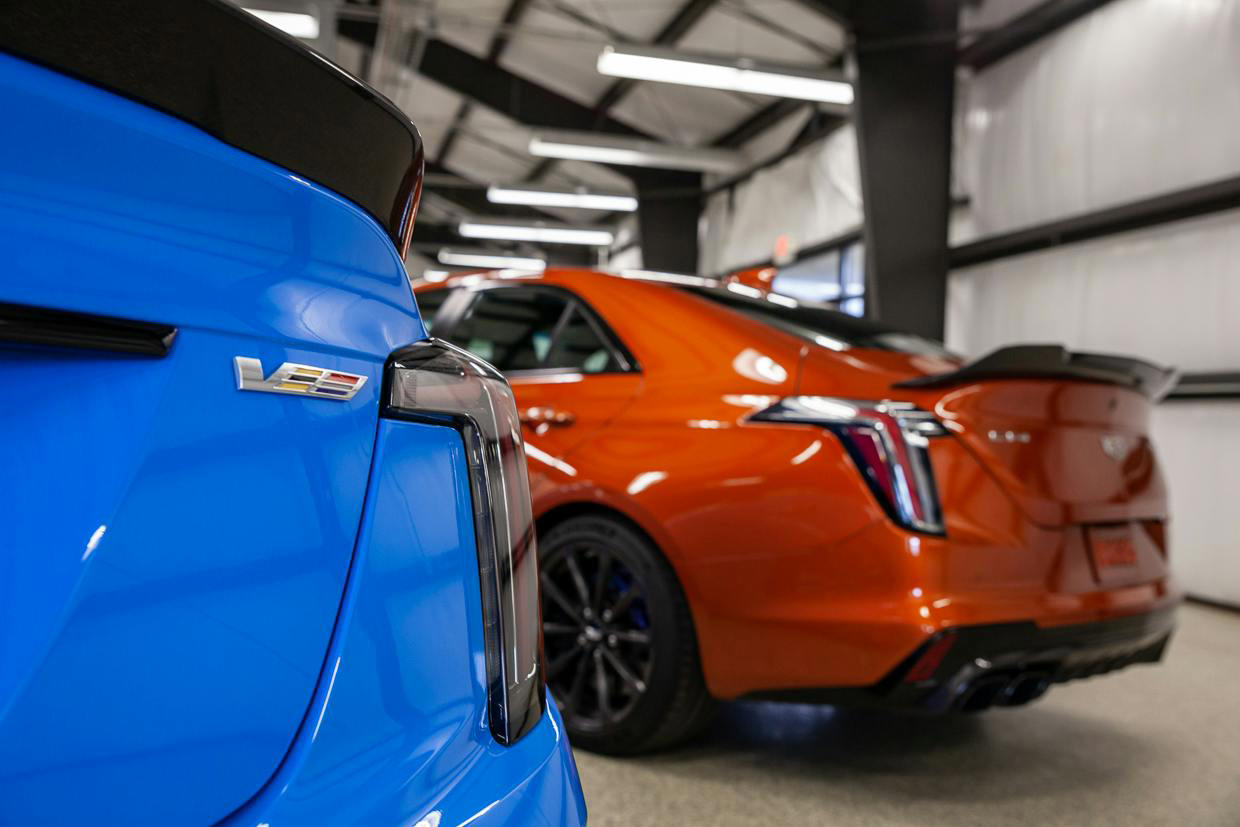
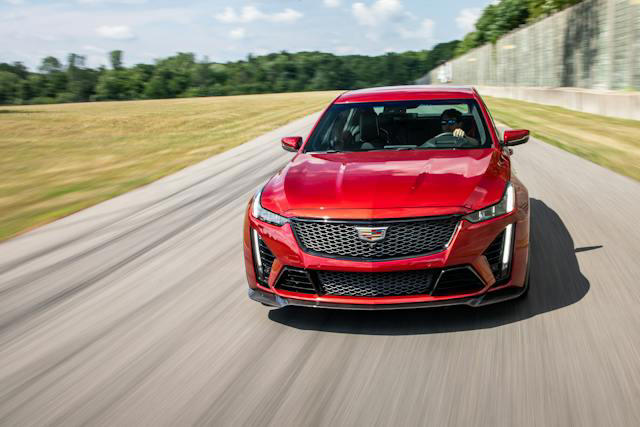
Saying goodbye to a friend that you know you’ll never see again is tough. You shake hands, maybe a hug, and a relationship you’ve both nurtured for years is never the same. From then on, it’s always in the rearview. I just bid farewell to the 2026 Cadillac CT5-V Blackwing, and I’m missing it already. More than 20 years ago, I drove what was then called the Cadillac CTS-V. It was tailored for me like a Savile Row suit. Four generations later, that feeling has remained and ripened. We’ve known for more than a year that the 2026 Cadillac CT5-V Blackwing was the end of the line for the current-generation car, with production set to conclude any day now. Not many cars deserve a proper obituary, and I suppose that’s what this story is. If ever there was a car built to my personal specifications, it’s the Blackwing: Big supercharged V-8, rear-wheel drive, a standard manual transmission, a roomy-enough rear seat, almost 12 cubic feet of trunk space, and one of my favorite characteristics: understated exterior design. No graphics shouting that this is a four-door Cadillac that can go 200 mph; just a few small badges and a modest rear-deck spoiler. If you know, you know. This was the 2026 CT5 Blackwing with which I had a final week-long hangout: Coastal Blue Metallic paint ($625) with a ton of options, including carbon fiber everywhere. Carbon on the seat backs inside, side skirts on the outside; the Carbon Fiber 1 and Carbon Fiber 2 packages added $14,380 to the car’s $98,900 base price. It’s impossible to find a Blackwing for less than six figures; just adding the $1795 shipping cost brings the price to $100,695. The sticker price for this car was $132,960, which included $3675 for GM’s 10-speed automatic transmission. Gray-haired readers may remember when most cars came with a manual transmission as standard, and an automatic as an extra-cost option. That’s just one of the more endearing old-school aspects of the Blackwing. Another is the ripping, undiluted American-V-8 exhaust note On the automatic-equipped Blackwing, you’ll pay $1700 for the federal “gas guzzler” tax, thanks to EPA ratings of 13 mpg city, 20 mpg highway, and 15 mpg combined. (Interestingly, the six-speed manual has the exact same EPA mileage numbers, but the guzzler tax for the manual is $2100.) Options on the test car totaled $32,265, with the gas guzzler tax oddly listed as a factory option. It is not optional. The CT5-V Blackwing is one of those cars that has forced us test drivers to look hard for something negative to write, lest our reviews read like a love letter or Cadillac advertisement. In that spirit, here goes: I didn’t much care for the brakes—just an odd, non-linear pedal feel. I might have expected that from the optional Brembo carbon-ceramic brakes, but this car had the standard iron-rotor brakes, which are fine unless you are serious about attending every single track day at your local circuit. It’s not just me who loves this four-door super sedan. Comedian/car collector/Hagerty columnist Jay Leno wrote this last summer: “The 2026 CT5-V Blackwing has 668 horsepower and is as good as anything they make in Germany, and you can get one with a six-speed manual. I would put it up against any Mercedes-AMG or BMW M car.” Though its muscle gets most of the publicity, it would be a mistake to overlook the Blackwing’s superior chassis tuning, and the model’s always-appropriate Michelin Pilot Sport tires; they combine to make this 4123-pound sedan feel as though it weighs about 400 pounds less than that. I asked my bosses, Eric Weiner, who is the director of digital editorial, and Eddy Eckart, our managing editor, for their thoughts as this Blackwing goes out the door. We’ve all driven Blackwings, of the CT4-V and CT5-V variety, and it seems we’re in lockstep. “The CT5 Blackwing is perhaps most distinctive, most versatile, most emotionally engaging car of the last decade,” Weiner said. “It is both a throwback and a technological tour-de-force. Throwback in the sense that high-powered V-8 sedans with manual transmissions just don’t exist anymore. But it’s technologically modern because it is an absurd geyser of power that is also manageable day to day, nestled alongside a truly magnificent chassis that can toe the line between luxury comfort and genuine track prowess. Inside are all of the creature comforts you want, and almost nothing you don’t. It’s subtle enough that most people won’t clock what this is—a supercar in disguise.” Said Eckart: “For 25 years, the folks in charge of Cadillac’s V (and subsequent Blackwing) program never lost the plot. Tech for tech’s sake wasn’t part of the equation; every advancement, particularly with MagneRide and their incredibly capable Performance Traction Management systems, was developed to foster mile-wide smiles. In an automotive landscape where any appliance can flatten your face with brutal acceleration and practically set lap records for you, the CT5-V Blackwing stands out as a stark reminder of why I got excited about cars in the first place.” So why is Cadillac killing off the Blackwing? For the same reasons almost every decision at every automobile manufacturer is made: Time and money. Since 2020, it’s estimated that CT5-V Blackwing production has averaged about 1500 a year. Even with its six-figure sticker, it’s gotta be tricky to make money on a vehicle that has so many bespoke parts, including the hand-built V-8, which is topped by a little plate that tells you who built your Blackwing’s engine. In my case, a tip of the hat to Jason Neal. The CT5-V Blackwing is built in GM’s factory in Lansing, Michigan, long known as a boutique-ish, comparably low-volume facility—it was called the Reatta Craft Centre (yes, “centre”) to build the Buick Reatta, and after Reatta production concluded in 1991, the name was changed to the Lansing Craft Centre. One of its early products was GM’s electric EV1; its last was the Chevrolet SSR pickup truck. After the last SSR was built in 2006, the Centre was torn down. Alongside the standard CT5 and mid-tier CT5-V, the CT5-V Blackwing is assembled at what is now called the Lansing Grand River Assembly Plant, but I’ll always think of it as some sort of Centre. It’ll be interesting to see what the future holds for the Lansing plant; several years ago, when everybody except the general public was convinced that electrification was the near-term future of the automobile, that also appeared to be the future for Lansing Grand River. Here’s the first sentence from a GM press release in 2024: “For more than 20 years, our GM Lansing Grand River team has built luxury and performance vehicles our customers love, like the Cadillac V-Series Blackwings. Now, we’re excited to announce that with a $500 million grant from the U.S. Department of Energy and our own investment, we’ll prepare Lansing Grand River for electrification.” The release went on to say that GM has “announced over $12 billion in investments for our North American EV manufacturing and supply chain development since 2020.” Word came a year ago from Cadillac’s former global VP, John Roth, that a next-gen CT5 is coming. If that happens, we’d be shocked if plans did not include a CT5-V Blackwing version, and we’d be grateful if they do. Maybe the Blackwing hasn’t been a prodigious money-maker for Cadillac, and likely never will be, but hopefully the company factors in how much horsepower-and-handling credibility it’s brought to the brand. We’d submit that it’s substantial. As far as my week with the current car went: I would have preferred the beefy, proven manual transmission, a version of the Tremec TR-6060 designed to handle high-torque engines, which the Blackwing certainly has: Yes, the 6.2-liter, supercharged V-8 has 668 horsepower, but I’m more impressed by its 659 lb-ft of torque, which is a number you’d typically find attached to diesel-powered pickups. This means the Blackwing pulls hard from a standing stop. It does so with the same brutishness through every gear—even in this 10-speed automatic’s case. During the week with the ‘Wing, I’ll admit to being very impressed with that 10-speed, a GM designed-and-produced Hydramatic 10L90. Granted, it’s busy, but the frequent shifting isn’t distracting. The engine itself is built at the Performance Build Center in GM’s factory in Bowling Green, Kentucky, which is, of course, home to the Chevrolet Corvette. Regardless of which transmission your Blackwing has, it’s an all-American powertrain. Interesting that just 35 percent of the parts in the Blackwing are made in the U.S. or Canada, with 23 percent of the parts sourced from Mexico and 15 percent from China. There’s still a modest supply of Blackwings on dealer lots; according to the locator on Cadillac.com, there are 17 examples available within a 50-mile radius of my home. Though most are in the $130,000 range, one Blackwing in particular caught my eye: A Deep Space Metallic (otherwise known as dark gray) manual-transmission model with minimal options. Not much carbon fiber, but I’m fine with that. After all, so many premium features come standard on the Blackwing, ranging from massaging seats to magnetic ride control to a performance data recorder. There’s very little extra I’d be compelled to add. Counting the $2100 gas-guzzler tax, $1795 in shipping, and a $2890 “jet black” leather interior, the sticker on this near-naked Blackwing at my nearby dealer totaled $107,285, a downright astounding, fully global bargain for what the Blackwing delivers. One of my favorite standard features: Teen Driver. It can lower the top speed, set the maximum volume for the sound system, and, says Cadillac, “the vehicle’s maximum acceleration will be limited.” Maybe this sounds harsh, but regardless of whether or not I had a teen in my household, everybody who’s likely to drive the car would be subjected to Teen Driver. Except me, of course. Bottom line, the 2026 Cadillac CT-5 V-Series Blackwing is a dazzling car, probably the best one built in America (and that includes the Corvette; stay tuned for my review of the latest Grand Sport). Like any friend, it will be missed, and mourned. In every area—every area—the Blackwing overdelivers. “If you gave me $150,000 and said I had to have only one car, that is what I’d get,” said Eric Weiner. “I will miss this particular expression of Cadillac, which fuses sophisticated chassis tuning with serious suspension hardware and enthusiast-minded stability control programming. How many cars do that, sound amazing, and also easily shuttle your relatives to and from the airport before you head to the racetrack for a few hot laps?” And does this mean the end of genuine high-performance products from Cadillac? Eddy Eckart suspects that it does not. Citing the brand’s participation in motorsports, from its championship-winning IMSA and WEC sports car programs to this year’s ambitious debut in Formula 1, “Cadillac’s motorsport ties are as strong as ever; GM’s got a big sedan platform on the way, and there’s plenty of room for a performance halo vehicle beneath the Celestiq. More importantly, the couple of hours I spent with the Blackwing engineers confirmed that passionate gearheads still roam GM’s facilities.” Let’s hope. I’m one friend short now, and not happy about it. Looking to purchase a car? Find your match on the MSN Autos Marketplace

 Liked by Claire Fortin, Emily Roy






 Liked by Claire Fortin, Emily Roy