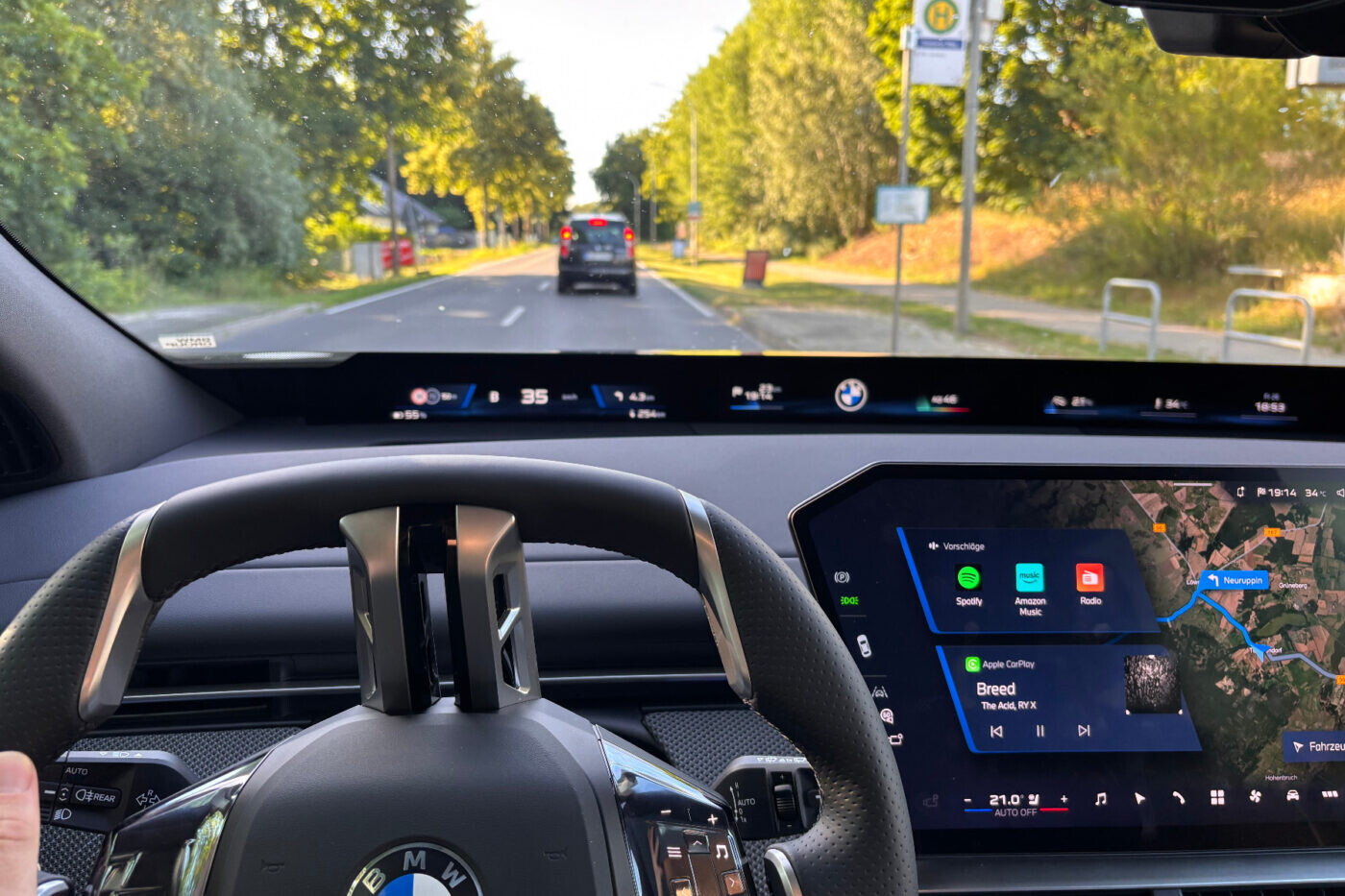
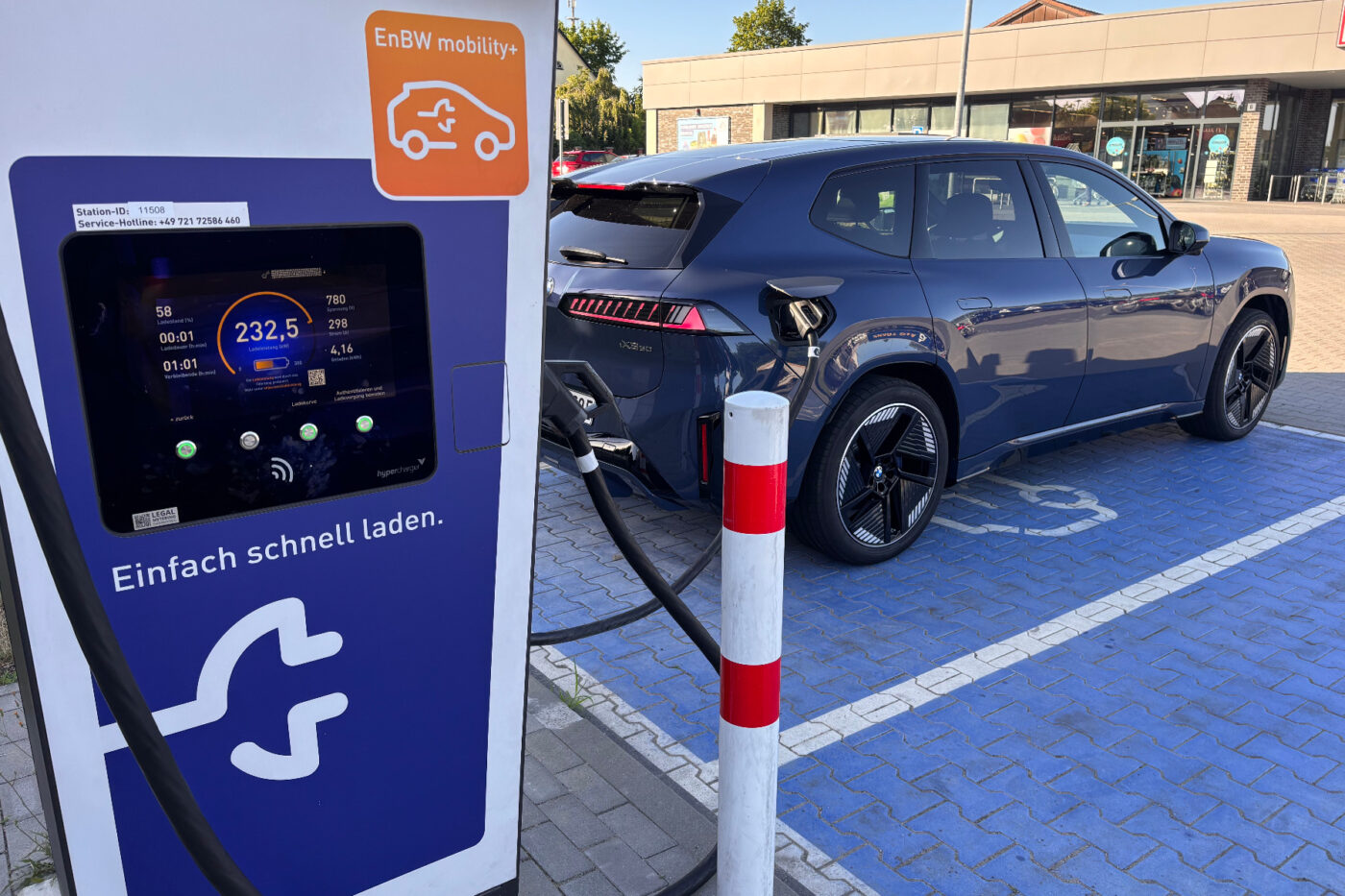
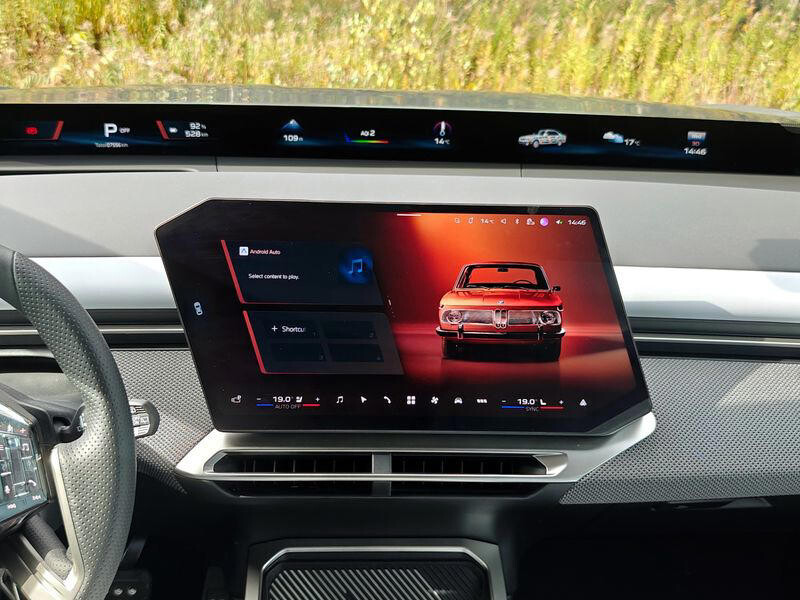
I am, if nothing else, a data person. I love numbers. I like the way, when something really makes sense, the numbers line up. I couldn’t understand iambic pentameter if William Shakespeare himself was explaining it to me, but show me a complex array of digits, and the pattern almost literally jumps out at me. Most of all, I suppose, I love the fact that, at least in my business of reviewing automobiles, numbers quantify tangible abilities. So, when I first jumped into BMW’s ix3 50 xDrive — freshly charged by one of BMW Canada’s corporate charging stations — the first thing I noticed wasn’t the Neue Klasse’s futuristic interior styling, the giant 17.9-inch touchscreen that dominates its dashboard, or the newfangled digital gauge set that stretches across the lower rim of the windshield. Nope, what jumped out to me was the “728” numeral right beside its 100% charge status. Holy shit, thought I — because I don’t deal in “Holy hecks” — did BMW slip a 200-plus-kilowatt-hour battery from a Cadillac Escalade iQ into the iX3’s frunk to boast such an incredible number of kilometres? And, what’s this, an 18.5-kilowatt-hour-per-100-kilometre lifetime average, also predominantly displayed, this time on that aforementioned touchscreen? Holy crap — I’m only allowed, per my contract, one true profanity per article — but such frugality is like an Escalade averaging 30 miles per gallon. Around town, no less. So, the first thing I did — even postponing a workout which is, to me, like Jack Black skipping a meal — was hit Ontario’s hilly and largely un-policed Highway 407 for a 125-kilometre Range Finder (a.k.a. real-world range) test. Here’s what I found. 2027 BMW iX3 50 xDrive battery range First of all, even BMW itself says the iX3 can’t hit 728 kilometres on a single charge. According to Transport Canada, all iX3s top the 600-kilometre mark in their ratings, though, ranging from a best of 698 clicks (on 20-inch summer tires) and a worst of 616 km (on 20-inch all-seasons). My test unit, riding on Yokohama 255/45R21s, was rated for 642 kilometres by the government org. That’s not the 728 km I saw (briefly) on the range readout, but still would have rated a “holy crap,” if not quite the full shit. In real life — and by “real,” I again mean 125 km/h on Ontario’s 407 toll road — the not-so-little iX managed some 520 kilometres before the lithium would have run out. That’s a pretty stout number, about 20 clicks better, in fact, than Lucid’s Gravity, until now the most efficient large(-ish) SUV we’d tested. The BMW’s also rather efficient itself. In North America, the iX3 boasts 112.2 kilowatt-hours of usable energy hidden beneath its false floor. Do the math and the 2027 iX3 50 xDrive consumes just 21.6 kilowatt-hours for every 100 kilometres of high-speed highway cruising. That’s pretty much the best I’ve achieved in any battery-powered SUV, regardless of size. The only exception is perhaps the Zeekr 7X, which used only 20.1 kWh/100 km, but that was in a test in Italy on a road similar to, but not exactly identical with, my Ontario test route. Besides, the Zeekr has a smaller battery and at least 70 kilometres less total range. And compared with previous BMWs, it’s miles ahead. The 2023 iX M60 used a similarly sized battery, yet managed only 414 kilometres — more than 100 clicks fewer — in the exact same test. I also called its 25.4-kWh/100-km energy efficiency “extremely impressive.” That the iX3 is some 15% more efficient than one of the company’s best EVs of just four years ago speaks to the progress Munich has made in battery technology. 2027 BMW iX3 battery charging BMW makes some impressive claims regarding the iX3’s ability to DC fast-charge. Peak input, says the company, is 400 kilowatts — amongst the highest charging rates available in Canada. That said, it runs on a 699-volt platform (which can be listed, as BMW does, as a “800V” system). The result is that, to achieve those 400 kilowatts — actually 402 kW at its peak, says website EVKX — the charger has to be feeding the iX’s battery more than 550 amperes. Amps are electricity’s destructive force, and while they are what launches an electric vehicle off the line like a Pro Stock Camaro, they also cause the heat that limits charging speed. So, while the BMW’s peak charging does indeed rise above 400 kW, it only stays there between 10% state-of-charger (SoC) and 16% SoC, after which it steadily declines; by 90% SoC, it’s only sucking back 74 kW. Compare that with the Zeekr 7X we just tested, which runs on a similar 685V architecture, but can still hold 100 kW at 90% SoC. Either Geely — Zeekr’s parent company — has found a better way to reduce the heat all that current produces, or it simply doesn’t have as much concern for the longevity of its batteries. In the end, BMW says the iX’s battery can be replenished from 10% to 80% SoC in just 21 minutes. That’s fairly — but not outstandingly — rapid, and works out to an average of 224 kilowatts. As the charging curve is front-end-loaded — again, that 10% SoC to 16% SoC charge I just mentioned — EVKX says hyper-milers who want to minimize their charging time can optimize charging speed by “filling up” between 5% and 61%, during which time they could regain 61 kilowatt-hours in just 12 minutes. That works out to an average of 305 kilowatts—speedy charging indeed. My test unit was rated for 642 km—that’s not the 728 km I saw (briefly) on the range readout, but still would have rated a 'holy crap,' if not quite the full shit Worthy of note: If you see the iX’s usable battery capacity listed elsewhere as 108.7 kWh, that’s for the European-spec iX3 50. Both batteries are the same (113.4 kWh total), but American versions have a small 1.2-kWh “buffer” (the smallest I’ve ever seen) while E.U. models have a more generous 4.7 kWh left unused. All things being equal, this would suggest Europeans are more concerned with battery durability, while we on the other side of the Atlantic favour range. Also, the iX3 offers bi-directional charging. That means it can do Vehicle-to-Load charging (camping equipment, e-bikes, and the like); Vehicle-to-Home charging (where it can serve as a back-up generator); and, soon, says BMW Canada, it will allow Vehicle-to-Grid charging, assuming such infrastructure comes to Canada BMW iX3 50 xDrive git-up-and-go Befitting its xDrive designation, the iX3 boasts dual motors, one at each axle. Between the two, they boast 463 horsepower and 476 pound-feet of torque. The result is a 2,338-kilogram sport-utility vehicle — the lightest in this segment with a 100-plus-kilowatt-hour battery — that can hit 100 kilometres an hour in less than 4.9 seconds, an exemplary figure for a gas-fed sport-brute, but only pretty good for a battery-powered version. If that sounds like a back-handed compliment, it is not. Never once did I want for more power. In fact, every time I floored the (not-so-)loud handle, the ferocity of the burst forward impressed. It’s just that EVs have raised the bar so much in terms of acceleration that one always expects the unexpected, and, in this case, hitting the “gas” resulted in exactly the reaction I thought I would. No one looking for a mid-level luxury SUV is going to be disappointed by the iX3. Not every battery-powered car has to be a dragster. 2027 BMW iX3 ride and handling Though my iX3 wore M-line badging, it was, save its 21-inch wheels and some red brake calipers, pretty much standard. But, like even standard BMWs, it handled just fine, if a little antiseptically. Oh, roll was well mitigated and the grip from those 255/40R21 Yokohamas was more than expected from EV-oriented tires (which tend to be built of quite hard compounds), and there was not a lot of feedback from either the steering wheel or my normally well-attuned butt. It felt a little like driving a simulator—not necessarily a bad thing if you’re young enough to be of the digital age, not so engaging if you’re older and analogue. The good thing is that the iX’s ride is not compromised by any of this. Electric steering may make BMW’s legendary steering feedback a hit-or-miss affair, but they still are the masters of tuning suspension for the ideal balance between pounding potholes and clipping apexes. The iX may have felt a little remote behind the wheel, but nobody complained about its suspension compliance. BMW iX3 50 xDrive interior The iX3’s interior is pretty much a stylistic triumph. My photographer, Chris, called it no less than an “amazing new design language.” It is exceedingly modern and truly a delight to the eyes, the whole mystery-light backdrop to the dashboard trim is extremely beguiling. Ditto the odd-shaped touchscreen, minimalist centre dashboard, and the futuristic gauge cluster, all set far forward right below the base of the windshield. That all said, not all of it works as well as it looks. For one thing, though the gauge set — again, a thin strip across the entire dashboard, right below the base of the windscreen — is quite easy to read, I found it odd. Not glaringly so, but it was, well, just different. As in, some of us old folk — see: analogue versus digital — could never get used to a bidet, while others become fans from the very first splash of freezing cold water. I found it attractive and informative the entire time I was behind the wheel, but I’m still not sure I liked it. I know I wasn’t a big fan of this latest iDrive system, whatever version BMW is on now. The display is most excellent and the some of the sub-menus — the trip data deserves much applause — are well-organized. But there’s just so much there that when something went wrong or missing, I had no idea — or, more accurately, was not bothered to invest the time to have an idea — how to correct the fault. Just one instance occurred while DC fast-charging the iX: there was a lovely and well laid-out display of what was happening, with State of Charge being displayed along with time remaining and the rate of charging. The only problem was that, after I futzed with the radio to change stations, I couldn’t get back to that specific display. Oh, there is a “Charging” sub-menu, but it featured less information and a far less interesting display. I tried finding it deeper in the system, but ran out of interest before I ran out of investigative channels to follow. Making matters more interesting is that when I returned after popping out for a quick bout of grocery shopping, my preferred data set was back front and centre on the touchscreen when I opened the door. Memo to BMW: the man-machine interface only works if man can conquer machine, and, considering the average age of the clientele I suspect the iX3 will attract, I suggest you make that domination easier. Much easier. As with all cars, even BMWs, the most important criteria that decides how well the new iX3 50 does in the marketplace is price, and, here too, the Neue Klasse is impressive. Base price for the 2027 iX3 50 xDrive is a relatively affordable $75,900, a more-than-competitive price for a German EV with such impressive range and a pretty nifty interior. Oh, mine was optioned up another ten grand, but of the two packages added — the Premium and M Sport Pro — only the former, with a Harmon Kardon sound system, BMW’s “multi-function” front seats, panoramic roof, and various high-tech safety features, seems worthwhile. How that affordability holds out against some of those premium Chinese products — like the Zeekr 7X I tested — is unknowable. But I think that, if BMW Canada can keep the iX3 within $10,000 of the upstarts soon to arrive, it’ll stand a chance. After all, the Neue Klasse seems to have lived up to the lofty expectations BMW foisted on it.

 Liked by Caleb Brown, Isabelle Hill




 Liked by Caleb Brown, Isabelle Hill