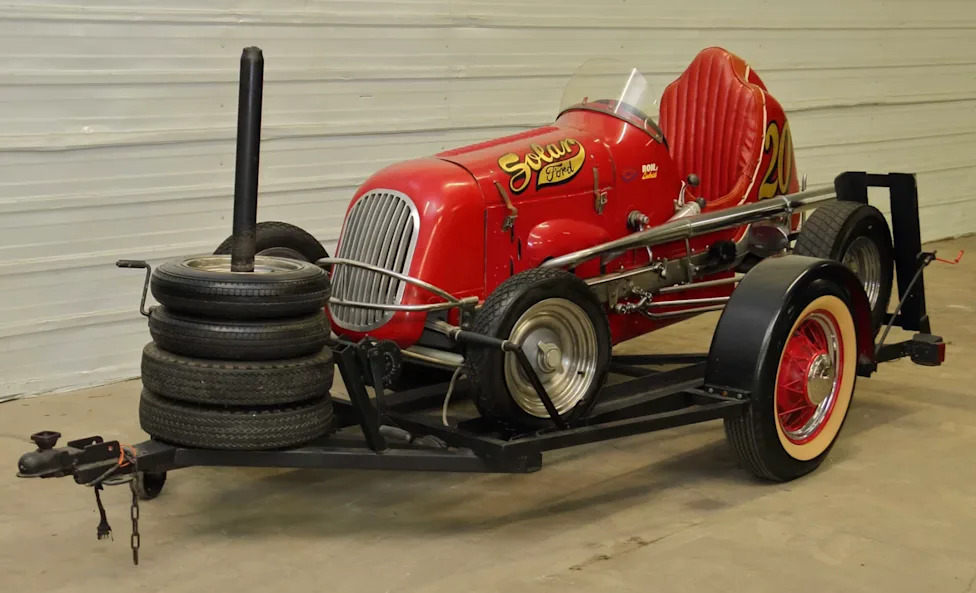















A 1946 Solar Midget That Raced Chicago's Meanest Bullrings Is Heading to Mecum's Nashville Block With No ReserveBackfire NewsEve NowellSun, September 13, 2026 at 8:00 PM UTCAdd us on GoogleA 1946 Solar Midget That Raced Chicago's Meanest Bullrings Is Heading to Mecum's Nashville Block With No ReserveLot S224 at Mecum's Nashville sale this month doesn't have a supercharger, doesn't have air conditioning, and definitely doesn't have room for a passenger. It's a 1946 Solar Midget race car, barely bigger than a go-kart, built to skid sideways around quarter-mile bullrings when Harry Truman was still settling into the White House. It's crossing the block with no reserve, which means whoever raises their hand highest on September 26th gets to own a genuine piece of postwar oval-track history, trailer included.Solar wasn't a car company in any traditional sense. It sold aluminum body-and-chassis kits to fabricators who wanted to build a midget racer without starting from a blank sheet of metal. Buyers supplied their own drivetrain, in this case a 136-cubic-inch Ford flathead V8 shrunk down and tuned specifically for midget duty. This particular kit was assembled in the Chicago area around 1946, right as midget racing exploded into the most affordable, most accessible form of motorsport in the country. Tracks needed cheap entertainment after the war, and a midget chassis with a flathead V8 crammed into it delivered plenty of noise for very little money.The car's first serious career belonged to Shorty Sorenson, a driver Mecum's own listing ties to the "Chicago Gang," a loosely organized crew of Chicago-area racers known for elbows-out driving. Sorenson ran this car at Soldier Field, which doubled as a midget track on weekends when it wasn't hosting football, along with other bullrings scattered around the city. Once its front-line racing days ended, the car kept working, moving into the Midwest Midget Auto Racing Association circuit at tracks across the region before eventually landing with the Solar Car Club, an enthusiast group organized around the marque itself. That club restored the car in 1994 specifically so it could keep running in vintage exhibition events, which is a meaningfully different job than being wrenched on to win main events. Restorations built for parade laps and demonstration runs are usually kinder to original components than a car still being raced hard, which matters if you're trying to gauge how much of this machine is genuinely original versus rebuilt.AdvertisementAdvertisementUnder the aluminum skin sits a 136 CI Ford flathead V8 fitted with a period-correct Eddie Meyer intake and dual carburetors. Eddie Meyer Engineering was one of the go-to Southern California speed shops for flathead hot-rodders in the 1940s, and finding its hardware on a Chicago-built midget shows how quickly speed parts traveled across the country even before the interstate system existed. The engine also runs a stroker crankshaft, which increases piston travel to add displacement and torque without touching the block itself. On a tiny midget chassis where every additional pound of torque matters more than it would in a full-size car, that's not a cosmetic upgrade, it's the difference between competitive and also-ran. Cross leaf springs front and rear were the standard suspension solution of the era: simple to fabricate, cheap to replace, and stiff enough to handle a chassis that weighs a fraction of what a modern go-kart does.Two details in the listing matter more to a buyer than they might first appear. The car is sold on a bill of sale rather than a title, which is standard for a vehicle that predates any state requirement to title race-only equipment and was never intended to see public roads. Treat that the way you'd treat any pre-title vintage racer: it's collectible property, not something headed to the DMV, and insuring it means shopping a specialty agreed-value policy built for exhibition and show vehicles rather than a standard auto policy. The no-reserve designation is the other detail worth noting. Mecum is guaranteeing this lot sells to whoever bids highest on sale day, with no hidden floor price protecting the seller, and that tends to pull in more serious bidders precisely because nobody's wasting time on a lot that could get pulled if the number isn't high enough.Midget racers like this one occupy a strange corner of the collector market. They aren't going to bring Duesenberg money, but the niche of oval-track and open-wheel history buffs chasing genuine 1940s-and-50s hardware runs deep, and documented driver history, a name, a track, a regional racing gang, adds real value an anonymous kit car simply doesn't have. It's the same reason a Mustang tied to Paul Newman's Daytona-winning history commands attention wildly disproportionate to its parts value, or why a barn-find muscle car with paperwork proving its factory options draws a crowd a clone never will. Mecum has leaned into that appetite lately, headlining sales with everything from a Chevelle LS6 that hid its own factory build sheet for 55 years to a fleet of championship-winning Honda race cars bound for Monterey. Small vehicles carrying oversized mechanical stories keep finding buyers too; a Burger King-branded Indy car go-kart with its own engine swap proved that earlier this year. A period-correct midget wearing a name-brand engine builder's parts and a documented driver isn't just a curiosity on the lot list, it's the kind of car that keeps a slice of racing history from disappearing into scrapyards, which is worth something no price guide can fully capture.Mecum is also selling the car's period racing trailer as a companion lot, a nice touch for anyone actually planning to haul this thing to vintage exhibition events rather than park it in a living room. For this corner of the hobby, that trailer is nearly as valuable as the car. Original period trailers rarely survive, and most midget owners today are stuck fabricating replicas from scratch. Whoever wins Lot S224 on September 26th isn't just buying a race car; they're buying the complete rolling exhibit, gang affiliation and Soldier Field war stories included.