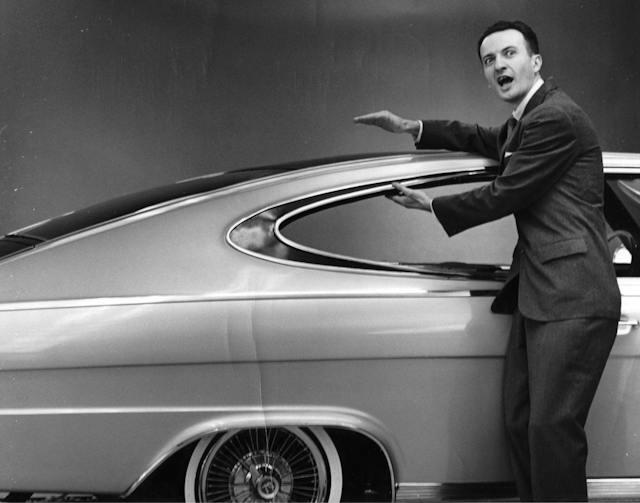
We track tens of thousands of vehicles in the Hagerty Price Guide. A lot of them are pretty mainstream. There are muscle cars, vintage pickups, Italian exotics, that kind of thing. Mixed in with all that are the ones that don’t quite fit into clean categories. We love all the obscure and the unusual vehicles out there, even if that obscurity sometimes makes them hard to value. Below are some of the oddballs that have finished out 2026 strong, with noticeable increases to their condition #2 (excellent) value over the previous quarter. “Panther Westwinds” isn’t exactly a household name, but the little company based in Surrey, England had a good run through the ’70s and ’80s building retro-styled sports and luxury cars with mechanicals sourced from Triumph, Vauxhall, and Ford. Think of it like a more obscure Morgan. The Kallista was Panther’s “volume” model, and combined an aluminum 1930s roadster-style body, steel chassis, and Ford power, either the Blue Oval’s CVH four-cylinder or the Cologne V-6. Production varied, with roughly 1400 and 1700 Kallistas built. South Korean firm SsangYong built another few dozen badge-engineered Kallistas from 1991 to ’93. Panthers are almost as rare a sight in the wild as the animal they’re named after, but a handful of strong recent sales have pulled their historically steady prices up a bit. They’re still cheap, with condition #2 (excellent) values at $23,100 on the higher end, and perfectly usable #3 (good) examples at $17,600. Formed in 1954 via the then-largest corporate merger in U.S. history, American Motors Corporation (aka “AMC”) spent its early years focusing on practical, reasonably priced mid-sized cars that offered a smart and often more efficient alternative to the stuff from the Big Three. As the ’60s progressed and muscle car fever took hold, however, AMC got a little more ambitious in its product line, with flashy models like the Javelin and AMX. There was also the Marlin. Under the direction of stylist Dick Teague, AMC designers worked up a small two-door hatchback based on the Rambler American and called it the Tarpon. By the time it reached production as the “Rambler Marlin” in 1965, its proportions grew enough for the two-door to have seating for six. The key to that space was the Marlin’s most famous and controversial feature—its backside, which took the idea of a fastback roofline to its most extreme. Marlins were well-equipped for the price and had a lengthy options list, while power came from a 232-cid six-cylinder, or a trio of V-8s: a 287-cid/198-hp unit, a 327-cid/250-hp two-barrel, or a 327-cid/270-hp four-barrel. For 1966, the Marlin lost the Rambler badges, and for 1967 AMC enlarged the Marlin, putting it on the longer-wheelbase Ambassador chassis and raising the price. After three years and a disappointing sales run of fewer than 18,000 cars, however, AMC dropped the Marlin from its lineup and it became something of a fat-bottomed footnote in ’60s American car history. Values for Marlins have been nearly flat for at least a decade, but some strong recent sales for clean examples suggest people are coming around to the fishy fastback from Kenosha. The 504 isn’t really an oddball per se. In fact, Peugeot built over 3 million examples of the thing in Europe alone, with hundreds of thousands of additional copies built in South America, Africa, and Asia. In many parts of the world, then, it’s very much mainstream. On U.S. roads, however, a French car of any kind was a bit unusual, particularly during the ’70s and ’80s. Peugeot offered the 504 in sedan and wagon forms in this country, but they were never big sellers and most went to the junkyard long ago. The Pininfarina-styled 504 Cabriolets are the only version in our price guide, and though they weren’t officially sold in the U.S., quite a few have been privately imported here. Values have been slowly but surely creeping up for several years now, and they currently sit at an all-time high. Condition #2 examples are worth somewhere in the low-$30K range for a four-cylinder model, or the mid-$40K range for 504s equipped with the 2.7-liter V-6. Faced with a competitive post-World War II car market in America, Kaiser-Frazer set its sights downmarket with a no-frills line that would appeal to folks on tighter budgets and had a target price of $1300. They named it the Henry J, after company chairman Henry J. Kaiser. Despite its low price, the Henry J was a decent looker, with a distinctive dip in the beltline and tasteful tailfins, while the available engines were dependable four- and six-cylinder Jeep units bought from Willys-Overland. They started rolling off the line in the summer of 1950, just in time for the Korean War to break out and disrupt production, though sales started strong with over 80,000 units sold in 1951. Things changed when the Big Three started offering much better-equipped cars at only slightly higher prices. Kaiser-Frazer tried to compensate with a 1952 model that had a nicer interior, but its rather uninspiring name—the Henry J “Vagabond”—can’t have done it any favors. The company even started selling a rebadged version, called the “Allstate,” through Sears. None of it reversed the Henry J’s fortunes, and it was dropped at the end of the ’54 model year. Today, quite a few Henry Js have been turned into gassers or hot rods. Ones that have been left alone make for a straightforward entry-level classic car, even after a recent bump in prices. Driver-quality examples in #3 condition can be had in the low- to mid-teens. EVs are essentially mainstream now, with over 1.2M sold in the U.S. last year. Look back to the late ’90s, though, and driving an electric car was something much more… unusual. Case in point, the Corbin Sparrow. Produced in California starting in the tech boom of the late 1990s, it was meant to be a cheap, basic, and futuristic means of personal transport. The plastic body, single seat, and single rear wheel made the Sparrow tiny, but in those pre-lithium-ion days, nearly half the Sparrow’s weight came from a rack of 12-volt lead-acid units, so it wasn’t as light as it looked. Top speed was about 70 mph, and this PEV (Personal Electric Vehicle) started in the mid-teens to buy, which was a steep ask at a time when that would buy you a perfectly good Civic. That, along with the bursting of the dot-com bubble, forced Corbin Motors into bankruptcy in 2003, though an Ohio company called Myers Motors bought the rights and kept building a version for another few years. During the Sparrow’s very brief flight, Corbin built roughly 300 copies in both “Jelly Bean” and “Pizza Butt” (originally designed for delivery use by Domino’s) body styles. They occasionally pop up for sale, and as electric vehicles become more relevant in the new car landscape, it makes sense that interest would grow for the earlier attempts at electrics. A handful of Sparrows have sold for more than ever recently. A like-new, #2 condition Jelly Bean currently sits at $15,700. A Pizza Butt will run $16,200. Looking to purchase a car? Find your match on the MSN Autos Marketplace

 Liked by Jackson Wilson, Evan Leblanc



 Liked by Jackson Wilson, Evan Leblanc