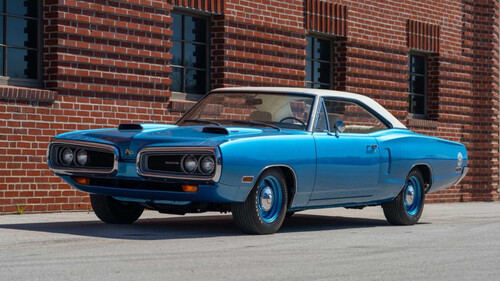
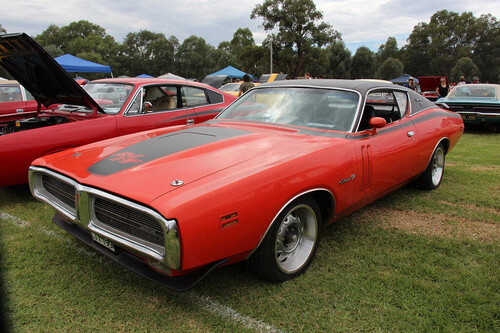
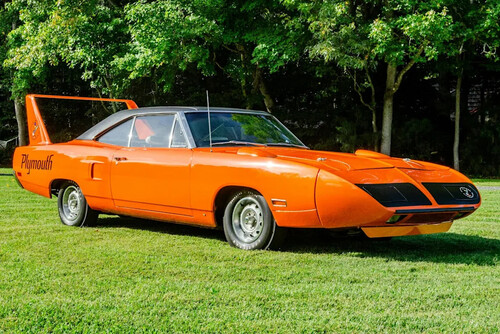
Heritage Images/Getty ImagesMany automakers have had so-called golden years — time periods when everything neatly slots into place, from marketing, to consumer sentiment, to sales figures, to design, to performance, and everything in between. It is a rare moment when the designers, accountants, and engineers all come together and head in the same direction to make a vision happen. For Dodge, that moment was the year 1969, and the evidence that we have surrounding it is quite astounding. To begin with, let's take a look at what the company had been doing, It was making race cars with huge wings that became so dominant in NASCAR that the governing body changed the race rules after just a year to make the car go away. It was also taking massive displacement V8 engines and stuffing them into mid-size bodies and selling the cars for what would today amount to fire sale pricing. Furthermore, Dodge was making some of the best non-Cadillac land yacht cars on the market, as well as legendary off-road capable trucks. In addition to all of that — if the above wasn't enough — the company was also supplying police forces around the country with vehicles. These good times would not last, of course — they rarely do — but for one glorious year, Dodge was absolutely untouchable. Here are five vehicles that prove that 1969 was the best year for Dodge.AdvertisementAdvertisementRead more: 4 Common Problems With V8 Engines1969 Charger R/T and SERM Sotheby'sFirst up, we have the 1969 Dodge Charger – the one pictured above sold for $170,500 at a Sotheby's auction — and was one of the longest-running nameplates used by the company. There were many generations, facelifts, trims, and engines available for the Charger, but we want to talk about the '69 Charger R/T and the SE. With regards to that first one, "R/T" was an abbreviation of Road/Track – which is exactly what it says on the tin — a car designed to excel both on the road, as well as on the superspeedway. R/T versions of the Charger remain highly desirable even today to collectors around the world, with examples frequently selling in the range of $100,000 to $200,000 at public auction. Charger SEs were "Special Editions" — hence the acronym at the end of the model name — that added hints of luxury to an otherwise brutally performance and speed-focused vehicle. Examples of the upgrades brought about on the SE models included things like leather and vinyl upholstery within the interior, and wood grain trim bits, among other things. The base engine in the 1969 Dodge Charger R/T would have been the 440 ci V8 Magnum motor that would have come mated to either a three-speed automatic transmission, or to a four-speed stick shift gearbox. Total power output for this motor stood at 375 hp and 480 lb-ft of torque, which are figures that would impress even today.1969 W200 Power WagonWorldwide Vintage Autos/YouTubeWhile the company was busy making cars that would keep opposing NASCAR teams up at night, Dodge was also producing one of the most legendary trucks in all of history. We're talking, of course, about the Dodge Power Wagon — specifically the W200 Power Wagon — which was actually a descendant of iconic wartime trucks. The engine in the W200 Power Wagon was the 225 ci six-cylinder motor, though larger V8 engines were optional upgrades. AdvertisementAdvertisementThe W200 Power Wagon was produced for years, with appearance through three long decades, from the 1950s through until 1980. For those who are wondering about the naming scheme, the "200" referred to the fact that the truck was a three-quarter-ton vehicle, and the "W" in the name was representative of Dodge's naming scheme for four-wheel drive at the time. The truck became known in the industry for its legendary durability, and is revered by enthusiasts today as one of the best square body trucks of all time, along with other offerings from the likes of Chevy and Ford.1969 Super Bee A12R.M. Sotheby'sDodge had just released the blue collar Super Bee in 1968, having scraped everything non-essential off a Coronet (with which the new Super Bee model shared its guts). Then, about halfway through 1969, buyers could get the Super Bee with an option package numbered A12 — and the timing when the package was made available is why it is sometimes referred to as the 1969½ Super Bee or the 1969.5 Super Bee. Both mean the same thing — a Coronet-derived Super Bee with massive upgrades. Where the base model Super Bee for 1969 got a 383 ci V8 engine making 335 hp, the A12 performance-pack optioned Super Bees came with the hulking 440 ci six-pack V8 from Dodge. This gargantuan powerplant ended up making the sum of 390 hp and 490 lb-ft of torque. The fact that the A12 performance package was only offered on the 1969 models also adds to the exclusivity. Considering only 1,907 A12-optioned Super Bees were produced, and you'll understand why the collector market fawns over this ride. It's worth mentioning that the A12 was also available on the Plymouth Road Runner, where it was even less embraced by buyers. The A12 pictured above went under the Sotheby's hammer in 2014, where it commanded a final price of $61,600.1969 Dodge Charger DaytonaHeritage Images/Getty ImagesArguably the most recognizable car on this list — and one that could have justified the title of this article all on its own — is the 1969 Dodge Charger Daytona. It was based, as the name suggests, on the Dodge Charger of that year, though with some extremely distinctive and extensive aero modifications, crucially a included a nose cone for better wind resistance, and a massive, towering rear wing. These modifications were also shared with the sister car to the Charger Daytona, which was the Plymouth Superbird. Finished in the iconic blue that fans have come to know and love, the Daytona Chargers, named after the legendary Daytona superspeedway, absolutely dominated that year's stock car racing. AdvertisementAdvertisementThe car also managed to get veteran driver Richard Petty back to Dodge/Plymouth after he'd left and joined Ford the year prior — the car was that good. In the hands of Richard Petty, the Charger Daytona romped home to victory on several occasions that season and the next. NASCAR officials then banned the Dodge Charger Daytona from competing altogether by changing the rules that allowed it to enter. However, the car had made its mark on the world, becoming the first stock car to reach 200 mph on the straightaways, among many other accolades. And the rest, as they say, is history.1969 Monaco 500MOPARMANIA/YouTubeIt is easy to mistake the Dodge of the late 1960s to be a sports car and truck company, since that was the brand's bread and butter at the time, no question. However, true enthusiasts will remember the legendary Dodge Monaco 500, which was a full-size luxo=barge cruiser that turned heads wherever one went. The nameplate was introduced in 1966, though the model had been around in spirit long before as the Dodge Custom 880. Available in a number of body styles, from pillared four-door sedan to a station wagon, the Monaco 500 quickly caught the public's attention. For 1969, the engine lineup in the Monaco 500 was similar to that of the Super Bee. The base engine was a 383 ci V8 unit that made 290 hp, while a 440 Magnum making 375 hp and a 426 Hemi V8 making 425 hp were optional upgrades. Also, the corporate cousin to the Monaco 500 — the Polara — was popular among police departments and counties across the U.S., with Dodge even making a special "Polara Pursuit" trim for sale to law enforcement agencies. In no other year imaginable would Dodge ever make such a vast, well-priced (for the time and relative to incomes, arguably), and performant lineup. The closest we'd ever get may be the mid-2010s when we had all the Scat Packs, Hellcats, SRTs, and a Hemi engine in a family-hauling Durango SUV. Still, that lineup couldn't hold a candle to what 1969 had on the cards from Dodge.Want the latest in tech and auto trends? Subscribe to our free newsletter for the latest headlines, expert guides, and how-to tips, one email at a time. You can also add us as a preferred search source on Google.Read the original article on SlashGear.