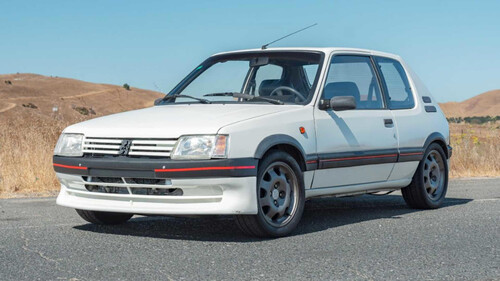
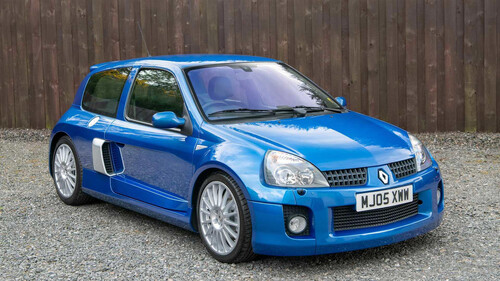
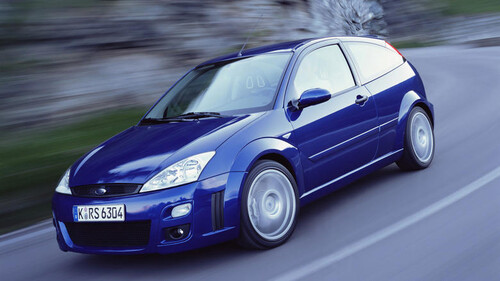
European automakers have built small performance-driven hatchbacks for decades, and we've missed out on some hot commodities here in the United States. While some hot hatches were simply never intended for the North American market, others fell victim to regulations, business decisions, or manufacturers having left the United States years prior. Oddly enough, a few hot hatches were developed and produced by American automakers, but they never made it stateside.Heritage Images / Getty Images3. Peugeot 205 GTIIn 1983, the Peugeot 205 made its way to the road with the sole mission of expanding the brand in the European supermini segment. A performance version, the 205 GTI, followed in 1984 and effectively became one of the region's defining hot hatches. While the French automaker considered bringing the 205 GTI to American shores, the idea was ultimately scrapped. Peugeot had been fighting an uphill battle in the United States for years, with sales declining until the brand ultimately pulled out of the market in 1991.Joe Morris / Getty ImagesThe Peugeot 205 GTI was far from a powerhouse, packing a 1.6-liter four-cylinder engine that offered 105 horsepower at launch, with output later boosted to 115 horsepower in 1986. Power was sent to the front wheels via a five-speed manual gearbox. While performance isn't exactly anything to write home about, the 205 GTI was extremely lightweight, coming in at just 1,870 lbs. As a result, it was incredibly agile and responsive to driver inputs, thanks in part to its unassisted steering and independent suspension..Peugeot followed up the 205 GTI 1.6 with a slightly more potent version carrying a 1.9-liter four-cylinder engine that generated 130 horsepower. The more powerful 205 GTI 1.9 was naturally a tad quicker, hitting 62 mph in 7.8 seconds versus 8.7 seconds in the 205 GTI 1.6.Gerd Schifferl / Getty ImagesUltimately, the 205 did exactly what Peugeot wanted, but in a wildly different way. The 205 Turbo 16 took part in Group B races, and its success brought the entire model's image to new heights. The 205 Turbo 16 went on to win the World Rally Championship in 1985 and 1986. While the Peugeot 205 GTI wasn't a homologation special for the rally car, the hot hatch quickly became associated with the nameplate's success in motorsports.Thinking about selling your car? Get an instant cash offer online now. Click here to get started.2. Renault Clio V6The 1990s were no stranger to outlandish design experiments, and Renault managed to show off a concept so interesting that it got the attention of Tom Walkinshaw Racing. From there, the concept became a work of engineering prowess, and, a few years later, the Clio V6 officially hit the market. Unfortunately, for American drivers, Renault had sold its stake in American Motors to Chrysler in the late 1980s, so the French hot hatch never made it to our shores.Heritage Images / Getty ImagesThe first-generation Clio V6 arrived with a naturally-aspirated 3.0-liter V6 engine mated to a six-speed manual that sent power to the rear wheels. Total output sat at a healthy 226 horsepower and 221 lb-ft of torque. That power brought the hot hatch to a top speed of 147 mph. Later models, known as Phase 2, saw performance boosted to 255 horsepower, a change that pushed the car's top speed to 155 mph.In order to make the Clio V6 a true powerhouse, Renault removed the rear seats and put the engine in its place. The hot hatch had just enough room for two occupants, driver and passenger, but Renault's design changes weren't limited to the interior. The car wore wider bodywork to accommodate its updated mechanical layout.Edd Hartley / Getty ImagesRenault built just 2,822 examples of the Clio V6, and 1,309 of those were the more powerful Phase 2 models. Production ultimately came to an end in July 2005, and the Clio V6 hot hatch has become something of a collector's item over the past 20 years.Shopping for a new car? Click here to get a great deal on your next vehicle. Powered by Carvana, no haggle pricing, 100% online.1. Ford Focus RS Mk2While the Ford Focus was present in the United States market from the 2000 model year onward, not every model made it to our shores. While we got the third iteration of the hot hatch, the high-performance first- and second-generation Focus RS didn't meet United States safety standards. Instead, they were sold in Europe.Sue Thatcher / Getty ImagesProduced between 2002 and 2003, the first-generation Focus RS rocked a 2.0-liter turbocharged four-cylinder paired with a front-wheel drivetrain. Output sat at a steady 212 horsepower that propelled the hot hatch to 60 mph in 6.4 seconds. While the first-gen Focus RS was no slouch, the second-generation picked up the pace.From 2009 to 2011, the Ford Focus RS Mk2 came stock with Volvo's 2.5-liter turbocharged five-cylinder engine and a front-wheel drivetrain. Total output sat at an impressive 300 horsepower, which was quick enough to get the hatchback to 60 mph in just 5.9 seconds. It also featured a RevoKnuckle front suspension that reduced torque steer. Naturally, the five-cylinder engine gave the Focus RS Mk2 a unique engine note that differentiated it from nearly every other hot hatch on the road.Sue Thatcher / Getty ImagesWhile Ford managed to rectify the issues that kept the Focus RS from American consumers for the third generation, some enthusiasts believe the Mk2 was the wildest of the trio. The third-gen Focus RS had some neat elements of its own, though, including the switch from front to all-wheel drive and a selectable drift mode. Still, the second generation's unique five-cylinder engine and Ultimate Green paint job were defining elements of the hot hatch that we certainly missed out on.Final thoughtsSjoerd van der Wal / Getty ImagesWhile the Peugeot 205 GTI showed how performance wasn't the only factor to consider in a hot hatch, the Clio V6 essentially became a mid-engine sports car. Meanwhile, the Focus RS Mk2 proved that front-wheel drive didn't have to be a serious limitation. Unfortunately, regulatory and safety requirements and low-volume production runs meant that some of the world's best hot hatches simply never managed to cross the Atlantic. On the bright side, many older hot hatches can now be imported to the United States.