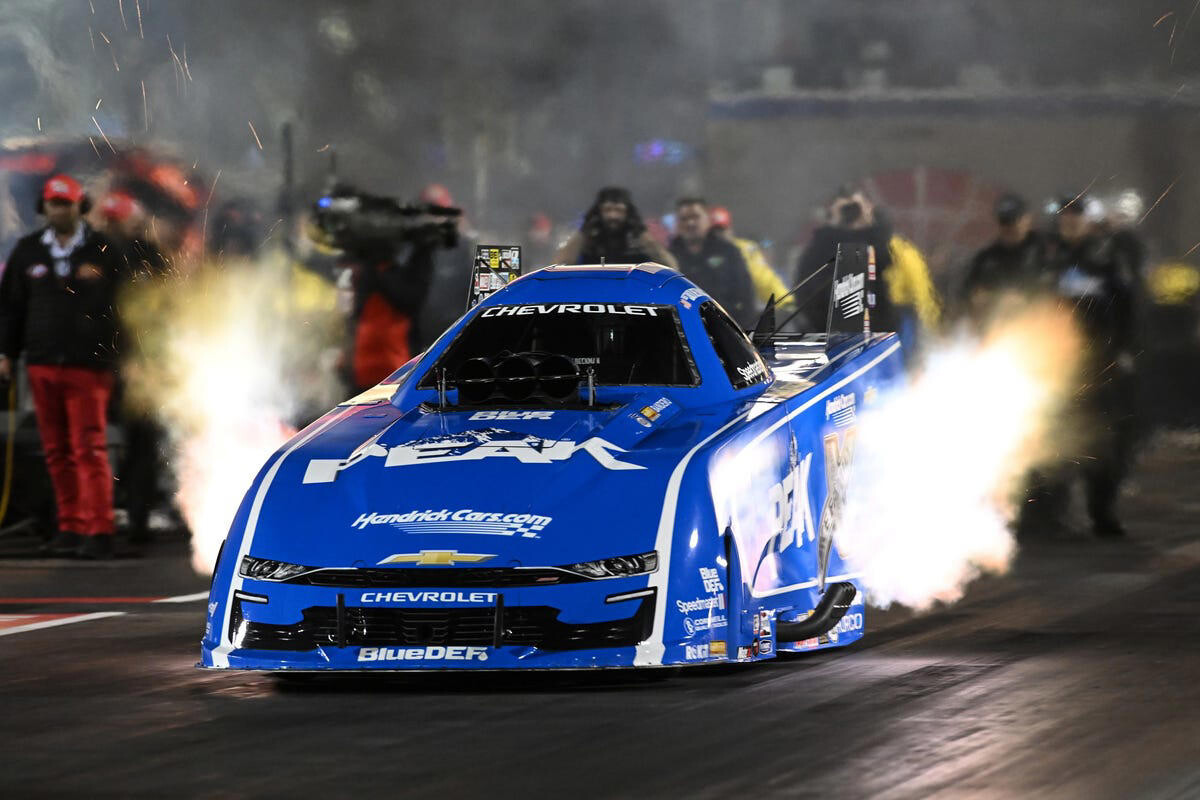
Justifiably using his bully pulpit as a multi-time Funny Car champion, Matt Hagan took the lead once again in raising concern about the NHRA’s practice of tethering the carbon-fiber bodies to Funny Cars. Reacting to fellow racer Terry Haddock’s nasty qualifying engine explosion and crash that trapped Haddock behind a vision-blocking wall of displaced car-body debris, Hagan took to social media Sunday morning to demand the NHRA fix the problem. Hagan spoke up in the past about the same issue but softened his tone then, saying he had let his emotions get in the way of his message and suggesting racers and the sanctioning body cooperate to solve the dangerous situation. This time Hagan wasn’t as conciliatory. He was demanding. In a Facebook post, Hagan wrote: “Hey NHRA I’m begging you to take the damn tethers off. Enough is enough with this!! We should not have to go through this as drivers and team owners, ruining chassis and hitting walls every blowup. You can’t see. You can’t steer. The parachutes are not coming out. You’re trapped in the car. The fires are bigger. On top of all that, him not knowing where he is on the track, if he’s pointed the other direction I’m running through him in my lane. This is not safe nor acceptable over the ‘optics’ that have been created from this. We have totally taken the ability of the driver to navigate such a dangerous situation away from him. Either back the fans up or don’t sell tickets past 300 ft. But it also shows you how smart I am, even though you know it’s going to hurt you eventually I am crawling right back in it this morning to try and battle it out for a 5th championship.” Haddock was charging hard late Saturday, trying to bump into the 16-car field, when he experienced an apparent valvetrain failure and his car exploded. Rather than jettison the debris away from the driver, the tethers on the body caused large chunks of the carbon-fiber structure to implode on Haddock, who sat inside his flaming race car. Haddock’s car hit the wall before he was able to stop the car and exit unhurt. The hard-working, small-budget privateer said, “I’ve never had one blow up like that when the body’s stuck to the car. You can’t see where you’re going. So then I crash into stuff. That ain’t my thing… We’ve tried so hard to do a good job. We hate the downside of it for the fans, so we’re sorry, fans. But we want to come here and put on the show for you. We love drag racing as much as you do. We’ll go home and fix all this junk, and I’ll try to figure out how to come back.” Tony Schumacher, the eight-time Top Fuel champion, saw it from the announcer booth and said within seconds, “I will guarantee there’s going to be another tethers discussion, because he couldn’t see. We couldn’t see him in the car, and he can’t see out.” Minutes later, Hagan said, “It makes me not want to crawl back in the cars anymore. Unbelievable.” Ever since the now-retired and NASCAR-involved Johnny Gray first experienced that situation, this has been an issue. A few other racers have been in a similar situation as Haddock was Saturday. But Hagan is the lone Funny Car driver who has spoken up about it publicly and passionately—without resolution. The NHRA has used the tethers in an effort to balance safety of fans and bystanders with protection of drivers. But that no longer is possible. The balance has shifted from driver protection. And that needs to change somehow to break the cycle of that saying that the rules are written in blood. Susan Wade has lived in the Seattle area for 40 years, but motorsports is in the Indianapolis native’s DNA. She has emerged as one of the leading drag-racing writers with nearly 30 seasons at the racetrack, focusing on the human-interest angle. She was the first non-NASCAR recipient of the prestigious Russ Catlin Award and has covered the sport for the Chicago Tribune, Newark Star-Ledger, and Seattle Times. She has contributed to Autoweek as a freelance writer since 2016.