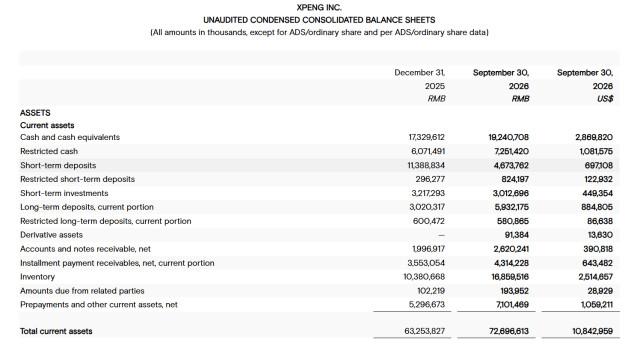
XPeng (NYSE: XPEV; HKEX: 9868) posted a net loss of 870 million CNY (c. $129 million) for the third quarter of 2026, up 127.9% from a 380 million CNY loss a year earlier. The loss came in a quarter when the Guangzhou-based company also booked record revenue of 24.28 billion CNY (c. $3.62 billion), up 19.1% year over year, according to unaudited results it filed with the Hong Kong stock exchange on November 16, 2026. Revenue cleared the top of the 21.7 billion to 23.4 billion CNY range XPeng had guided in August. Deliveries reached a quarterly record of 118,390 vehicles, up 2.1% from a year earlier and 14.6% from the second quarter, inside the 115,000 to 121,000 range the company had forecast. Revenue rose 23.0% from the second quarter's 19.74 billion CNY. The quarterly table in the filing shows how uneven 2026 has been. Deliveries fell to 62,682 in the first quarter, from 116,249 in the fourth quarter of 2025, before recovering to 103,295 in the second quarter and 118,390 in the third. Revenue followed the same path, dropping to 13.03 billion CNY in the first quarter before climbing to 19.74 billion CNY and then 24.28 billion CNY. Revenue grew much faster than volume because each car brought in more money. Vehicle sales revenue rose 19.8% to 21.63 billion CNY, which XPeng put down to higher deliveries and a higher average selling price from a better model mix. Dividing that figure by deliveries gives roughly 182,700 CNY (c. $27,210) per vehicle, against about 155,600 CNY a year earlier and 165,000 CNY in the second quarter. Vehicle margin was 13.1%, flat year over year and up 1.0 percentage point from the second quarter. The overall gross margin slipped to 18.9%, from 20.1% a year earlier and 20.7% in the second quarter. The drag came from services, not cars. Services and other revenue rose 13.7% to 2.65 billion CNY on carbon credit trading, but the margin on that business fell to 67.1% from 75.1% in the second quarter. XPeng said revenue from technical research and development services shrank after large milestone catch-ups were booked in earlier periods. Research and development spending rose 17.5% year over year to 2.85 billion CNY, and selling, general and administrative expenses rose 11.4% to 2.78 billion CNY, which XPeng tied to marketing and sales staff costs. Other income also fell 18.3% to 115 million CNY as government subsidy receipts declined. Even so, the loss from operations held at 0.75 billion CNY, the same as a year earlier. That GAAP figure includes a 162 million CNY non-cash gain tied to the DiDi deal, against a 74 million CNY loss a year earlier. On a non-GAAP basis, the operating loss widened to 0.77 billion CNY from 0.52 billion CNY. Most of the wider net loss came below the operating line, where a 197 million CNY loss on long-term investments replaced a 131 million CNY gain, currency swings turned into a 120 million CNY loss, and interest income fell to 245 million CNY from 301 million CNY. GCEV Weekly · Every Tuesday China's EV industry in five minutes. Launches, sales, batteries and policy — the week's stories that matter, with the context the headlines leave out. Sent by GigaCharts Inc. Questions? Write to globalchinaev@gmail.com. Unsubscribe anytime. See our . XPeng posted its first-ever net profit, 380 million CNY, in the fourth quarter of 2025, and every quarter of 2026 so far has ended in a loss. Its accumulated deficit grew from 42.77 billion CNY at the end of 2025 to 46.76 billion CNY on September 30, 2026. Excluding share-based compensation and a fair-value gain tied to its purchase of DiDi's smart car business, the non-GAAP net loss was 890 million CNY, against 150 million CNY a year earlier. The cash position rose to 45.41 billion CNY (c. $6.76 billion) from 40.48 billion CNY at the end of June. Short-term borrowings reached 10.68 billion CNY on September 30, up from 4.28 billion CNY at the end of 2025. Over the same nine months, inventory rose 62% to 16.86 billion CNY (c. $2.51 billion) from 10.38 billion CNY. For the fourth quarter, XPeng guided deliveries of 169,000 to 174,000 vehicles, up 45.38% to 49.68% year over year, and revenue of 30.40 billion to 31.80 billion CNY (c. $4.53 billion to $4.74 billion). October already brought a record 50,237 deliveries, so hitting that guidance would take 118,763 to 123,763 deliveries in November and December combined. That works out to about 59,400 to 61,900 a month, or roughly 9,100 to 11,600 more than October's high. New models are part of that math. The Mona L05 SUV launched on October 29, 2026 in six versions, battery-electric and range-extender, from a limited-time price of 139,800 CNY (c. $20,820). XPeng said 5,000 units had come off the line before launch, with deliveries starting November 1. That puts the L05's first full sales months inside the quarter the guidance covers. Mona L05 in one of its six launch colors, with deliveries from November 1, 2026 (XPeng rendering) The sales network grew alongside volume. XPeng had 731 stores across 253 cities and 4,035 self-operated charging stations as of September 30. Through October, its year-to-date deliveries reached 334,604. Management again framed the carmaker as a physical AI company. Chairman and CEO He Xiaopeng said the car business had entered a period of rapid growth on the back of several hit models and expansion abroad. He added that the company's "next-generation humanoid robot is accelerating toward the mass-production milestone by year-end." XPeng also said it had been approved for L4 robotaxi demonstration operations across Guangzhou, which it announced on October 26, 2026. XPeng humanoid robot at an automated production line; mass production is targeted by year-end 2026 (XPeng) Fourth quarter revenue guidance tops out about 43% above the 22.25 billion CNY XPeng booked in the same quarter of 2025, when it turned its first profit. Vice Chairman Brian Gu said XPeng would chase better operating results through scale and a more favorable business mix. Can that extra volume cover operating costs that are still rising, plus the investment and currency losses that deepened this quarter's result? Conversion rate: 1 USD = 6.7141 CNY as of November 16, 2026. GCEV Weekly · Every Tuesday China's EV industry in five minutes. Launches, sales, batteries and policy — the week's stories that matter, with the context the headlines leave out. Sent by GigaCharts Inc. Questions? Write to globalchinaev@gmail.com. Unsubscribe anytime. See our .


 Liked by Camille Brown, Thomas Morgan




 Liked by Camille Brown, Thomas Morgan