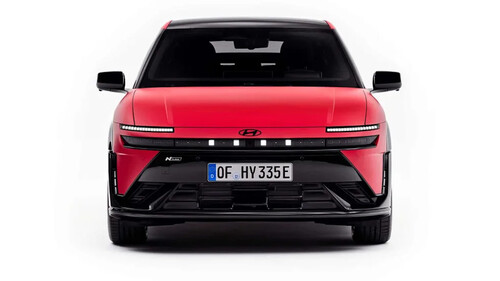
Octavian Lazar/ShutterstockFollowing the 1970s oil crises, the car industry's priorities shifted to efficiency and have never gone back to the good, old 10 mpg days. Engine sizes shrank and have stayed that way, which comes as a surprise considering cars themselves have grown larger over the past three decades in a well-documented phenomenon known as "carspreading."However, today's engines seem to have settled at a sweet spot: 2.0-liter with four cylinders. In fact, if you count them up, you'll find over 50 models on sale in the U.S. running a turbocharged 2.0-liter four right now, from Hyundai to Land Rover. There's a good reason why this is a thing.Two liters works out to roughly 2,000 cubic centimeters. Split that four ways, and you land at about 500cc of air and fuel inside each cylinder. That 500cc figure works out as the optimal point since it's the size that squeezes the most work out of each drop of fuel without giving up power. How these cylinders are shaped also plays a major role because they determine bore and stroke, which shape an engine's power.AdvertisementAdvertisementBore is how wide the cylinder is, and stroke is how far the piston slides up and down. Most 500cc cylinders are narrow and tall rather than wide and shallow, which allows for greater efficiency. But why four of them specifically? That's because it's generally agreed upon that 2.0 liters is about the smallest gasoline engine that can push a family sedan without straining too hard.Read more: 4 Common Problems With V6 EnginesEmissions rules and economies of scaleToyotaFrom there, if you slash down a cylinder, you arrive at just 1.5 liters, which is simply too underpowered for most cars on the road — unless you add a turbocharger, which we'll get to in a bit. Add a cylinder instead, and you arrive at a 2.5 liter with five cylinders, which are simply not built for a good reason (even if 2.5 liters with four cylinders are somewhat common). Beyond the physical size, there are several other reasons at play, the biggest being emissions rules.For instance, American regulators back in April 2010 finalized rules that pushed cars and light trucks to a 35.5 mpg fleet average – the average across every new car a brand sells — by 2016. This was then extended to a target of 54.5 mpg in August 2012 by 2025. Phasing out the V8s for V6s and subsequently four cylinders helped hit those numbers across an entire lineup. One major reason why is the fact that something like a V6 has more cylinders, meaning there's more movement and consequently more scraping on cylinder walls, creating more drag. And drag costs fuel. Four helped reduce this drag. Now, V6 is still popular, but certainly diminished compared to a decade or so ago.AdvertisementAdvertisementAnother major factor is the parts bin math. Let's take Mercedes-Benz, which has built its four-cylinder, inline-six, and V8 engines around a shared 500cc cylinder. Once a company is able to perfect one 500cc cylinder, it can reuse that design into any layout it likes.The role played by packaging and turbochargersARTPROXIMO/ShutterstockThen there's the overall footprint of a four, which basically seals the deal for it. Four cylinders in a row take up less space under the hood than something like a V6, which also needs two banks of cylinders. This frees up some space for the cabin and the trunk, and the roomier the car, the better it sells in the U.S. The compact footprint also allows the same engine to fit sideways in a front-wheel-drive hatchback and lengthwise in a rear-wheel-drive sedan, covering a brand's entire range with just one engine.On the consumer end of things, it helps that four cylinder 2.0 liters are often paired with turbochargers – these engines wouldn't have sold well if they felt slower than the V6 they replaced. One great example here is Hyundai, which back in 2011 proved the appeal by pulling the V6 out of its Sonata sedan, upgrading the car to a 2.0-liter turbo. The older 3.3-liter V6 made drivers wait until 4,500 rpm for peak torque. But the 2.0-liter turbo delivered at just 1,750 rpm. Turbochargers also make 1.5-liter engines more viable in comparatively bigger cars, like the Ford Escape. Both 2.0 and 1.5 liter four-cylinder engines are also commonly paired with electric motors, which, besides boosting power, also boost mpg at the same time.Want the latest in tech and auto trends? Subscribe to our free newsletter for the latest headlines, expert guides, and how-to tips, one email at a time. You can also add us as a preferred search source on Google.Read the original article on SlashGear.